Tuesday, November 16, 2010

The Haj - In This Sacred Moment, The 'Arafah Day

Tarwiyah Day, the eighth day of Dzulhijjah, one of the greatest days of Haj.

Pilgrims spent their time in Mina’s Tent City praying, supplicating (du'a) and contemplating preparing themselves for the second stage of their five-day greatest trip.

The Day of Tarwiyah marks the very beginning of the rites of Haj, the day during which the pilgrims redo what Prophet Muhammaad s.a.w. did, from the day the rules of Haj started, when He s.a.w. reached Mina where He s.a.w. prayed Dzhuhr, 'Asr , Maghrib, 'Isya' and Fajr prayers and then proceeded to 'Arafah before the sunrise.

Narrated 'Abdul 'Aziz bin Rufai: I asked Anas bin Malik, "Tell me what you remember from ALLAH s.w.t.'s Apostle (regarding these questions): 
Where did He s.a.w. offer the Dzuhr and 'Asr prayers on the day of Tarwiyah (8th day of Dzulhijjah)?"


He s.a.w. replied, "(He offered these prayers) at Mina."  


I asked, "Where did He offer the 'Asr prayer on the day of Nafr ( the departure from Mina on the 12th or 13th of Dzulhijjah)?" 


He s.a.w replied, "At AlAbtah," and then added, "You should do as your chiefs do."  - Bukhari.

Among the rules of this day is that Haj pilgrims frequenting their Talbiyah and perform the prayers at their specific times.

The Prophet s.a.w. and his companions had already assumed Ihram before they proceeded to Mina - so are we, not necessarily from Masjidil Haram - enough from the place where we stay.


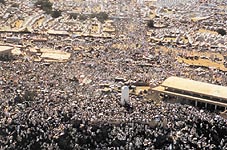
Photo: Arab News

Today, nearly three million pilgrims 'Wuquf' or standing on Mount 'Arafah or on its plain, the climax of the annual pilgrimage.

The Prophet s.a.w. said, “Haj is ‘Arafah.”

The very core of Haj takes places on the day of ‘Arafah as well as at the site known as ‘Arafah, an area where the Prophet s.a.w. went, on the 9th Dzulhijjah, as a part of His Haj.

'Arafah is where Haj pilgrims, standing and supplicating to the ALMIGHTY s.w.t., seeking HIS forgiveness and mercy.

Men, draped in two white unsewn pieces of cloth, an extraordinary symbol of Islam’s unity and equality. 
Islam, a religion of universal character fit for all times and people.

On the Mount Arafah and the plains surrounding it from where Prophet Muhammad s.a.w. gave his farewell sermon more than fourteen centuries ago, men and women formed a massive stream of white set out, chanting that they have come to answer GOD’s call. The endless sea of  'white' pilgrims, in their endless chants,  

"Labbaikallaahumma Labbaik” (O GOD, here I am answering YOUR call).

Hear ALLAH s.w.t.
Fear Allah s.w.t., in private and public.
Adhere to Islamic creed and deeds, and radiance insyaALLAH, is reflected in us, in our doings, in our daily life.

Getting to 'Arafah is not without difficulties for many.
Hardship aside, having reached the plains of Arafah is a dream come true, for all pilgrims.
All believers, from all corners of the world, come to 'Arafah, to pray to GOD.

The feeling of wanting to meet GOD, the whole body shivers...
Ability to make connection with ALLAH s.w.t. is an individual experience.
Unexplainable...
No words can explain one's feeling although everyone on the sacred ground of 'Arafah is obviously with one intention, HIS acceptance.

Arafah, peaceful, is where the connection with GOD takes place, Dzulhijjah after Dzulhijjah, over and over again.
Today, the day of Haj, is the day where connectivity and communication to ALLAH s.w.t. is obvious.

While in 'Arafah, wise pilgrims spend the day making supplications to ALLAH s.w.t. as the Prophet s.a.w said,  

“The best du‘a is the du‘a on the day of ‘Arafah.” - Abu Dawud.

It is the ultimate day to ask for forgiveness of every single sin of us, as the Prophet s.a.w. also said,  

“There is no day in which Allah s.w.t. sets free more souls from the fire of Hell than on the day of ‘Arafah.” - Muslim.

People spent the day in worship and supplication, praying for their needs, and for the welfare of all.
Praying for an end to sufferings in Afghanistan, Haiti, Iraq, Pakistan, Palestine, and everywhere else in the world.
Insya ALLAH we will have peace.
We have worldwide peace if we pray in sincerity, if the fund we use for the pilgrim is blessed, no abuse of any breathing creatures.
Unity in prayers itself has created a peaceful atmosphere, at the most peaceful place on earth.

"Labbaikallaahumma Labbaik”, reenacted again and again, since fourteen centuries ago.

The 'Arafah Day, one of the cornerstones of the pilgrimage, at the site where Prophet Muhammad s.a.w. delivered his farewell sermon, is where, on this day, the doors of heavens open to answer prayers and grant forgiveness.

Mina, Arafah and Muzdalifah are the three stops on the pilgrims’ journey during the Haj, traces the steps of Prophet Muhammad s.a.w.

'Arafah reminds us of our beloved Prophet s.a.w.
He asked the believers to undertake this journey and here, today, the Haj pilgrims from all over the world, undertake the journey, since the last fourteen centuries.
And Muslims will continue to do so until the Judgment Day.

Haj is tiring but rewarding.
HIS choicest blessings is on the very true believers, he who believes with his heart, mind and soul.
Answer the call of ALLAH s.w.t. and pray for peace and tranquility.
Pray sincerely, spread humanity.

Haji Mabrur aside, the feeling in us now, in this sacred moments all over the world, indescribable... 

Sunday, November 14, 2010

The Haj - From Japan To Mecca

Road To Hajj - Islam In The Land Of The Rising Sun 

The road to Hajj in the Land of the Rising Sun begins with the little known fact that there are ethnic Japanese Muslims.

Everyday the call to prayer is made in different corners of the predominantly Buddhist country - unobtrusively within the confines of its 50 or so mosques and approximately 100 musollas or communal prayer rooms.

Twenty-six-year-old Kubo-san prays at a small musolla in the agricultural district of Saitama, about two hours outside the capital, Tokyo.

Built 15 years ago by Bangladeshi workers, Kubo is the only ethnic Japanese in the congregation.

"I was born into a very ordinary Japanese family," he says. "We did not have a strong sense of religion."
Kubo's upbringing mirrors that of many Japanese - their attitudes and philosophy towards life shaped by the ancient religion of Shinto.

An ancient polytheistic faith, Shinto involves the worship of nature and is unique to Japan.

While divination and shamanism is used to gain insights into the unknown, there are no formal scriptures or texts, nor a legacy of priesthood that structures the religion.

After the Second World War, Shinto suffered a huge setback when the emperor was forced to denounce his status as a 'living god'.

While many historians would claim that the Japanese people lost their faith after this, recent surveys suggest that at least 85 per cent still profess their belief in both Shintoism and Buddhism.

'Special meaning'

"The first I knew about Islam was in my school days," Kubo says.

"The schools in Japan usually teach history. I knew about Islam in such history classes. Although I knew only a little bit, it shook my soul strongly."

His interest in Islam developed as he read more about it, but it was only when he began to meet expatriate Muslims in Japan that he considered converting.

Now, he is preparing to go on Hajj, the annual pilgrimage to Mecca, for the first time.

"We Muslims pray five times a day towards Mecca. And pray 'peace be upon Prophet Muhammad'. He was born in this town and started Islam in Mecca. So for Muslims, it has a special meaning to go to Mecca. I feel honoured that I have this opportunity to go there."

'First step'

But just five years ago, Kubo's pilgrimage would not have been possible.

Reda Kenawy is Egyptian but he moved to Japan when he was in his twenties. He worked for a travel agency and decided to branch out to form his own agency specialising in organising Hajj pilgrimages for Japanese Muslims.
Japan's small Muslim community is tightly-knit
"All my staff said I was crazy when I wanted to plan the Hajj trip," Kenawy says. "In terms of business aspects, there must be a demand in the market to cover the costs. It would not work if there are no Muslims going."

"So I told them someone has to start, someone has to take the first step, then others could take it from there."

But, it was an uphill task, particularly when dealing with the Saudi Arabian authorities.

Kenawy says they told him: "We've never heard of Japanese Muslims and we've never heard of Hajj trips organised from Japan."

"So I told them there were Muslims in Japan and I was there as a Japanese. I have the Japanese nationality and I was representing Japan and wanted to bring Japanese pilgrims for Hajj.

"They said I couldn't and that my passport was forged and I looked Egyptian."

'Honour and happiness'

Kenawy persisted in his quest to take Muslim pilgrims from Japan to Mecca and five years on, his travel agency is one of only two registered companies that have been sanctioned by the Saudi government to organise Hajj pilgrimages for Japanese Muslims.

The number of pilgrims using Kenawy's agency has grown year on year, but for him the most encouraging development is the increase in ethnic Japanese Muslims.

"Right now, we have 90 per cent foreigners and 10 per cent [ethnic Japanese]. My dream is to have the opposite - to have 90 per cent Japanese or maybe 99 per cent original Japanese and only one per cent foreigners."

Abdullah Taki is a 36-year-old former body-piercer who converted to Islam in 2006. He made his Hajj pilgrimage in 2007.

"For me, the meaning of visiting the Kaabah is not to see a building but to visit God's home, to meet God," he says.

"At first, when we reached the country by airplane, we entered Madina before entering the city of Mecca. Although I could not see the area because I was in the airplane, when I heard the announcement that we [were there], I shed tears unconsciously.

"I felt an indescribable sense of honour and happiness. I was very deeply touched."

Camaraderie

Like Kubo, Taki's contact with Muslims in Japan started mainly with the expatriate community.

Every Friday, Muslims from Turkey, the Middle East, Central Asia, China, India, Pakistan, Indonesia, Bangladesh, Malaysia and Japan pray together in Tokyo's Cami Mosque, which is modeled on Turkey's beautiful Blue Mosque.
Kubo learnt about Islam from
Muslim expatriates in Japan
There are no official records of the number of ethnic Japanese Muslims but some estimates put it at 10,000 - about a tenth of the country's total Muslim population.

The community of Japanese Muslims is so small that when they meet new faces for the first time, a sense of camaraderie is immediately established.

Higouch-san is 73 years old and has been a Muslim for more than 45 years. Mahmuda Saito is 63 and converted more than 30 years ago. Both know how difficult it can be to practice Islam in Japan.

When Higouch and Saito became Muslims there were only two mosques in the whole of Japan.

"It was very difficult. We Japanese have our own culture and traditions so it is quite difficult to carry out five prayers a day and fasting for a month," Higouch says.

'Planting seeds'
Saito is preparing to go on Hajj for the first time. As for many other Japanese Muslims, this involves a lot of self-study.

"It is not a normal holiday so I try to start from the preparation of my heart," she says.

"To learn how to prepare my mind to carry out the Hajj rituals, I read the books regarding the Hajj everyday at home. I would like to absorb the knowledge of the Hajj as much possible before the trip.

"It could be my last Hajj ... [so] I visit this holy city to try to feel the life of the Prophet and his companions of a long time ago."

Kenawy will be leaving Japan with 120 pilgrims - seven of whom are ethnic Japanese and going on Hajj for the first time and he is hopeful that this number will continue to grow.

"Like when you plant a seed and watch it grow, it can easily die or grow to be a big tree with many branches which cover everything. But it's not a tree yet. It's very easy to be broken now," he says.

"But with all the people's support, I think 10 or 20 years from now, maybe I'm not here, I can see there will be an organisation like a ministry for Hajis like in Singapore or Indonesia."

Source: AlJazeera

Saturday, November 13, 2010

Sharon's Home, Sabra Shatilla Relive


An ambulance brought the former Israeli prime minister, Ariel Sharon, to his ranch in the Negev Desert on Friday. Photo: Reuters

New York Times  yesterday reported former prime minister of Israel Ariel Sharon - in a coma after a major stroke almost five years ago - had been moved to his Sycamore Ranch, his vast farm with livestock and nature, in the western Negev Desert, not far from the Gaza Strip.

The ranch, where his wife is buried, was known as the beloved retreat of the 82-year old Mr. Sharon, who breathes on his own but fed intravenously.

An elevator and other equipment had been installed at the family ranch to accommodate his arrival and long-term care.
The cost of keeping Mr. Sharon in the hospital is borne by the taxpayer.

This week, a parliamentary committee approved 1.6 million shekels (US$440,000) in annual funding for Mr Sharon's medical treatment.
  Ariel Sharon ... when prime minister in 2005.
Ariel Sharon ... when prime minister in 2005. Photo: AFP

Mr Sharon is in a vegetative state.
Even though he is in a permanent coma and is likely to never recover, Ariel Sharon is admired by many Israelis as a great military leader, still casts a shadow over Israeli politics but reviled by Palestinians.

The elected prime minister in 2001 who pledged to achieve "security and true peace", however, was keen on promoting the expansion of Israel and initiated the construction of the security barrier around the West Bank.

He is reviled by Palestinians and widely despised in the Arab world:

- For masterminding Israel's invasion of Lebanon in 1982 and,

- His role in the massacres at the Sabra and Shatilla refugee camps outside Beirut in 1982, when he was Israel's Defence Minister.
The killings of between 800 and 3,500 Palestinian civilians led some to label Sharon "the Butcher of Beirut". He was found to bear personal responsibility "for ignoring the danger of bloodshed and revenge" and "not taking appropriate measures to prevent bloodshed".
His negligence in protecting the civilian population of Beirut, which had come under Israeli control amounted to a non-fulfillment of a duty with which the Defence Minister was charged.

During the invasion, Lebanese Christian militiamen allied to Israel massacred hundreds of Palestinians in two refugee camps under Israeli control.
The Sabra and Shatilla massacre occurred between September 16 and 18 where the Palestinian civilians in the Sabra and Shatilla refugee camps were killed by the Phalanges—Lebanese Maronite Christian militias.

The Phalange were sent into the camps to clear out PLO fighters while Israeli forces surrounded the camps, blocking camp exits.

He was at the height of his power when he had the stroke in January 2006.

******

Dr Franklin P. Lamb - an international law scholar, political writer and author.

He is the Director of the Sabra Shatilla Foundation and has been living in Palestinian refugee camps of Lebanon, dedicating years of his life and more of it, to the service of Palestinians.
Read more of his entry...

Friday, November 12, 2010

The Haj - The Long Awaited, Short Journey (By Train)


The area for tents in Mina has decreased by 30 percent this year due to the various ongoing construction projects, including the SR6.5 billion Mashair Railway (Makkah Metro)
Thus it has limited the number of Haj pilgrims - 1.75 foreign and 250,000 locals - although every year, 3.5 million people would perform their Haj.

Eidul Adha will fall on November 16.

210,000 Indonesians will be performing their Haj this year, followed by the Indians and the Pakistanis, at 160,000 each, 100,300 pilgrims from Iran and 100,000 from Turkey.

******

More than 150,000 pilgrims from Saudi Arabia and other GCC countries will use the facility during the first phase as these pilgrims account for 73 percent of domestic pilgrims and it will help to withdraw about 53,000 buses and other vehicles being used by pilgrims coming by land from within the kingdom and neighboring GCC countries.
780,000 pilgrims from Iran, Turkey, Europe, Australia, US and those from non-Arab African countries will also be using the facility.

The system will enable to ferry 70,000 pilgrims between the holy places within an hour or at least 500,000 within six to eight hours.


The railway will reduce the time it takes for pilgrims to move from Arafah to Muzdalifah to five minutes on the 9th of Dzulhijjah.
It will also take pilgrims five minutes to move from Muzdalifah to Mina on the 10th.
About 20 percent of passengers will be seated and 20 percent of seats in the train will be allocated for the elderly while it moves at between 80 and 120 km/hour.

Nine stations had been constructed in Arafah, Mina and Muzdalifah, each having its own three stations.
The railway which would be operating throughout the year will have 12 carriages and each carriage holding 250 passengers.

The system would be developed further to transport three million pilgrims in the future and would bring about remarkable improvements in the transportation of pilgrims between the holy sites.

1,000 Egyptian drivers will operate the electric trains of the Mashair Railway.

These drivers are from more than 27,000 Egyptians employed specially for the Haj season, whom among them are veterinary doctors, bus drivers and butchers that had been recruited as seasonal workers - selected from 50,000 Egyptians' applicants.
This year, 80,000 pilgrims are from Egypt.

Foreign workers are imported because only a few hundred Saudis responded to advertisements that had been up for several months.

Mashair Railway will help reduce the number of vehicles on the road and ease the transportation of some 35 - 50 percent of 2010's Haj pilgrims.
The restriction on small vehicles entering Mecca and the holy sites called for stopping illegal vehicles carrying pilgrims at the first checkpoint to reduce pressure on the main checkpoint.

Studies are now underway on extending the monorail to a station on Umm Al-Qura Road, close to the Grand Mosque in Mecca, and link it with the Haramain Railway that connects the two holy cities of Mecca and Madinah.
It will also be linked to the Haramain Railway that will connect Mecca to Madinah and Jeddah.

******

The Saudi government is taking all efforts to make this year's Haj to be hassle-free and smooth movement of pilgrims to the Jamrahs is top in the agenda.

Instructions are given and measures are taken to stop illegal pilgrims from squatting in public places which had been one of the key factor in previous Mina's stampede and trampling.

******

The monorail project which was implemented by a group of companies led by China Railway Company saw 1,600 of Chinese employed by the company converted to Islam in September.

The Government Islamic Guidance Centre in Makkatul Mukarramah said all the converts are workers in the train project that was launched three years ago.

“The Centre held a reception for nearly 1,600 Chinese who embraced Islam and gave them token gifts on the occasion of Eid al Fitr,” Al Madina daily said.
.

Thursday, November 11, 2010

Is Faith Really Working?

Muslim School Helps Out Secular Neighbour
   On the face of it the two schools have nothing in common apart from the city they share.
Tauheedul Islam Girls' School in Blackburn was one of the country's first state-funded Muslim schools, set up by parents who wanted an alternative to the state sector. Ranked as outstanding by Ofsted, it has some of the best exam results in Britain.
Blakewater College has traditionally served a more white working-class Lancastrian community in another part of the city. It has a chequered past, having problems with behaviour and exam performance.
But now Tauheedul is helping Blakewater turn itself round. It is the first time that a Muslim school has been asked to perform a rescue act on a non-faith state school, but the experiment is already paying dividends.
After only eight months the percentage of pupils gaining five A* to C grade passes at Blakewater has risen from 11 per cent to 26 per cent.
Alan Chambers, head of Blakewater College for the past year, said the link with Tauheedul – led by its principal, Hamid Patel – had helped immeasurably. "Hamid is a Blackburn lad and there is no doubt that he wants to put something back into the wider community that both of us serve," Mr Chambers said.
The college now assesses the performance of pupils as soon as they arrive, giving them extra support if they fall short. It has also approached parents to get them more involved in the process – a tactic previously honed by their colleagues across the city.
"At Tauheedul, we get 90 to 95 per cent parental attendance," said Mr Patel. "If they don't come we ring them and say 'Come tomorrow'. We keep doing that until they come." Another of the key challenges, he said, was to raise pupils' aspirations.
Mr Patel has already written to Michael Gove, the Education Secretary, outlining plans for a countrywide network of schools like Tauheedul – using the "free schools" initiative to get them up and running. Tauheedul was run as an independent school for more than two decades in terraced houses, accepting financial contributions from parents.
It joined the state sector in 2006 and has since expanded, now having to turn away more than 200 applicants a year. Mr Patel said that within five years he would like to open the doors to non-Muslim pupils, as white families are already asking for its prospectus on the strength of its exam results.
"Come back in five years and I guarantee [we] will have white families. In some areas of the country there are Church of England schools that are 100 per cent Muslim because they like the ethos of the school," he said.

******

An Example Of How Faith Can Work
   The stereotypical Muslim school is an institution that isolates itself from the wider community; an establishment that places more emphasis on religious observance than educational attainment. As we report today, the Tauheedul Islam Girls' School in Blackburn confounds that stereotype. Tauheedul began as an independent faith school and entered the state system in 2006. It has the second-best performance of any non-selective school in the country at GCSE level. And now the local council has asked Tauheedul's management to help turn around another struggling state school in the area – a task the school's head, Hamid Patel, is relishing.
And Mr Patel wants to go further than merely offering advice on engaging parents and monitoring performance. He envisages co-operation between the two schools in sport and other extra-curricular activities. Nor does Mr Patel want Tauheedul to be a school exclusively for Muslims. He has already received interest from non-Muslim parents and expects they will be a growing feature of the school's intake as Tauheedul expands. Mr Patel also points out that half of Tauheedul's teachers are non-Muslims. So much for the religious ghetto.
Critics of faith schools will argue that this is only a single school and that not all the managements of these institutions are as progressive as Mr Patel. True, but what Tauheedul shows is that Muslim faith schools do not necessarily have a separatist mentality. It is not a foregone conclusion that these schools will divide communities.
The Coalition's schools reforms – in many respects a continuation of the direction of the previous government – will mean an expansion in the number of faith schools in Britain. The shift needs to be accompanied by safeguards. If these institutions are to receive state funding, the state must require them to play an active part in their local community. Any covert selection needs to be eliminated.
Tauheedul is an encouraging example of how the new system can work. It should not be an excuse for ministers to neglect their responsibility to ensure schools serve communities. A freeing up of the education sector must not mean laissez-faire.

******

But is faith really working?
Read here  if it works with science and sickness too.

Wednesday, November 10, 2010

The Haj - Dzulhijjah, The Month Of Many Virtues

Dzulhijjah is here again.
Today is the third of Dzulhijjah - after Maghrib now, so is the 4th, the 12th month of the Islamic lunar year month, the month of Haj, which gives Dzulhijjah a very special significance.

Dzulhijjah days are among the most magnificent days in Islamic calendar.
Dzulhijjah has many virtues, based on many things, particularly in its first ten days.
The first ten days of Dzulhijjah are the days of virtue and righteous deeds. Quranic verses and Hadith indicate that the first ten days of Dzulhijjah are better than all the other days of the year.

The first ten days of Dzulhijjah have been preferred by ALLAH s.w.t. over all the other days of the whole year, except that the last ten days of Ramadhan, which are considered better than them for they include Lailatul Qadr - the Night of Power - which is better than a thousand months.

"And remember ALLAH during the appointed Days. But whosoever hastens to leave in two days, there is no sin on him and whosoever stays on, there is no sin on him, if his aim is to do good and obey ALLAH (fear HIM), and know that you will surely be gathered unto HIM." - (Al-Baqarah: 203).

Celebrate the Praises of ALLAH s.w.t. during the appointed days - Takbir (Allahu Akbar), Tasbih (Subhaanallah), Tahmid (Alhamdulillah), and Talbiyah (Labbaikallah Humma Labbaik).
It is our duty to appreciate the blessed month of Dzulhijjah, having more concentration in our prayers, always on our very best.
Dzulhijjah is a wonderful moment immersing ourselves as much iba'dah, acts of worship, as possible.
Devotion and sincerity do have its reward.

Abdullah ibn Umar r.a., the son of Saidina Umar r.a., reported that The Prophet s.a.w. said: 
"There are no days greater in the sight of ALLAH and in which righteous deeds are more beloved to HIM than these ten days, so during this time recite a great deal of Tahlil (La ilaaha ill-Allah), Takbir and Tahmid." - (Reported by Ahmad: 7/224).

Prophet Muhammad s.a.w. commanded the believers to recite a lot of Tasbih, Tahmid and Takbir during these days.

Ibn Abbas r.a. reported that The Prophet s.a.w. said:
"There are no days in which righteous deeds are more beloved to ALLAH than these ten days." 
The people asked, "Not even jihad for the sake of ALLAH?" 
He said, "Not even jihad for the sake of ALLAH, except in the case of a man who went out to fight giving himself and his wealth up for the cause, and came back with nothing." - (Bukhari).

These ten days are a great blessing from ALLAH s.w.t. to all of us.

Even for us, who are not undertaking the Haj, the first ten days of Dzulhijjah are a special time to remember ALLAH s.w.t., the opportunity to sincerely correct oneself, bettering our deeds and seek HIM for forgiveness and guidance.

The Prophet Muhammad s.a.w. encouraged people to do righteous deeds due to the virtue of these days and the Haj season during which the Haj season is situated.
The Prophet s.a.w. said that the first ten days of Dzulhijjah are a special time for devotion, for during these ten days that most of the Haj rites occur.
Arafat


i) - 9th Dzulhijjah is the 'Arafah Day (Yaumul 'Arafah), the date when all pilgrims assemble on the plain of 'Arafah, six miles away from Makkatul Mukarramah, where the pilgrims perform the most essential part of the prescribed duties of Haj - Wuquf  - the stay in 'Arafah. Yaumul Arafah is the day when the Mercy of ALLAH s.w.t. descends in Abundance.

Yaumul 'Arafah is the day when sins are Forgiven, and do'a Accepted, all through HIS Compassion and Mercy. Yaumul 'Arafah is the day which ALLAH sw.t. perfected one's Religion.

The Prophet s.a.w. was asked about fasting on Yaumul 'Arafah.
He s.a.w. said, "It compensates for the (minor) sins of the past and the coming year." - (Ibu Majah)

Fasting on this day will be forgiven the sins of two years - before and after the Arafah Day.
The 'Arafah fast has been emphasized by the Prophet s.a.w. as a desirable act. Fasting on these ten blessed days, or at least a day, on the 9th Dzulhijjah, will bring us closer to HIM.

Prophet Muhammad s.a.w. has said, "One fast during these days is equal to the fasting of one complete year, and the worship of one night during this period is equal to the worship in the "Lailatul-Qadr".
 For us not performing the Haj, it is desirable to fast on this day.

ii) - Beginning from the Fajr of the 9th Dzulhijjah up to the 'Asr prayer of the 13th, it is encouraged on us to recite the Takbir of Tashriq after each daily prayer. 
Allahu Akbar, Allahu Akbar,
La Ilaha Illallahu, Wallahu Akbar,
Allahu Akbar wa Lillahilhamd.
(There is no other God but ALLAH and ALLAH is the Greatest, 
Allah is the Greatest and to ALLAH belongs all Praise).

iii) - 10th Dzulhijjah is Eidul Adha. Unlike 'Eidul Fitr, the sunnah is not to eat before the 'Eid prayer.

iv) - The Qurban. An act of total submission to ALLAH s.w.t. and a complete obedience to HIM, without hesitation.
It is encouraged for all to make sacrifices for themselves and their dependents. The sacrifice of animals - goat, sheep, cow or camel - during the 10th, 1lth and 12th of Dzulhijjah.

Looking beyond its mundane benefits, its to understand the spirit of most superior qualities so necessary to keep humanity in a state of lasting peace and welfare.
Qurban is but a powerful symbol of the required human conduct vis-a-vis the DIVINE commands.
The spirit of total submission to HIM, irrespective of difference in our economy or society.

Pine not, whine not if we are unable to slaughter a sacrifice - for general qurban included all acts of charity too, all year round.
The purpose of charity is nothing but to seek ALLAH s.w.t.'s pleasure. And, sacrifices are in many forms too. Sincerity is always priorotised. Verily, good deeds remove small sins. A gentle reminder for the mindful, for those who accept advice.

Perform sincere prayers.
"And establish regular prayers at the two ends of the day and at the approaches of the night: for those things that are good remove those that are evil: be that the word of remembrance to those who remember (their LORD) - (Hud: 114).

Pray that HE Bless us with HIS Virtues. Pray that HE Bless us with spiritual gains
Pray that we are all Blessed in these magical moments of Dzulhijjah.

Reflecting of our past doings will have great benefits for us, and people around us, family, neighbours, relatives and friends.
Pray for the very best, for His Bounty of what's already in our possession, His Reward, not a burden:

"On no soul do ALLAH place a burden greater than it (the soul) can bear. It gets every good that it earns, and it suffers every ill that it earns. 
(Pray): "Our GOD, condemn us not if we forget or fall into error. 
Our GOD, lay not on us a burden like that which YOU did lay on those before us. 
Our GOD, lay on us not a burden greater than we have strength to bear. 
Blot out our sins, and grant us Forgiveness. Have Mercy on us. 
YOU are our PROTECTOR, Help us against those who stand against Faith." - (Al-Baqarah : 286)    

Monday, November 8, 2010

Java's Merapi And Its Green Lady

Merapi is being associated with Mbah Marijan. But to associate Merapi with Nyai Gadung Melati too? Who is Nyai Gadung Melati

Channel News Asia did interview Mbah Marijan and I happened to watch the programme when it was shown - on October 26, the Tuesday that he was found dead, buried under Merapi's ash.
His life is believed to have been snapped instantly by the 1,000-degree Celsius cloud of gas and ash.  
His responsibility as Merapi's gatekeeper led to his refusal to evacuate the October 26 eruption and his body was found in a praying position. He died still honouring his words as Merapi's gatekeeper - with responsibility well intact. 
As he had said in 2006, "Everybody has their duty. Reporter, soldier, police, they have their duty. I also have a duty to stand here".
The Yogyakarta Palace, where he was a chosen palace servant (hamba dalem) there, was said that the palace had 'known long before it happened that Mbah Marijan would be taken by Merapi'.

The late Mbah Marijan is a well respected man who lived only about 5 kilometres (3m) from Merapi's peak in his home village of Kinahrejo.
The Merapi's folks believe the late Mbah Marijan had the ability to communicate with the Merapi's 'unseen beings'.
They believed he would be warned in a vision if an eruption was imminent.

The late Mbah Marijan is known for his dedication and loyalty to the king.
He was a chosen palace servant (abdi dalem) for the Yogyakarta Sultanate in 1970 by Sultan Hamengku Buwono IX and was named Mas Penewu Suraksohargo by the sultan.
His duty was, as an assistant to his father who was the then Merapi's gatekeeper until the father's death on March 3, 1982, when Mbah Marijan became the official Merapi's gatekeeper.
He spoke using refined 'palace' (Kraton) language - always soothing to the ears.

For Yogyakarta Sultanate, Merapi holds a significant cosmological symbolism, because it is forming a sacred north-south axis line between Merapi peak and Southern Ocean (Indian Ocean).
Merapi peak is a sacred axis - according to Javanese ancestral belief - the axis runs along Malioboro street to Northern Alun alun (square) across Yogyakarta's Kraton, and to the southern Alun-alun, all the way to Bantul -  Bantul's batiks  had been considered as world heritage by the UN.
The Sultan of Yogyakarta, Sultan Hamengku Buwono IX for now, is the leader of the Javanese kingdom.

Because of the history that goes way back before Islam came to the country, even though Indonesia is acknowledged as a republic country, Yogyakarta , or Solo to some, is always a 'special state' (D.I.Y - Daerah Istimewa Yogyakarta) to the Indonesians, especially the Javanese.


Mount Merapi is located in Indonesia
Mount Merapi

Merapi, which elevates on the main Java island, plays a great role in Javanese way of life, beliefs and livings - its more than just a volcanic mountain - Merapi is a special Javanese heritage and the heritage is a living thing too - it breathes - smoke can be seen emerging from the mountaintop almost all year round.
Merapi, being the youngest in a group of volcanoes in southern Java, is growing.
And as any growing human, a massive lava dome 'formed its height' near the tip of Merapi's crater.

As human who has to be look after, and whose body temperature undergoing subtle changes when not feeling well, so is Mount Merapi - It breathes, it grows, it sneezes, it coughs, it clears its phlegm, it sleeps and now it has awakened! - Not eruption -  Experts monitoring Merapi's awakening were reported as being 'baffled' despite earlier predictions that the earlier eruptions following the initial blast in the earlier weeks would ease pressure of building up behind a magma dome.

****** 

Mbah Marijan was surprised when Nyai Gadung Melati did appear in his dream. 
Something BIG is going to happen???
Only GOD knows, but it is not a good sign as Nyai Gadung Melati would occasionally appears in dreams of some 'selected' Merapi's villagers - to warn them of the coming Merapi's eruption. 
Mount Merapi and all mountain that matter, need to be pleased, need to be look after. 

Nyai Gadung Melati is fourth in line to Merapi unseen monarchy headed by King Kiyai Merapi. 
These 'unseen beings' to the naked eyes, made of fire by THE CREATOR, has its palace (Kraton) in Merapi's crater.  
Kiyai Merapi's main man, Kiyai Sapu Jagad, holds the key to the volcano and its pending eruption - but all eruption is not without its own mystical origins - mankind contributed to the factor too.  
Third in line is Kiyai Megantara, in charge of weather and the surroundings.  

Merapi has nine 'unseen guardians' and Nyai (Lady) Gadung Melati ( Leaf Green), the fourth, is in charge of merapi's environment - vegetations and animals - with staff of hundreds of ladies, are said all dressed in green - and their main duty is to look after Merapi's greeneries and fertility. 

Nyai  Gadung Melati is assisted too by Ada Kartadimeja - overseeing livestocks and always appear in common Merapi villagers' dreams about the coming eruption and steps that need to be taken.
The villagers living on Merapi's slopes rely on natural signs rather than official orders - usually they heeded not government warnings of evacuation, but the advice of the mountain’s official 'gatekeeper'. 
Or, they dream of Ada Kartadimeja, or some fortunate ones would dream of Nyai Gadung Melati.
Beside dreams, the villagers too, will always be on the look out for lightning around Merapi's peak, thundering clouds and days of ash raining down, or animals unusual activities and these animals' moving down the Merapi's slopes.

All mountains in Java islands are the dwelling places of the 'unseen beings' - so is Mount Merapi.
Their dwelling places and the surroundings need to be acknowledged, should not be disturbed - and the local folks knew that pretty well.
Unnecessary forest clearing is strictly forbidden!!!
Shifting or looting of forests' possessions have its consequences.

Javanese folks are known for their choicest of words, lest these words are offending to the ears, not only to mankind, but to the 'unseen beings' too - These 'unseen beings' hear and understand the conversations of human beings around them, and they just know how it is to be hurt.
These 'unseen beings' live with mother nature, appreciate mother nature, and they expect the same harmony living with us, human beings - not relieving ourselves - anywhere human beings assumed all-right, no eyes seeing them.
Not anywhere, any place in the forest is a relieving place. Some places up the mountain is sacred too. 

Local folks know and understand what should and should not be done, but not outsiders - and this seemed to anger Nyai Gadung Melati.
She feels ashamed, she feels hurt with them, seeing their abhor characters.

In 2004, the Ministry of Forestry declared a 6,410 hectares national park around Mount Merapi - the local residents were baffled.
During the 2006 Merapi 'awakened', local residents were reluctant to leave fearing their residences would be confiscated for further expansion of the national park.

Despite the devastation, lives lost and homes destroyed, Merapi's dwellers accept their fate - it's DIVINE retribution. 
The spate of recent disasters are warning signs to those who are out of touch with nature and not keeping and honouring their positions which they had promised to shoulder.

Indonesia, with 220 million people, which Muslims being the majority, greatly believe the 'unseen beings' - either in religious context or by way of ancestral belief: The spiritual past and an unseen kingdom that exists in Merapi's crater.

After thousands of years living dangerously, and Islam being the religion of most Javanese, it is hard to shed off the mythology and belief alongside the majority's religious believe.