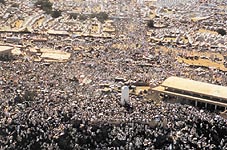
Haj - the annual Pilgrimage to Mecca, Saudi Arabia - the world's largest annual Pilgrimage.
Fulfilling one of the five "Pillars" of Islam, it's the central religious' duties of the believer - The Duty that must be carried out at least once in the lifetime by every able-bodied Muslim who can afford to do so - as long as the pilgrim possesses the means.
The Pilgrimage begins from the 8th to 12th day of
Dzulhijjah, the 12th and last month of the Islamic calendar, the lunar calendar - Eleven days shorter than the Gregorian calendar used in most parts of the world.
The Gregorian date of the Haj changes yearly.
******
The Haj is a demonstration of the solidarity of the worldwide Muslims, and their submission to GOD.
Pilgrims join processions of millions of people, who simultaneously converge to Mecca for the week of the Haj, and perform a series of rituals: Each person walks counter-clockwise seven times about the
Ka'abah, the cube-shaped building which is the
Kiblah, Muslim's direction of prayers.
Walks or runs back and forth between the hills of
Safa and
Marwah, drinks from the
Zamzam Well, goes to the plains of Mount
'Arafah, and throws stones in a ritual Stoning of the Devil.
The pilgrims then cut some of their hair, or for some males, their heads shaved, perform a ritual of animal sacrifice, and celebrate
'Iidil Adha - Performing animal sacrifices, symbolising GOD's Mercy on Ibrahim
a.s. and replacing His Son with a ram.
Centralised butcher houses sacrifice for each pilgrim, a single sheep, the meat then packaged and given to charity and shipped to the poor, around the world.
At the same time as the sacrifices occur in Mecca, Muslims worldwide perform similar sacrifices, in a four day global festival
'Iidul Adha.
Haj - A journey of a lifetime in the life of a Muslim - Pilgrimage to Mecca is an ultimate journey to GOD.
The Holy
Qur'an lay the emphasis on the importance of Haj - once in a lifetime, irrespective of ethnic group, colour, social status or culture - A Ritual that is designed to promote the bonds of Islamic fraternity by showing that everyone is equal in the eyes of ALLAH
Subhaanahu Wa Ta'aala.
The Pilgrimage makes a Muslim realise the importance of life on earth, and therefore, do away with all social status, wealth and pride.
******
According to the Holy
Qur'an, it was Prophet Ibrahim (Abraham)
'alaihis salam who, together with Isma'il (Ishmael)
'alaihis salam, built the
Ka'abah, "The House of GOD," the focal point toward which Muslims turn to, in the five times a day and night, worshipping HIM.
It was Ibrahim
a.s., too, around 2000 BC, - known as
Khalilullah, "The Friend of GOD" - who established the rituals of the Haj.
It recall events or practices in His life and that of Siti Hajar (Hagar)
radhiallaahu 'anha and Their Son Isma'il.
It is believed that the Prophet Ibrahim
a.s. was ordered by ALLAH
s.w.t. to leave His Wife Siti Hajar
r.a. and His infant Son Ismail alone in the desert.
While He was away, the Child crying of thirst, and Siti Hajar
r.a. frantically ran back and forth seven times searching for water for Her Son.
The Baby cried and hit the ground with His foot - Or the Angel scraped His foot or the tip of His wing along the ground (whichever is believed) - And source of
Zamzam water miraculously sprang forth.
******
In the Holy
Qur'an, the chapter "The Pilgrimage" speaks of the DIVINE command to perform the Haj and prophesies the permanence of this institution:
And when We assigned for Abraham the place of the House, saying "Do not associate anything with ME,
and purify MY House for those who go around It and for those who stand and bow and prostrate themselves in worship.
And proclaim the Pilgrimage among humankind: They will come to you on foot and on every camel made lean.
By traveling deep, distant ravines.
Indeed, The First House (of worship) established for mankind was that at Makkah - blessed and a guidance for the worlds. - (Quran - 3:96)
Ka'abah, Baitullah, or the House of GOD, is one of GOD's sign on earth.
In it are clear signs (such as) the standing place of Abraham.
And whoever enters it shall be safe. And (due) to ALLAH from the people is a Pilgrimage to the House - for whoever can make their way there.
The ritual of Pilgrimage that stretched back thousands of years to the Prophet Ibrahim
a.s., brings together Muslims of all races and languages for one of life's most moving spiritual experiences.
The haj, based on a pilgrimage, was ancient practise, even in the time of 7th century Prophet Muhammad
sollallaahu 'alaihi wasallam.
Then, each year, tribes from all around the Arabian peninsula would converge on Mecca, as part of the pilgrimage.
The exact faith and religion of each tribe was never a great importance, then.
******
The Haj is associated with the life of Islamic Prophet Muhammad s.a.w. began when He s.a.w., received the DIVINE call, ordained by GOD, continued the original observances of Abrahamic Haj after restoring the Rituals to their original purity which was muddied with pagan practices.
Prophet Muhammad s.a.w. Himself instructed the believers in the rituals of the Haj - by His own practice, or by approving the practices of His Companions.
Although This added some complexity to the Rituals, but It also provided increased flexibility in carrying Them out, much to the benefit of pilgrims ever since.
It is lawful, for instance, to have some variation in the order in which the several Rites are carried out, because the Prophet
s.a.w. Himself is recorded as having approved such actions.
Thus, the rites of the Haj are elaborate, numerous and varied.
'GOD, from such a distant land I have come to YOU...
Grant me shelter under YOUR Throne.'
******
For 14 centuries, millions of Muslims, men and women, have made the Pilgrimage to Mecca, the birthplace of Islam.
A pilgrim undertaking the journey, they follow in the footsteps of millions before them.
For souls that have strayed, seek HIM for comfort once again.
Hearts, that have hardened, melt them before HIM.
And eyes which had lost its vision, sparkle them with HIS radiance.
Redress all wrongs, pay all debts, prepare for good conduct throughout the Haj.
Be kind, be considerate, render help in the way we can, is the key to Haj being accepted.
People asked, "What makes Haj mabrur, Messenger of ALLAH?"
He s.a.w. said "Providing food to people and spreading the greeting of salaam."
******
Haj is a comprehensive act of worship, involving finance and physical exertion - Both for HIS sake.
Come prepared, never be ignorant, confused, frustrated or angry during the holy Journey.
Prepare - physically and spiritually - for this sacred Journey!
Lest It's only a vacation that leaves no lasting impression.
Haj is not a vacation - “Going to the Haj” is submitting to GOD's command.
All the excitement about the luxurious hotels and sophisticated lifestyle will narrow down to just two pieces of cloth, responding to ALLAH
s.w.t.’s invitation, chanting:
“Labbaik, Allaahhumma Labbaik”
crying to the CREATOR, needing and hoping for HIS Mercy.
One should utilise his time to the maximum in 'ibadah and praising ALLAH s.w.t. during the Journey and in all the Holy Places.
******
During the Haj, ihram, a white seamless garment made up of two pieces of cloth or towel worn by men, with the top thrown over the shoulder or draped over the body, the bottom covers the body from waist to ankle. The pilgrim wears a pair of sandals, with exposed toes.
Male pilgrim does not cover the head - at all times.
A symbol of purity and of the renunciation of evil and mundane matters, it also indicates the equality of all human beings in GOD's 'eyes'.
This garb was worn by both Ibrahim
a.s. and Muhammad
s.a.w., too
Women are simply required to maintain their normal modest dress, which does not cover the hands or face. Women generally wear a simple white dress and with their heads covered but not veiled.
In
Ihram is also the name given to the special state in which pilgrim lives whilst on the Pilgrimage.
Ihram is also symbolic for holy virtue and pardon from all past sins.
The
ihram, meant to show equality of all pilgrims in the eyes of GOD, - no difference between black and white, blue blooded or the normal red blooded human beings.
Once wearing the white apparel
ihram, the pilgrim enters into a state of purity that prohibits shaving, clipping of nails, wearing perfume, wearing of any jewellery, marrying or performing any ugly acts of swearing and quarrelling.
Pilgrim needs to have a love for ALLAH's creations - Prohibited from committing violence to all living creatures, no uprooting or damaging plants, and no killing of animals: Insects too.
The donning of the
ihram is accompanied by the primary invocation of the Haj, the
Talbiyah:
Here I am, O GOD, at YOUR Command!
Here I am at YOUR Command! YOU are without associate;
Here I am at YOUR Command!
YOU are Praise and Grace and Dominion! YOU are without associate.
The thunderous, melodious chants of the
Talbiyah ring out not only in Mecca, but at other nearby sacred Locations connected with the Haj too.
******
As the pilgrims throng spread through Mina, an uninhabited place east of the city, on the eight day, the pilgrims generally spend their time meditating and praying, as the Prophet
s.a.w. did on His Pilgrimage.
On the ninth day, pilgrims leave Mina for Mount
'Arafah, the central rite of the Haj - Haj is invalid if pilgrims do not spend the afternoon on '
Arafah.
There, pilgrims spend the afternoon within a defined area of
'Arafah until after sunset.
No specific rituals or prayers are required during the stay at
'Arafah, although many pilgrims spend time praying, and thinking about the course of their lives.
As pilgrims congregate at
'Arafah, the gathering bring to the mind of the Judgment Day. Some pilgrims in contemplative vigil and pray and recite the Holy
Qur'an, near the hill of
Jabar Rahmah (The Hill of Forgiveness, Mount
Arafah) from where the Prophet
s.a.w. delivered his unforgettable Farewell Sermon, enunciating far-reaching religious, economic, social and political reforms.
On the sacred spot of
'Arafah, pilgrims feel the presence and closeness of the Merciful GOD.
These are emotionally charged hours, which the pilgrims spend in worship and supplication.
Many shed tears, poignant in its intensity, of that great concourse of humanity as GOD's forgiveness is seek. Many tears streaming down, others raised their faces to the night sky that had witnessed this repeating episodes since the past centuries - the shining eyes, the passionate appeals, the pitiful hands outstretched in prayer, a strong wave of spiritual exaltation, an act of complete surrender to HIS Supremacy.
The ultimate closeness one can achieve while living in this world. Haj holds a prominent position among all Muslim acts of worship - It is the supreme act of Worship.
The hopeful pilgrims prepare to leave
'Arafah with feeling of reborn, pure and with new leaf turned.
The spirit of the religion is, submission to GOD's will, will always lead.
'GOD, from such a distant land I have come to YOU...
Grant me shelter under YOUR Throne.'
As pilgrims of diverse races worldwide, return to their countries and lands, they carry with them cherished memories of Ibrahim
a.s., Isma'il
a.s., Siti Hajar
r.a. and Muhammad
s.a.w., memories of
Ihram, Tawaf,
Sa'ie, Wukuf and
Ziarah, and memories of
Mecca, Zamzam, Arafah, Muzdalifah, Mina and
Madinah.
They will always remember that universal concourse, where poor and rich, black and white, young and old, met on equal ground.
They return with a better understanding of the conditions of their brothers in Islam - Thus is born a spirit of caring for others and human understanding that will last throughout a lifetime.
The pilgrims return with a sense of serenity - Serenity for having shed sins on that
'Arafah plain, and being thus relieved of such a heavy burden.
The experience at
'Arafah, where GOD is felt the closest, at the place where the Prophet
s.a.w. delivered His sermon during His first and last Pilgrimage.
They have fulfilled GOD's ancient injunction to humankind to undertake the Pilgrimage.
The pilgrims, radiance with hope and joy, for above all, they return with prayer set deep in the heart.
Haj is not just the importance of the rites of Pilgrimage, it is the spirit in which the Haj is performed.
Complete the Haj and 'Umrah for ALLAH!!!
Whoever submitted oneself wholeheartedly, body and soul, for this act of
'Ibadah, then as The Prophet Muhammad
s.a.w. said,
"... there is no reward for Haj mabrur, except Paradise."
May it please GOD, the Haj acceptable, and may what the Prophet
s.a.w. said - be true of one's own individual Journey.
It is not merely going to and returning from Mecca, but returning from Mecca with faith in GOD strengthened and rekindled
.
For the disbelievers, indeed, ALLAH
s.w.t. is free from all worldly needs...


 The Saudi government is taking all efforts to make this year's Haj to be hassle-free and smooth movement of pilgrims to the Jamrahs is top in the agenda.


 Dzulhijjah is here again.