Showing posts with label Makkatul Mukarramah. Show all posts

Friday, July 15, 2011

You Think The Prophet Is Not Knowing?

Prior to my last year's Umrah Syawal, strange thing happened.
I would see vision of main road, highway and the side of a flyover whenever I recited my selawat and salam.

Whenever I feel like wanting to be close to Prophet Muhammad sollallaahu 'alaihi wasallam, beside selawat and salam, it would be the last two verses of Surah At-Taubah
Verily, 
there has come unto you a Messenger (Muhammad
from amongst yourselves 
(i.e. whom you know well). 
It grieves him that you should receive any injury or difficulty. 
He (Muhammad ) is anxious over you 
(to be rightly guided, to repent to ALLAH, 
and beg HIM to pardon and forgive your sins, 
in order that you may enter Paradise 
and be saved from the punishment of the Hell-fire), 
for the believers (he is) full of pity, kind, and merciful.
But if they turn away, 
say (O Muhammad ): 
"ALLAH is sufficient for Me.  
La ILAHA Illa HUWA (none has the right to be worshipped but HE), 
in HIM I put my trust and HE is the LORD of the Mighty Throne." 

.    ******

My late sister never failed herself to recite Maulid every Monday, and everyday when Rabi'ul Awwal was around.
She stood up when she reached the marhaban page, to welcome Rasulullah s.a.w., even when she just recited it all alone, just by herself.

Maybe that's part of the reason why she could sense the time had come before her final day.
She was all prepared to meet Izrael, the death angel, asking to be bathed with Zamzam water a day before her death.
At any time of the year, Zamzam is well stocked at our homes.

******


I used to increase my selawat and salam when there was sudden urge is in me to visit Baitullaah and Rasulullah s.a.w.

As usual, I did what I usually did last year, increasing the frequency of selawat and salam.
But the vision of main road, highway and the side of a flyover kept recurring.

What was really happening?

When I was in 'Arafah in 2001, after reciting Maulid, the smell of fresh citrus engulfed the whole tent.
There were only two jema'ah in the tent, myself and another sister, a new Chinese Muslim.
The rest of the jema'ah went to the washroom preparing for Maghrib.

The Chinese sister, just two years into Islam, was amazed by the new experience.
The tent openings was as if blown with misty air fresheners.
But that was not the case as we were in Ihram.
No perfume what so ever.

It was only after the swish swashing of a person wearing a like long robe walking past inside the tent, then could the sister refreshed what she had just recited in the Maulid book.

******

On another occasion, while waiting for Subuh, sitting outside Masjidin Nabawi in 2005, I took pity of an old Turkish pilgrim who was massaging her legs with crucial pain shown on her weathered face.
ubat minyak geliga
Using lemon grass oil, minyak geliga I brought from home, I massaged the old woman's legs.

She kept praying, lifting both hands high up, thanking GOD of lifting the pain she had to bear.
At last she could smile.

Very soon, one after another old Turkish women, a small pre-dawn crowd outside Masjidin Nabawi was built in no time.
These old Turkish women, old they were, but definitely they were raring for a quarrel.
I was not used to the scene of pushing and shoving their way for just an ordinary massage.
I just pushed the minyak geliga into the hand of one of them, then I exited out of the scene.

The quarrel intensified as I left the scene.
Now, who has had the right to the small bottle of ointment...

I used to bring many bottles of local ointment for my Haj and Umrah.
But on that morning, there was only one bottle in my bag.

I thought nothing of the pre-subuh incident.
But the dream I had that night, carved an eternal memory in me.

Three men, one of them with henna red beard, were searching for the person who massaged the legs of an old jema'ah.
They were hurrying to the person who massaged the legs of an old jema'ah, infront of Rasullah s.a.w. in the early morning...

******

It was only after I walked down Suqul Lail, the night market, [but Malays usually called it Pasar Zink (?)] last Syawal, I could fully understand my dream of main road, highway and the side of a flyover.

The first time I was in Mecca in 1996, we stayed at Ar-Reem Hotel in the area of Suqul Lail.
It was the place where day or night, we could see men eagerly volunteered carrying dead bodies on their way to Ma'la cemetery.
We never fail to pass by Ar-Reem whenever we were in Makkatul Mukarramah.

But walking down memory lane last year, we were not able to find the place, due to the many constructions took place all at once around Masjidil Haram.
Even to Pasar Zink was no easy access for us. 
There were just too many blockages.

But we were sure that the access to the library of Makkatul Mukarramah was not blocked. 
It is now a very big open space.

To safeguard the historical place from being neglected, a library was built, but now demolished. 
The library, located on Al-Qashashia Street used to be in the Maulid District, is the birth place of Muhammad.
The place where Hazrat Muhammad (SA) Born, at Makkah
Photo Source: Panoramio

The small library was the original home of Sayyidina Abdul Muttalib's foundation.
We had many times tried to visit the place since 1996, but it was closed most of the time.

My eldest sister told me, before the sacred place was made a library, Maktabat Makkatul Mukarramah, the house in which Prophet Muhammad s.a.w. was born, it was razed and turned into a cattle market.

In 1990, the matrimonial home of Prophet Muhammad s.a.w. and his wife, Saiyidatina Siti Khadijah rodhiallaahu 'anha was paved over.
It was the spot where the Revelation descended upon The Prophet s.a.w. from GOD.
The site was buried in concrete and covered in marble.

Enough indication of the demolished blessed house with just a public toilet now stands nearby!!!

Friday, November 5, 2010

The Haj - Chinese Pilgrims, Then And Now

Photo:<!--###IMAGE_BRIEF###-->

"Chinese?"
Then He was shown the escalator to the second floor, I supposed, when He nodded.

I followed Him from behind, about to escalate, when the guard in Masjidil Haram stopped me.

"Malaysia," he said as he pointed to the straight path ahead on the ground floor.

At that moment, He realised He was mistaken again as a Chinese pilgrim from China.
That was in  2005, when we did our Haj.


Way back in 2005, I used to see Chinese pilgrims, after their 'Isyak prayer, on the way back, would carry fresh chickens, vegetables and groceries to cook.
They passed by the place we stay at Habibah, some 300 metres from The Grand Mosque. 
They walked further uphill, not sure their living place, though.

On our part, there were a lot of daily  food wastage  as each pilgrim's portion was the same - men and women. 
To top that, not all Malaysian pilgrims have Johor taste-bud, as the food was prepared by Johoreans.

I told the personnel in charge of food distributions about giving the extras to the Chinese, but complain of not getting food is the thing they did not want to hear.

Gladly, at least after that, dinner not taken at the cut-off time was finally brought down to be distributed to the Chinese pilgrims or any passers-by.

******

In 2005, the China Islamic Association established the Haj Working Office.
Aside from the establishment of the provincial religious and ethnic administrations, it also organises and serves ethnic Muslim pilgrims in China.

The number of Chinese pilgrims increased significantly, thus their presence were felt and seen, projecting its economic stability, ethnic unity and the international image of China.
With the growing number of pilgrims, China Islamic Association began to study, thus gradually improving the management system of the Chinese Haj affairs and formed the regulated, institutionalised and regular mechanism of Haj work.

On the invitation of Saudi Arabia and working together with the Saudi Haj Ministry and other supervising and service agencies, the association, summarised the service of the previous Haj and makes plans for the coming year, to ensure that the Chinese can accomplish their pilgrimage.
The association set a target of the “safe, orderly and well-conducted Haj”.

It was in 2005 too, the Chinese government, to shorten the travel duration and reduce the cost of Haj, launched the pilgrimage direct flight from Lanzhou, Northwest China's Gansu Province, Yinchuan and Kunming, Beijing, and Urumqi too.
In the same year, it was said, about 2,000 Kyrgyzstan places were taken by the Chinese using Kyrgyz passports


Bodies removed in Mena January 12, 2006. Photo: Reuters


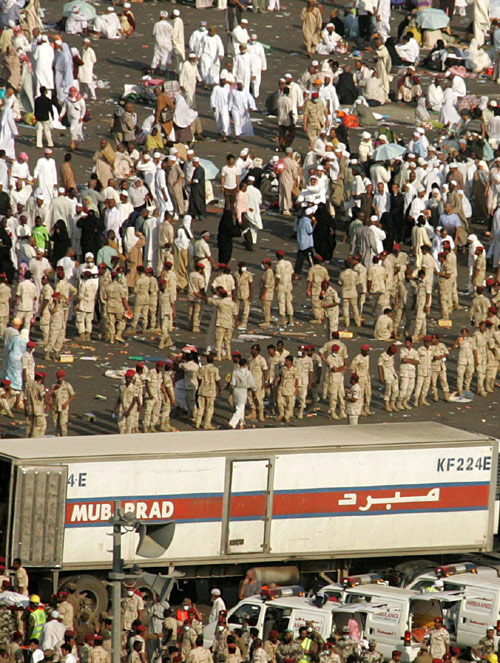
In 2005 too, pilgrims tripped over luggage in Mina that caused tramplings resulting in at least 345 death - four were confirmed to be Chinese nationals. Several Chinese pilgrims were injured in the tragedy.
All the four were from Qinghai Province in western China - 62-year old Ma Taishan, 61-year old Ma Delin, 58-year old Sha Tianlu and a 49-year old woman Ru Geya.

About 20,000 Muslims gathered in Xining, capital of Northwest China's Qinghai Province prayed for the four deceased after religious leaders informed the Friday crowd of their identities.

Families of the four Chinese pilgrims, regarded such deaths predestined, were handed 50,000 yuan (US$6,200) each, from the China Islamic Association.

About 7,000 Chinese performed their Haj in 2006, 10,700 in 2007, 11,000 in 2008 and 12,700 in 2009.

******

The earliest Haj visit recorded in the historical literature of the Chinese ethnic Muslims was in the middle of the Ming Dynasty (1368 - 1644) when the famous Chinese navigator Zhen He (Cheng Ho 1371–1435), led his fleet to Mecca to perform Haj during one of his seven marine adventures.

The Chinese used to follow two routes to Mecca: the sea and the land.
The land route passed through the Hexi Corridor in Gansu - the most important route from North China to Central Asia for traders - passed Xinjiang, Central Asia, Iran, Iraq, Syria, Palestine and Egypt before crossing the Red Sea and reaching the Jeddah port.
The marine route started from Hong Kong and passed Myanmar and India until arriving at Jeddah port.
These travellers encountered difficulties in their efforts to reach Makkah for Haj - financial constrain, long journey and backward transportation means: They had to walk, carriage or horse-ride, or take another ship before reaching home.
The trip often took months, or even years that led to sufferings and death for many Chinese pilgrims.

******

After the People’s Republic of China was founded and with more liberal religious freedom policy, China Islamic Association, with its missions and duties of assisting the people's government in the implementation of the policy of freedom of religion, was formed in July 1952.

The national organisation represent Muslims of all ethnic groups, unifying them in participating in the socialist construction of the motherland and to cherish it.
Its establishment placed a bridge between China's Muslims of different ethnicities.

The association's main tasks, beside The Haj Office being responsible for bringing together people of different nationalities to perform Haj,
- its Academic Department involved in implementing Islamic regulations within the context of service activities, to hold training of teaching personnel to attend the masses religious issues.
- to meet the requirements and interpretation of social development and - The Offices Operational Agencies promote Islamic associations and mosques around the country and serve the community.
- The Research Department identifies and colllects Islamic historical data and the cultural heritage beside books compilation and publication, and
- The International Department is task with relationship promotion with Muslim countries.

******

The Office of Haj's team of 16 pilgrims set off for Saudi Arabia in 1952.
For some reason, they returned home after reaching Pakistan.

In 1955, the late Chinese Prime Minister Zhou Enlai (1898 -1976), after meeting with Prince Faisal of Saudi Arabia (1904 - 1975) in Bali, a 20-member Chinese team were approved of their Haj visas, thus accomplished their Haj mission.
Between 1955 and 1964, China organised 10 Haj trips to Mecca attended by altogether 132 pilgrims.

However, the trips came to a stop after the Cultural Revolution in China but the pilgrimage resumed again, after a lapse of fourteen years.

The Chinese government used to allocate part of the foreign currency quota for Haj pilgrims, even when the country was faced with foreign currencies shortage.
It facilitated visits to their relatives in Saudi Arabia too.

Despite forbidden to perform pilgrimage during the Cultural Revolution, the persistent Chinese still attended to the callings through Pakistan, until the reverse in policy in 1979.
When the 80s came, Chinese pilgrims paid their own expenses. They were responsible for their own fare, no more allocations from the Chinese government.
Despite the self-funded Haj trips, the number of Chinese pilgrims grown considerably to 2,200 in 1985.

In 1986, the government gave its support for the organised Chinese Haj team - The organisation has been incorporated into the government management tasks. 
To help Muslims perform their pilgrimage and striving towards excellent management of the pilgrims, it provided all-round service for the Chinese.

China Islamic Association sent its first Haj Team on the field, in the same year.
It helped the pilgrims with Haj visa application, ticketing, traffic, accommodation and all formalities in Karachi and Islamabad in Pakistan, and Jeddah, Mecca and Madinah in Saudi Arabia as diplomatic relations with Saudi Arabia was not established, then.

In 1989, China and Saudi Arabia reached an agreement to set up business offices in each other’s capital city. To facilitate the Haj for its Muslims, the Chinese government once arranged six chartered flights directly to Jeddah and helped 900 Chinese pilgrims get visas on arrival.
In July 1990, the two countries established diplomatic relations, thus laying the foundation to cooperate in politics, economy and culture and making it easier for pilgrims to perform Haj and get consular protection.

April 2001, the government set up the China Islamic Association, described as aiming to "help the spread of the Qur'an in China and oppose religious extremism". It is run by 16 religious leaders, in charge of making "a correct and authoritative interpretation" of Islamic creed.
With the awareness, in 2003, more than 3,000 people in the Ningxia Hui Autonomous Region alone, performed their religious call - contrary to 1988 when only 15 pilgrims made their journey.
The mostly farmers pilgrims - along with imams from some mosques - paid more than 30,000 yuan (US$3,627) for the pilgrimage.
By then, more than 45,000 Chinese had done so. Beside direct flight, they were provided with Arabic interpreters and health workers too.

******


In 2004, more than 4,000 Chinese performed their Haj. 

30 Chinese pilgrims from Gansu were pushed to the ground in a stampede that took away 244 lives - five were from China.

******

In 2004, the government - working with China Islamic Association - to safeguard the interests and legitimate rights of the Haj pilgrims and facilitating the trips, issued the Regulations on Religious Affairs - the first comprehensive decree regulating the religious affairs.
In accordance with the Article XI in the Regulations, “The national Islamic organisation is responsible for organising the Chinese citizens holding Islam as their belief to go on Haj overseas.”
The article conveyed two messages: Clarifies and protects the basic rights of the Muslims going on Haj, which are not be infringed on by any organisation or individual, and designated the China Islamic Association as the main body of organising, managing and serving the teams and regulates that "no other organisation or individual" can organise the Haj teams as there were still illegal organisers that deceived pilgrims and some were forced out of their hotels to the streets - The legitimate rights and interests of the pilgrims, while abroad, are not guaranteed.

******

China, with official statistics recorded of around 23 million Muslims in more than 20 provinces, autonomous regions, and municipalities, is seeing a steep jump in the number of its Haj pilgrimage.

 The last 980 Chinese pilgrims for 2010, left Beijing on Wednesday evening aboard three chartered flights headed for Saudi Arabia.
 
Muslims gather in front of a mosque before going to an airport to leave for Mecca in Yinchuan, capital of northwest China's Ningxia Hui Autonomous Region, Oct. 31, 2009. A group of 297 Muslims took off from Yinchuan by chartered flight to Mecca for hajj Saturday. From Oct. 30 to Nov. 18, about 12,700 Muslims will go to the holy city for hajj in 41 chartered flights from Xinjiang, Gansu, Ningxia, Yunnan and Beijing. The number of pilgrims is 700 more than that of last year.
Gathering in front of a mosque before leaving for Mecca in Yinchuan, capital of northwest China's Ningxia Hui Autonomous Region


The first 2010 chartered flight from northwest China's Ningxia Hui Autonomous Region to Mecca took off on October 18, marking the start of pilgrims' annual journey from China's largest Hui community.

2,250 people from Ningxia, had left by seven chartered planes from Yinchuan, Ningxia's capital 
- An official with the regional religious bureau of Ningxia, 71 personnel, including doctors and interpreters, accompanied the pilgrims, helping them in the foreign country. 
- Fourteen imams, or senior and revered Muslims, accompanied them too, to help solving religious and Haj issues. 

The pilgrims, mostly farmers, paid 30,000 yuan (US$4,412)
Ningxia, known as China's "Muslim province" has more than one third of its population - 2.1 million - are from Hui ethnic minority.

The number of Chinese pilgrims coming for Haj is seeing the ever increasing number.
This year, around 13,500* pilgrims had their spiritual callings answered.

*** 13,500* - Many papers claim the figure of 24,000. One of them is  here.


.

Monday, November 1, 2010

The Haj - InsyaALLAH, Mabrur

hajj_copy

Haj -  the annual Pilgrimage to Mecca, Saudi Arabia - the world's largest annual Pilgrimage.

Fulfilling one of the five "Pillars" of Islam, it's the central religious' duties of the believer - The Duty that must be carried out at least once in the lifetime by every able-bodied Muslim who can afford to do so - as long as the pilgrim possesses the means.
The Pilgrimage begins from the 8th to 12th day of Dzulhijjah, the 12th and last month of the Islamic calendar, the lunar calendar - Eleven days shorter than the Gregorian calendar used in most parts of the world.
The Gregorian date of the Haj changes yearly.

******

The Haj is a demonstration of the solidarity of the worldwide Muslims, and their submission to GOD.
Pilgrims join processions of millions of people, who simultaneously converge to Mecca for the week of the Haj, and perform a series of rituals: Each person walks counter-clockwise seven times about the Ka'abah, the cube-shaped building which is the Kiblah, Muslim's direction of prayers.
Walks or runs back and forth between the hills of Safa and Marwah, drinks from the Zamzam Well, goes to the plains of Mount 'Arafah, and throws stones in a ritual Stoning of the Devil.
The pilgrims then cut some of their hair, or for some males, their heads shaved, perform a ritual of animal sacrifice, and celebrate 'Iidil Adha - Performing animal sacrifices, symbolising GOD's Mercy on Ibrahim a.s. and replacing His Son with a ram.

Centralised butcher houses sacrifice for each pilgrim, a single sheep, the meat then packaged and given to charity and shipped to the poor, around the world.
At the same time as the sacrifices occur in Mecca, Muslims worldwide perform similar sacrifices, in a four day global festival 'Iidul Adha.

Haj - A journey of a lifetime in the life of a Muslim - Pilgrimage to Mecca is an ultimate journey to GOD.
The Holy Qur'an lay the emphasis on the importance of Haj - once in a lifetime, irrespective of ethnic group, colour, social status or culture - A Ritual that is designed to promote the bonds of Islamic fraternity by showing that everyone is equal in the eyes of ALLAH Subhaanahu Wa Ta'aala.
The Pilgrimage makes a Muslim realise the importance of life on earth, and therefore, do away with all social status, wealth and pride.

******

According to the Holy Qur'an, it was Prophet Ibrahim (Abraham) 'alaihis salam who, together with Isma'il  (Ishmael) 'alaihis salam, built the Ka'abah, "The House of GOD," the focal point toward which Muslims turn to, in the five times a day and night, worshipping HIM.
It was Ibrahim a.s., too, around 2000 BC, - known as Khalilullah, "The Friend of GOD" - who established the rituals of the Haj.

It recall events or practices in His life and that of  Siti Hajar (Hagar) radhiallaahu 'anha and Their Son Isma'il.
It is believed that the Prophet Ibrahim a.s. was ordered by ALLAH s.w.t. to leave His Wife Siti Hajar r.a. and His infant Son Ismail alone in the desert.
While He was away, the Child crying of thirst, and Siti Hajar r.a. frantically ran back and forth seven times searching for water for Her Son.
The Baby cried and hit the ground with His foot - Or the Angel scraped His foot or the tip of His wing along the ground (whichever is believed) - And source of Zamzam water miraculously sprang forth.

******

In the Holy Qur'an, the chapter "The Pilgrimage" speaks of the DIVINE command to perform the Haj and prophesies the permanence of this institution:

And when We assigned for Abraham the place of the House, saying "Do not associate anything with ME, 
and purify MY House for those who go around It and for those who stand and bow and prostrate themselves in worship. 
And proclaim the Pilgrimage among humankind: They will come to you on foot and on every camel made lean. 
By traveling deep, distant ravines.

Indeed, The First House (of worship) established for mankind was that at Makkah - blessed and a guidance for the worlds. - (Quran - 3:96)  

Ka'abah, Baitullah, or the House of GOD, is one of GOD's sign on earth. 

In it are clear signs (such as) the standing place of Abraham.
And whoever enters it shall be safe. And (due) to ALLAH from the people is a Pilgrimage to the House - for whoever can make their way there.

The ritual of Pilgrimage that stretched back thousands of years to the Prophet Ibrahim a.s., brings together Muslims of all races and languages for one of life's most moving spiritual experiences.

The haj, based on a pilgrimage, was ancient practise, even in the time of 7th century Prophet Muhammad sollallaahu 'alaihi wasallam.
Then, each year, tribes from all around the Arabian peninsula would converge on Mecca, as part of the pilgrimage.
The exact faith and religion of each tribe was never a great importance, then.

******

The Haj is associated with the life of Islamic Prophet Muhammad s.a.w. began when He s.a.w., received the DIVINE call, ordained by GOD, continued the original observances of Abrahamic Haj after restoring the Rituals to their original purity which was muddied with pagan practices.

Prophet Muhammad s.a.w. Himself instructed the believers in the rituals of the Haj - by His own practice, or by approving the practices of His Companions. 
Although This added some complexity to the Rituals, but It also provided increased flexibility in carrying Them out, much to the benefit of pilgrims ever since.
It is lawful, for instance, to have some variation in the order in which the several Rites are carried out, because the Prophet s.a.w. Himself is recorded as having approved such actions.
Thus, the rites of the Haj are elaborate, numerous and varied.

'GOD, from such a distant land I have come to YOU... 
Grant me shelter under YOUR Throne.'

******

For 14 centuries, millions of Muslims, men and women, have made the Pilgrimage to Mecca, the birthplace of Islam.
A pilgrim undertaking the journey, they follow in the footsteps of millions before them.
For souls that have strayed, seek HIM for comfort once again.
Hearts, that have hardened, melt them before HIM.
And eyes which had lost its vision, sparkle them with HIS radiance. 
Redress all wrongs, pay all debts, prepare for good conduct throughout the Haj.
Be kind, be considerate, render help in the way we can, is the key to Haj being accepted.

People asked, "What makes Haj mabrur, Messenger of ALLAH?"

He s.a.w. said "Providing food to people and spreading the greeting of salaam." 

****** 

Haj is a comprehensive act of worship, involving finance and physical exertion - Both for HIS sake.
Come prepared, never be ignorant, confused, frustrated or angry during the holy Journey.
Prepare - physically and spiritually - for this sacred Journey!
Lest It's only a vacation that leaves no lasting impression.        

Haj is not a vacation - “Going to the Haj” is submitting to GOD's command.
All the excitement about the luxurious hotels and sophisticated lifestyle will narrow down to just two pieces of cloth, responding to ALLAH s.w.t.’s invitation, chanting:  

“Labbaik, Allaahhumma Labbaik”
crying to the CREATOR, needing and hoping for HIS Mercy.
One should utilise his time to the maximum in 'ibadah and praising ALLAH s.w.t. during the Journey and in all the Holy Places.

******

During the Haj, ihram, a white seamless garment made up of two pieces of cloth or towel worn by men, with the top thrown over the shoulder or draped over the body, the bottom covers the body from waist to ankle. The pilgrim wears a pair of sandals, with exposed toes.
Male pilgrim does not cover the head - at all times.

A symbol of purity and of the renunciation of evil and mundane matters, it also indicates the equality of all human beings in GOD's 'eyes'.
This garb was worn by both Ibrahim a.s. and Muhammad s.a.w., too

Women are simply required to maintain their normal modest dress, which does not cover the hands or face. Women generally wear a simple white dress and with their heads covered but not veiled.

In Ihram is also the name given to the special state in which pilgrim lives whilst on the Pilgrimage.
Ihram is also symbolic for holy virtue and pardon from all past sins.
The ihram, meant to show equality of all pilgrims in the eyes of GOD, - no difference between black and white, blue blooded or the normal red blooded human beings.

Once wearing the white apparel ihram, the pilgrim enters into a state of purity that prohibits shaving, clipping of nails, wearing perfume, wearing of any jewellery, marrying or performing any ugly acts of swearing and quarrelling.
Pilgrim needs to have a love for ALLAH's creations - Prohibited from committing violence to all living creatures, no uprooting or damaging plants, and no killing of animals: Insects too.

The donning of the ihram is accompanied by the primary invocation of the Haj, the Talbiyah:

Here I am, O GOD, at YOUR Command! 
Here I am at YOUR Command! YOU are without associate; 
Here I am at YOUR Command! 
YOU are Praise and Grace and Dominion! YOU are without associate.  

The thunderous, melodious chants of the Talbiyah ring out not only in Mecca, but at other nearby sacred Locations connected with the Haj too.

******

As the pilgrims throng spread through Mina, an uninhabited place east of the city, on the eight day, the pilgrims generally spend their time meditating and praying, as the Prophet s.a.w. did on His Pilgrimage.

On the ninth day, pilgrims leave Mina for Mount 'Arafah, the central rite of the Haj - Haj is invalid if pilgrims do not spend the afternoon on 'Arafah.
There, pilgrims spend the afternoon within a defined area of 'Arafah until after sunset.

No specific rituals or prayers are required during the stay at 'Arafah, although many pilgrims spend time praying, and thinking about the course of their lives.
As pilgrims congregate at 'Arafah, the gathering bring to the mind of the Judgment Day. Some pilgrims in contemplative vigil and pray and recite the Holy Qur'an, near the hill of Jabar Rahmah (The Hill of Forgiveness, Mount Arafah) from where the Prophet s.a.w. delivered his unforgettable Farewell Sermon, enunciating far-reaching religious, economic, social and political reforms.
On the sacred spot of 'Arafah, pilgrims feel the presence and closeness of the Merciful GOD. 

These are emotionally charged hours, which the pilgrims spend in worship and supplication.
Many shed tears, poignant in its intensity, of that great concourse of humanity as GOD's forgiveness is seek. Many tears streaming down, others raised their faces to the night sky that had witnessed this repeating episodes since the past centuries - the shining eyes, the passionate appeals, the pitiful hands outstretched in prayer, a strong wave of spiritual exaltation, an act of complete surrender to HIS Supremacy.
The ultimate closeness one can achieve while living in this world. Haj holds a prominent position among all Muslim acts of worship - It is the supreme act of Worship.  

The hopeful pilgrims prepare to leave 'Arafah with feeling of reborn, pure and with new leaf turned.
The spirit of the religion is, submission to GOD's will, will always lead.

'GOD, from such a distant land I have come to YOU... 
Grant me shelter under YOUR Throne.' 

As pilgrims of diverse races worldwide, return to their countries and lands, they carry with them cherished memories of Ibrahim a.s., Isma'il a.s., Siti Hajar r.a. and Muhammad s.a.w., memories of Ihram, Tawaf, Sa'ie, Wukuf and Ziarah, and memories of Mecca, Zamzam, Arafah, Muzdalifah, Mina and Madinah.

They will always remember that universal concourse, where poor and rich, black and white, young and old, met on equal ground.
They return with a better understanding of the conditions of their brothers in Islam - Thus is born a spirit of caring for others and human understanding that will last throughout a lifetime.

The pilgrims return with a sense of serenity - Serenity for having shed sins on that 'Arafah plain, and being thus relieved of such a heavy burden.
The experience at 'Arafah, where GOD is felt the closest, at the place where the Prophet s.a.w. delivered His sermon during His first and last Pilgrimage.
They have fulfilled GOD's ancient injunction to humankind to undertake the Pilgrimage.

The pilgrims, radiance with hope and joy, for above all, they return with prayer set deep in the heart.
Haj is not just the importance of the rites of Pilgrimage, it is the spirit in which the Haj is performed.

Complete the Haj and 'Umrah for ALLAH!!! 
Whoever submitted oneself wholeheartedly, body and soul, for this act of 'Ibadah, then as The Prophet Muhammad s.a.w. said,

"... there is no reward for Haj mabrur, except Paradise."

May it please GOD, the Haj acceptable, and may what the Prophet s.a.w. said - be true of one's own individual Journey.
It is not merely going to and returning from Mecca, but returning from Mecca with faith in GOD strengthened and rekindled

For the disbelievers, indeed, ALLAH s.w.t. is free from all worldly needs...