Showing posts with label Malaysian. Show all posts

Monday, May 16, 2011

Towards Lesser Crime In JB (12)

Rape

Four men, S. Aramagam, 30, M. Viji Kumar, 29, B. Devandran, 22 and Steven Lim Beng Chuan, 21, on Friday 13, 2011, received a jail term totalling 64 years.

They were also ordered to be collectively caned 52 times for robbing a couple of more than RM15,000, including some electrical items.

Worst still, they raped the wife at their home in Kangkar Pulai, Johor Bahru, at between 6am and 7am on February 28 last year.

Except Viji Kumar, the others admitted to also raping the 27-year-old wife after tying up her husband.

Aramagam also forced the woman to perform oral sex on him.

Sessions Court Judge Zambri Bakar sentenced Aramagam to 20 years' jail and ordered him to be given 16 strokes of the cane.

Steven Lim and Devendran were each sentenced to 18 years' jail and ordered to be given 14 strokes of the rotan for their double crimes - robbery and rape.

Viji Kumar, the only person who did not commit the rape, was sentenced to 10 years' jail and ordered to be caned eight times.

Each of the four men, however, will only serve 10 years in prison as the judge ordered the jail sentences to run concurrently from the date of their arrest.
DPP Norashikin Ibrahim prosecuted the case while all the accused were not represented.

The men were seen staring downward in a sombre mood before Judge Zambri Bakar.

But after the judge stepped down and left the courtroom, the four men switched to jovial mode and started to joke and laugh among themselves.
They could still laugh and joke among themselves despite the heavy sentences passed on them.

Earlier, they had pleaded for leniency after pleading guilty to a total of seven charges against them.

Camera shy: Two of the four robbers being led out of the Johor Bahru court. 
Photo: The Star
 
The four men had refused to leave the court room, saying they did not want to be caught on camera by press photographers waiting outside the court.

"What are they going to do with my picture? Are they going to post it up?" one of them was heard saying in Tamil, quoting from The Star.

A court policeman later led them out through a back entrance.

According to the facts of the case, the husband had woken up and was about to perform his prayers when he noticed intruders were inside his double-storey house.

The intruders had entered through an unlocked window at the back of the house.

They grabbed some knives from the kitchen and threatened the husband.
One of the men had threatened him with a knife.

The husband tried to put up a fight, but was beaten up.
Another man repeatedly hit him with a golf club.
They then tied up the victim with his wife's clothes.

They then left him in one room and took his daughter and his wife to another room upstairs.

The woman, who study at a local university, pleaded to them to release her.

But they started beating her and threatened to kill.

The robbers took turns to rape her.

The husband, in his 20s, then rushed the woman to the hospital.

After the gang rape of the Kangkar Pulai housewife on February 28 last year, 22 men were rounded up in connection with the rape and robbery.

One of the detainees was found to be the mastermind behind the crime.

He was then detained by a special task force led by Johor CID chief Senior Asst Comm II Datuk Amer Awal.

******

Three months later in June, police launched massive hunt for four notorious Indonesian robbers.

They not only took away cash and valuables during a house break-in, but they also raped another housewife, the owner’s 50-year-old wife in full view of the man and his teenage daughter.

Ledang OCPD Supt Harun Idris earlier said police had rounded up 22 illegal immigrants to ascertain the whereabout of suspects.

The robbers broke into the house in Kampung Sengkang near Bukit Gambir in Johor at about 3.30am.

Armed with parang, they forced themselves into the house while the couple and four of their children were asleep.

They tied them before ransacking and taking RM1,300 and jewellery worth about RM5,000.

One of the robbers then decided to force himself upon the wife, in full view of the husband and their 13-year old daughter.

Thursday, April 28, 2011

Let Living?

8,778 Plead For Condemned Man’s Life
Teoh El Sen

Singapore President Gets A Petition Seeking Clemency For Death Row Inmate Cheong.

 
PETALING JAYA: The family of Cheong Chun Yin, a 28-year-old Malaysian who is on death row in Singapore, has submitted a petition to the president of the island state, asking him to stop Cheong’s execution and order a retrial of his case.
The petition carries 8,778 signatures, including 401 submitted by Singaporeans and 786 collected online. It was submitted to President SR Nathan at his palace at about 10am today.
Cheong’s cause has been taken up by the Save Vui Kong Campaign (SVKC), the anti-death penalty group that takes its name from Yong Vui Kong, another Malaysian on the Singapore death row.
In a statement released today, SVKC urged the Singapore government to “seriously look into” Cheong’s plea for clemency and called on the Malaysian government to show more concern. It urged Putrajaya to “take more pro-active steps” to help Cheong’s family.
SKVC noted a recent Foreign Ministry statement that 833 Malaysians were detained in foreign countries over drug-related offences.
“Deputy Foreign Minister Richard Riot was also quoted as saying that those arrested were often cheated into becoming drug mules and were most often single mothers and young girls,” said the SKVC statement.
“He also referred them as innocent victims (of drug barons). Cheong is an example.”
The movement also urged both Singapore and Malaysia to re-examine their tough anti-drug laws and policies.
Singapore police arrested Ipoh-born Cheong in June 2008 on suspicion of drug trafficking and the High Court convicted and sentenced him to death in February last year. The Court of Appeal rejected his appeal last October.
He is now awaiting a response from Nathan to a petition for clemency presented at the end of last January. He is due for hanging in the second week of May. The Singapore president is expected to give his response by the end of this month.
Cheong told the Singapore courts he thought he was transporting gold bars for a man named Lau De, who was a regular customer at his DVD stall in Johor Baru.
His lawyers and supporters claim that his conviction and the rejection of his appeal were done hastily.
In the clemency plea, Cheong’s lawyers noted that the trial judge had said, “I do not believe your story” without justifying his statement. They also noted that the appeal court did not give grounds for its judgment.
Cheong was accused of trafficking in 7.7kg of diamorphine. He was arrested with another Malaysian, a woman named Pang Siew Fum , 54.

Source: Free Malaysia Today - April 27, 2011

****** 

Singapore’s Death Penalty: Opportunity For Change? 
By Andrew Loh


Drug trafficking carries a mandatory death sentence in Singapore. (Yahoo! file photo)

OPINION
As Singapore prepares for its 12th General Election post-independence, 23-year-old Malaysian Yong Vui Kong languishes in Changi Prison's death row.
Caught in 2007 in Singapore's Orchard Road shopping district with 47g of heroin, Yong was charged under the city state's Misuse of Drugs Act (MDA) for trafficking. He was found guilty and was subsequently sentenced to death.
The campaign to save him from the gallows has been going on for more than a year, initiated by activists and supporters from both Singapore and Yong's home country of Malaysia. Having exhausted his appeal to the courts, Yong's last hope is an appeal for clemency to the Singapore President.
The provisions in the MDA and Singapore's application of the death penalty have been criticised locally and internationally by activists and various non-governmental organisations.
Receiving particular attention are the clauses which effectively put the burden of proof on the accused rather than the state, and the provision for the death sentence to be mandatory for cases where the possession of the drugs are above certain statutory limits.
In other words, trial judges have no authority to consider mitigating factors in individual cases and are required by law to sentence the accused to death, if he is found guilty of trafficking. No other (discretionary) sentences are allowed or provided for under the law.
It is the latter issue which perhaps is what activists and some Singaporeans cannot understand — why not allow judges discretion in sentencing? Why make death mandatory for traffickers, many of whom are small-time drug mules?
Government officials have been reluctant to be drawn into a debate about the issue, preferring instead to defend Singapore's use of the death penalty by citing the law's deterrent effect on traffickers. The government has so far avoided commenting  specifically on the mandatory application of the death penalty rather than the death penalty itself.
In any case, anti-death penalty activists dispute the deterrent claim, arguing that there is no hard evidence or studies to substantiate this.
With the government adopting a hardline stance and relative silence on the matter, it is hard to see that any changes to the law will happen in the near future. But all is not lost, as far as the activists are concerned. The campaign to save Yong has generated public awareness on a wider scale than in past campaigns, partly due to the Internet which campaigners have used extensively in trying to save the Malaysian.
Coincidentally, the release of British author Alan Shadrake's book, Once A Jolly Hangman, which delves into the little-told aspects of those sentenced to death in Singapore, has played a part in raising awareness, too.
Shadrake himself was arrested a day after he attended the book launch in Singapore in 2010. His arrest made the news around the world and cast a spotlight on the use of the death penalty in Singapore.
He was later found guilty of being in contempt of court for certain statements in his book, and was sentenced to six weeks in prison and fined S$20,000. He has appealed the sentence and is awaiting the court's decision.
Perhaps campaigners can also take heart that several political opposition parties have spoken out against the death penalty, namely the Singapore Democratic Party and the Reform Party.
The Workers' Party (WP), which is the biggest and best-supported opposition party in Singapore, hasn't called for outright abolition, a position which perhaps is borne out of the recognition that the Singapore public do support the death penalty, by and large. Instead, the WP wants the processes in sentencing convicts to death to be tightened.
For example, in its election manifesto released on Saturday, the party wants trials for capital cases to "be conducted by a tribunal of two judges whose decision to impose the death sentence must be unanimous." Currently, such trials are heard before a single judge.
"On appeal," the WP says, "the death sentence should be upheld only if it is confirmed unanimously by all three judges in the Court of Appeal."
The party also wants "discretion [to] be given to judges to decide whether the death penalty or a lesser penalty is justified for each case. Parliament can set limits on the degree of discretion, depending on the offence."
Will the government accept these recommendations? It remains to be seen. But it is likely that some sort of rethinking on the part of the government will take place, if not in public, at least in private.
Cases of wrongful executions, such as that of Chiang Kuo-ching in Taiwan, have given impetus to the global campaign to abolish capital punishment.
Campaigners in Singapore can be hopeful that eventually the city-state will have to turn in the same direction as most countries which have already done away with the mandatory death penalty, and that more people are being made aware of the flaws in the laws through heightened public awareness.
In the meantime, the clock ticks away for Yong, who's been on death row for three years.
Andrew is the co-founder and current editor-in-chief of socio-political website The Online Citizen.

Source: Sg.News.Yahoo.com - Sunday, April 24, 2011

Monday, February 7, 2011

The Crime - Assault By None Other Than The ...

Woman Identifies Five Cops In Assault Case

PETALING JAYA: A pregnant store owner has identified five officers as being among her assailants.  Chow Soo Meng, 36, a mother of two who is eight months’ pregnant, picked out the five among 11 policemen in an identification parade at the Petaling Jaya police headquarters here yesterday.  She also identified one of them as the person who had slapped her and taken RM20,000 from her.  However, Chow said a female police officer who was also responsible for the missing cash was not in the line-up.  Segambut MP Lim Lip Eng who accompanied Chow urged police to do a thorough investigation.  “We have asked the Selangor police to take over the investigations which is being conducted by the Petaling Jaya police now,” he added.  According to Chow, at least 10 men and a woman who claimed to be policemen tried to enter her convenience shop at Jalan Perkhidmatan, Kampung Baru Sungai Buloh, at about 6.30pm on Monday.  Chow claimed that when she refused to let them in as they did not show any identification, the group cut the grill, barged in and handcuffed her.  “They refused to let me know what offence I had committed but instead slapped me twice,” she said, adding that the men then took several cartons of cigarettes, liquor, cell phone SIM cards and RM20,000 from her handbag.  She also alleged that they removed the CCTV system from her shop.  OCPD Asst Comm Arjunaidi Mohamed later said his officers went to the shop to investigate claims that drugs were being sold there.  ACP Arjunaidi denied his men had stolen money from the woman but had instead seized RM15,900 as part of the investigations.  He said the money was in police custody and they were investigating if it was proceeds from ill-gotten gains.  “We will investigate her claims that she was slapped. If there is truth to her allegations, I will take action against those responsible,” he said.

Source: The Star - Sunday, February 6, 2011

******


Chia Buang Hing - Picture: Malaysian Insider 
34-year old Chia Buang Hing, a frame-maker, is just an ordinary Malaysian citizen.

On December 18, about an hour to midnight, he drove his wife's car with an expired road tax.
Chia's nightmare of being repeatedly beaten, his life threatened, relieved of RM13,000 and his business threatened with ruin began as he was driving from his house in Tropicana to Kota Damansara, where traffic police had set up roadblocks.
Having spotted the expired road tax, one of the police officers asked for his driver's licence and identification card.

At the stop, Chia claimed police officers had noticed a stack of RM50 notes totalling RM7,000, sticking out of his pocket as he was producing his driver’s licence.
The officer demanded that he hand them over.
He refused, and insisted he be issued with a summons.

But as the officer kept asking for the money, Chia warned that he would lodge a report.

Chia said he was carrying a total of RM18,000 that he had collected from his three frame-making shops that night, with RM10,000 in his pockets and RM8,000 in the car.
For refusing to bribe the police, the alleged assaults then began.

Chia tried to take the officer's picture with his mobile phone, but he was repeatedly punched by him and two other officers.
One of them handcuffed him and he screamed for help, but he was shoved inside a police car and beaten again.
There were several witnesses to the act, including a security guard and a friend of his who was in another car.

Chia was beaten at various points from the time he was pulled over until he was brought to the Kota Damansara police station.
He was outside a toilet at the station and seven officers kicked and stepped on him until he vomited blood and sustained injuries on his face.

Then, one police officer took the RM7,000 from his front pocket and RM3,000 from his back pocket and they threw it on the floor.
The officer became angry when he demanded the money be returned and he threw the remainder he was holding into the toilet and hit him again.

At about 3am the following morning, he was threatened by an officer that drugs would be injected into his bloodstream.
He was later assaulted again, by as many as five officers at once, at the police station and on an empty plot of land he could not identify.

Chia was beaten up until he vomited blood.
One thing he managed to do, was to leave his bloodied fingerprints in many parts of the police station that he had been dragged to. (Most of the bloodstains had been removed, but there were some under a table, behind a mirror and under a cupboard, which were photographed by police).

Only when they saw that he was barely surviving, as he had vomited blood and white foams were trickling out of his mouth, then they took him to Sungai Buloh Hospital.

By then, it was already 7am.
Chia was taken to the Petaling Jaya magistrate's court, about 10am, for a remand order against him.
He informed the magistrate of his ordeal but he was ignored.
The magistrate ordered him to be remanded by police until December 22 on suspicion of possession of drugs and weapons.
He was once again beaten outside the courthouse.

The police had wanted Chia to report that his injuries had been sustained in a traffic accident.
When he refused, they threatened to plant a blood-stained machete and drugs in his car and get him locked up for a long time.
The father of two was detained for five days.

******

Selangor police chief Datuk Tun Hisan Tun Hamzah had said that initial investigations by the task force indicated that the reason for Chia’s detention is for suspected possession of heroin and a parang in his car.
However, Chia vehemently denied of possessing the weapon and drug in his car.

Chia is currently out on police bail.
He also denied that he was allowed to meet his family and lawyers.
He claimed that the police had not informed him that he could lodge a police report while under detention.

During that period, he was taken to a officer at narcotics department in the Petaling Jaya district police headquarters.
Since there was no case against him, the men who abused him were called up.
The officer at the narcotics department advised him to lodge a report and allowed him to contact his family.

He was then released on police bail and RM5,000 was returned to him.

******

After almost a month since Chia was allegedly held and beaten by about a dozen cops, he was supposed to report himself to the Narcotics Department of the Petaling Jaya district headquarters to find out the status of his case.
However, once he was there, no one attended to him.
He was told by a desk officer to return on January 21.

Chia now has more questions than answers.
* Why only five policemen were charged in court when he had reported 11 attackers?
- Mohd Azwan Hassan, Norzali Rosle, Ahmad Saifullah Osman, Alizulhafiz Abdul Ghafar are accused of voluntarily causing hurt to Chia in the Kota Damansara police station between 12.30am and 3am on Dec 19.
- Mohd Azwan and Norzali, who are under suspension, were similar accused of voluntarily causing hurt to Chia at Jalan PJU 3/15, Persiaran Tropicana, Kota Damansara between 11.30pm on Dec 18 and 12.30am on Dec 19.
- Lance Corporal Mahadi Adam was charged with committing the offence at the Kota Damansara police station between 12.30am and 3am on Dec 19.
- All of them pleaded not guilty in the same court.

* Why were the five released without bail?
- Deputy Public Prosecutor Amirah Mohamed Yusoff sought bail of RM3,000 for each of the policemen.
Counsel Suraj Singh, representing Norzali, and counsel Ahmad Zaharil Muhaiyar, representing Ahmad Saifullah, Alizulhafiz and Mahadi, objected by saying that there was no provision in the law to impose bail for summons offences.
Magistrate Nik Mohd Fadli Nik Azlan dismissed the prosecution's application for bail and set February 14 for mention of the case.

* Why was it that he could not get his car back despite him asking the police numerous times?

* Why did he has to pay for the towing of his car?
(Chia claimed the cops who rode with him in the patrol car had told him to pay the tow truck attendants for towing his car from Kota Damansara to the police station).

* Why did the deputy public prosecutor (DPP) in his case gave 'special treatment' to the five cops by taking them out of the courtroom via a different route, where the media couldn't see them?

****** 

Chia Buang Hing hoped the policemen involved would not be given preferential treatment by the DPP at the next case mention.
He was not informed of the day the five were charged in court, nor given details of the charges until a few days later.
He felt the police are not thoroughly investigating his report on the cops who had threatened to plant drugs and a parang in his car.

Because the police are tight-lipped about his case, Chia now lives in fear although he is considered lucky to be alive.

All because he refused to bribe the police officers, he is now scared as everyone is telling him that he will be charged, although he did not carry any illegal stuff in his car.
He wants to clear his name and he could not wait for the nightmare to end.

Chia hope God will help him in telling the truth.
Hard for him to find others believing in him after the alleged police brutality.
All he wants is justice to be done and his money back.

Chia would rather die than be defamed by the police. 

Thursday, January 6, 2011

5 Hrs In Malaysia, 30 Hrs In UK

A Man Sits In His For 5 Hours To Prevent It From Being Taken Away


Saravanan Abbu
NO WAY! Saravanan's colleagues taking turns to sit in the car while negotiations were ongoing at the police station. They were afraid it would have been towed away — Pic: Gan Jin Liang

PETALING JAYA: A man whose car was about to be towed away by Petaling Jaya City Council officers for parking on a yellow line created a ruckus when he refused to get out of his vehicle.
"You can't tow my car with me in it. I won't get out," he insisted during the five-hour standoff.
The fiasco began about 12.30pm yesterday when credit services assistant manager Saravanan Abbu, 35, was having lunch at a restaurant in Section 8 when he saw council officers attempting to tow away his illegally-parked Honda City.
He rushed to his car and apologised to the council officers who were hooking up his car to a tow truck.
He pleaded with them to issue him a summons instead.
When they ignored his plea, and knowing a car cannot be towed with a passenger inside, he got into the driver's seat.
"I wouldn't have done so if the car was already hooked up to the truck and moving.
"I would have gladly acknowledged my fault and followed procedures," said Saravanan, adding the officers were only in the midst of hooking up the car to the truck and they could have considered his plea.
"They hadn't towed it yet, but still they wouldn't accept my plea for a straightforward summons, which is why I decided to sit in the car."
To break the impasse, police were called in.
"We were informed this standoff was causing traffic congestion. So, we urged both parties to go to the PJ police headquarters instead to settle the matter," said one of the police officers called to the scene.
He said police could not interfere in such a case as all they could do was provide security if things went out of control.
"The council has its own guidelines and rules. We can't interfere."
At the PJ police headquarters, both parties lodged separate reports on the incident.
The council officers alleged Saravanan was obstructing when they were carrying out their duties while Saravanan's complaint was against them attempting to tow away his car despite his early presence at the scene.
After an hour of discussion mediated by an inspector at the police headquarters, the matter was eventually settled with Saravanan paying a RM270 fine, after negotiating it down from RM310.
While these negotiations took place, Saravanan's colleagues took turns to sit in the car as he was afraid it would be towed while he was away.
Saravanan remains unhappy with the council and plans to take the case further.
"All I care now is I've got back my car and I need to get back to work."
Said council spokesperson: "We were only carrying out our duties following the rules. He was obstructing our duties and wasting our time.
"We had to call the police as Saravanan was adamant on staying in his car despite numerous attempts by our officers to explain our regulations to him."

******

Similar Cases In UK Too

Reported on Aug 17, 2010
HAROON ZAFARYAB was returning from Ramadan prayers last August when he found his car clamped for being parked illegally on private property.
The Daily Mail had then reported Haroon was met by an official who demanded £100 (RM477) for the clamping fine and an extra £265 for a tow truck which had been called to haul his Toyota Prius away even though the car was clearly still there.
While admitting he had failed to see a small notice saying he had parked on private property, Haroon said he knew the officials were trying to rip him off.
Furious at the cost and knowing a car cannot be towed with a passenger inside, he decided to get into the driver's seat in protest.
So he sat inside for 30 hours to prevent it from being towed away. Two tow trucks turned up for an around-the-clock watch on Haroon.
Residents in the local area cheered Haroon on and provided him with refreshments and treats to keep his energy up. Some of his friends also arrived to show their support.
As he was planted inside the vehicle, police clamped all four wheels and stuck about 40 more tickets onto the windshield, amounting to £3,565 in fines.
Haroon even called lawyers, who said the police were just trying to scare him. They advised him to stick it out.
Finally, after 30 hours, his car was finally released after he paid a £100 ($156) fine for parking on private land without a permit.

******

Reported on Sept 23, 2008
ANOTHER British driver had also managed to escape paying a parking fine of £250 in September 2008 by refusing to leave his car for almost three hours.
Tow truck workers, who had loaded his BMW 5 Series onto their truck, gave in and lowered it back down after the man claimed to have been asleep in the back seat.
Known as Mr Shah , the 29-year-old personal trainer later admitted he had actually hopped onto the tow truck and got into the driver's seat as the attendants looked the other way.
Alerted by his neighbours of his car being loaded onto the truck, he later described the feat as a victory escaping the fine. It would have cost him £250 if they had taken it to the pound.
He admitted he was in the wrong but said he had not understood the parking signs near his West London house when he parked on a single yellow line in Beaconsfield Terrace Road, West Kensington.
Not only refusing to get out, he also sat in the car reading the papers, listening to music and even ordered a sandwich from the cafe nearby.
The police came around and the owner of the tow company arrived but Shah was still adamant, and in the end, they got frustrated and released the car.

Friday, November 5, 2010

The Haj - Chinese Pilgrims, Then And Now

Photo:<!--###IMAGE_BRIEF###-->

"Chinese?"
Then He was shown the escalator to the second floor, I supposed, when He nodded.

I followed Him from behind, about to escalate, when the guard in Masjidil Haram stopped me.

"Malaysia," he said as he pointed to the straight path ahead on the ground floor.

At that moment, He realised He was mistaken again as a Chinese pilgrim from China.
That was in  2005, when we did our Haj.


Way back in 2005, I used to see Chinese pilgrims, after their 'Isyak prayer, on the way back, would carry fresh chickens, vegetables and groceries to cook.
They passed by the place we stay at Habibah, some 300 metres from The Grand Mosque. 
They walked further uphill, not sure their living place, though.

On our part, there were a lot of daily  food wastage  as each pilgrim's portion was the same - men and women. 
To top that, not all Malaysian pilgrims have Johor taste-bud, as the food was prepared by Johoreans.

I told the personnel in charge of food distributions about giving the extras to the Chinese, but complain of not getting food is the thing they did not want to hear.

Gladly, at least after that, dinner not taken at the cut-off time was finally brought down to be distributed to the Chinese pilgrims or any passers-by.

******

In 2005, the China Islamic Association established the Haj Working Office.
Aside from the establishment of the provincial religious and ethnic administrations, it also organises and serves ethnic Muslim pilgrims in China.

The number of Chinese pilgrims increased significantly, thus their presence were felt and seen, projecting its economic stability, ethnic unity and the international image of China.
With the growing number of pilgrims, China Islamic Association began to study, thus gradually improving the management system of the Chinese Haj affairs and formed the regulated, institutionalised and regular mechanism of Haj work.

On the invitation of Saudi Arabia and working together with the Saudi Haj Ministry and other supervising and service agencies, the association, summarised the service of the previous Haj and makes plans for the coming year, to ensure that the Chinese can accomplish their pilgrimage.
The association set a target of the “safe, orderly and well-conducted Haj”.

It was in 2005 too, the Chinese government, to shorten the travel duration and reduce the cost of Haj, launched the pilgrimage direct flight from Lanzhou, Northwest China's Gansu Province, Yinchuan and Kunming, Beijing, and Urumqi too.
In the same year, it was said, about 2,000 Kyrgyzstan places were taken by the Chinese using Kyrgyz passports


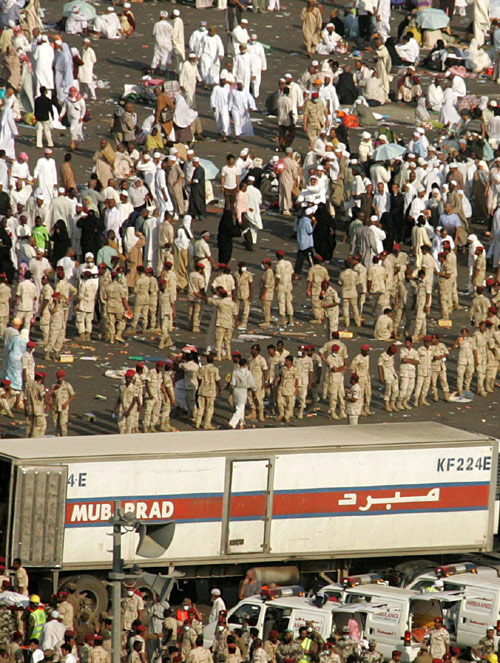
Bodies removed in Mena January 12, 2006. Photo: Reuters


In 2005 too, pilgrims tripped over luggage in Mina that caused tramplings resulting in at least 345 death - four were confirmed to be Chinese nationals. Several Chinese pilgrims were injured in the tragedy.
All the four were from Qinghai Province in western China - 62-year old Ma Taishan, 61-year old Ma Delin, 58-year old Sha Tianlu and a 49-year old woman Ru Geya.

About 20,000 Muslims gathered in Xining, capital of Northwest China's Qinghai Province prayed for the four deceased after religious leaders informed the Friday crowd of their identities.

Families of the four Chinese pilgrims, regarded such deaths predestined, were handed 50,000 yuan (US$6,200) each, from the China Islamic Association.

About 7,000 Chinese performed their Haj in 2006, 10,700 in 2007, 11,000 in 2008 and 12,700 in 2009.

******

The earliest Haj visit recorded in the historical literature of the Chinese ethnic Muslims was in the middle of the Ming Dynasty (1368 - 1644) when the famous Chinese navigator Zhen He (Cheng Ho 1371–1435), led his fleet to Mecca to perform Haj during one of his seven marine adventures.

The Chinese used to follow two routes to Mecca: the sea and the land.
The land route passed through the Hexi Corridor in Gansu - the most important route from North China to Central Asia for traders - passed Xinjiang, Central Asia, Iran, Iraq, Syria, Palestine and Egypt before crossing the Red Sea and reaching the Jeddah port.
The marine route started from Hong Kong and passed Myanmar and India until arriving at Jeddah port.
These travellers encountered difficulties in their efforts to reach Makkah for Haj - financial constrain, long journey and backward transportation means: They had to walk, carriage or horse-ride, or take another ship before reaching home.
The trip often took months, or even years that led to sufferings and death for many Chinese pilgrims.

******

After the People’s Republic of China was founded and with more liberal religious freedom policy, China Islamic Association, with its missions and duties of assisting the people's government in the implementation of the policy of freedom of religion, was formed in July 1952.

The national organisation represent Muslims of all ethnic groups, unifying them in participating in the socialist construction of the motherland and to cherish it.
Its establishment placed a bridge between China's Muslims of different ethnicities.

The association's main tasks, beside The Haj Office being responsible for bringing together people of different nationalities to perform Haj,
- its Academic Department involved in implementing Islamic regulations within the context of service activities, to hold training of teaching personnel to attend the masses religious issues.
- to meet the requirements and interpretation of social development and - The Offices Operational Agencies promote Islamic associations and mosques around the country and serve the community.
- The Research Department identifies and colllects Islamic historical data and the cultural heritage beside books compilation and publication, and
- The International Department is task with relationship promotion with Muslim countries.

******

The Office of Haj's team of 16 pilgrims set off for Saudi Arabia in 1952.
For some reason, they returned home after reaching Pakistan.

In 1955, the late Chinese Prime Minister Zhou Enlai (1898 -1976), after meeting with Prince Faisal of Saudi Arabia (1904 - 1975) in Bali, a 20-member Chinese team were approved of their Haj visas, thus accomplished their Haj mission.
Between 1955 and 1964, China organised 10 Haj trips to Mecca attended by altogether 132 pilgrims.

However, the trips came to a stop after the Cultural Revolution in China but the pilgrimage resumed again, after a lapse of fourteen years.

The Chinese government used to allocate part of the foreign currency quota for Haj pilgrims, even when the country was faced with foreign currencies shortage.
It facilitated visits to their relatives in Saudi Arabia too.

Despite forbidden to perform pilgrimage during the Cultural Revolution, the persistent Chinese still attended to the callings through Pakistan, until the reverse in policy in 1979.
When the 80s came, Chinese pilgrims paid their own expenses. They were responsible for their own fare, no more allocations from the Chinese government.
Despite the self-funded Haj trips, the number of Chinese pilgrims grown considerably to 2,200 in 1985.

In 1986, the government gave its support for the organised Chinese Haj team - The organisation has been incorporated into the government management tasks. 
To help Muslims perform their pilgrimage and striving towards excellent management of the pilgrims, it provided all-round service for the Chinese.

China Islamic Association sent its first Haj Team on the field, in the same year.
It helped the pilgrims with Haj visa application, ticketing, traffic, accommodation and all formalities in Karachi and Islamabad in Pakistan, and Jeddah, Mecca and Madinah in Saudi Arabia as diplomatic relations with Saudi Arabia was not established, then.

In 1989, China and Saudi Arabia reached an agreement to set up business offices in each other’s capital city. To facilitate the Haj for its Muslims, the Chinese government once arranged six chartered flights directly to Jeddah and helped 900 Chinese pilgrims get visas on arrival.
In July 1990, the two countries established diplomatic relations, thus laying the foundation to cooperate in politics, economy and culture and making it easier for pilgrims to perform Haj and get consular protection.

April 2001, the government set up the China Islamic Association, described as aiming to "help the spread of the Qur'an in China and oppose religious extremism". It is run by 16 religious leaders, in charge of making "a correct and authoritative interpretation" of Islamic creed.
With the awareness, in 2003, more than 3,000 people in the Ningxia Hui Autonomous Region alone, performed their religious call - contrary to 1988 when only 15 pilgrims made their journey.
The mostly farmers pilgrims - along with imams from some mosques - paid more than 30,000 yuan (US$3,627) for the pilgrimage.
By then, more than 45,000 Chinese had done so. Beside direct flight, they were provided with Arabic interpreters and health workers too.

******


In 2004, more than 4,000 Chinese performed their Haj. 

30 Chinese pilgrims from Gansu were pushed to the ground in a stampede that took away 244 lives - five were from China.

******

In 2004, the government - working with China Islamic Association - to safeguard the interests and legitimate rights of the Haj pilgrims and facilitating the trips, issued the Regulations on Religious Affairs - the first comprehensive decree regulating the religious affairs.
In accordance with the Article XI in the Regulations, “The national Islamic organisation is responsible for organising the Chinese citizens holding Islam as their belief to go on Haj overseas.”
The article conveyed two messages: Clarifies and protects the basic rights of the Muslims going on Haj, which are not be infringed on by any organisation or individual, and designated the China Islamic Association as the main body of organising, managing and serving the teams and regulates that "no other organisation or individual" can organise the Haj teams as there were still illegal organisers that deceived pilgrims and some were forced out of their hotels to the streets - The legitimate rights and interests of the pilgrims, while abroad, are not guaranteed.

******

China, with official statistics recorded of around 23 million Muslims in more than 20 provinces, autonomous regions, and municipalities, is seeing a steep jump in the number of its Haj pilgrimage.

 The last 980 Chinese pilgrims for 2010, left Beijing on Wednesday evening aboard three chartered flights headed for Saudi Arabia.
 
Muslims gather in front of a mosque before going to an airport to leave for Mecca in Yinchuan, capital of northwest China's Ningxia Hui Autonomous Region, Oct. 31, 2009. A group of 297 Muslims took off from Yinchuan by chartered flight to Mecca for hajj Saturday. From Oct. 30 to Nov. 18, about 12,700 Muslims will go to the holy city for hajj in 41 chartered flights from Xinjiang, Gansu, Ningxia, Yunnan and Beijing. The number of pilgrims is 700 more than that of last year.
Gathering in front of a mosque before leaving for Mecca in Yinchuan, capital of northwest China's Ningxia Hui Autonomous Region


The first 2010 chartered flight from northwest China's Ningxia Hui Autonomous Region to Mecca took off on October 18, marking the start of pilgrims' annual journey from China's largest Hui community.

2,250 people from Ningxia, had left by seven chartered planes from Yinchuan, Ningxia's capital 
- An official with the regional religious bureau of Ningxia, 71 personnel, including doctors and interpreters, accompanied the pilgrims, helping them in the foreign country. 
- Fourteen imams, or senior and revered Muslims, accompanied them too, to help solving religious and Haj issues. 

The pilgrims, mostly farmers, paid 30,000 yuan (US$4,412). 
Ningxia, known as China's "Muslim province" has more than one third of its population - 2.1 million - are from Hui ethnic minority.

The number of Chinese pilgrims coming for Haj is seeing the ever increasing number.
This year, around 13,500* pilgrims had their spiritual callings answered.

*** 13,500* - Many papers claim the figure of 24,000. One of them is  here.


.

Monday, June 28, 2010

Money Temptation


A CERTIS Cisco vault assistant, who was in charge of keeping cash boxes and helped himself to S$50,000, was jailed 1 1/2 years on Monday. Worker Lim Ming Yao pleaded guilty in a district court to stealing the money and taking it to Malaysia.

The court heard that the 19-year-old started work at Certis Cisco in April.
As the vault assistant, the Malaysian was to assist the vault custodian in issuing and receiving these boxes containing cash for automated teller machines or holding the cash earnings of retail businesses.

On June 5, Lim cut open a box in the inner sanctum of the vault at the Certis Cisco Secure Logistics centre in Jalan Afifi and stuffed the money in his jeans pocket and later placed the money in a sling bag.
After his shift ended at 7am the next day, Lim signed out taking the sling bag full of money, and crossed over to Johor after 8am.

Certis Cisco reported the theft on June 9 - four days after the offence.

However, within weeks, Lim was tired of life on the run and surrendered himself with $41,150 and RM900 (S$380) on him.
Asking District Judge Lee Poh Choo for a lenient sentence, Lim said that he surrendered himself because he realised his mistake.

The Malaysian was jailed 1 1/2 years for stealing from his employer and jailed nine months for moving criminal proceeds amounting to $50,000 out of the country. As the sentences were ordered to run together, he will have to serve only 1 1/2 years in jail.