Showing posts with label pilgrimage. Show all posts

Tuesday, May 24, 2011

The Maid - Unholy Acts In The Holiest Place (11)

Daring Escape

A newly arrived Asian housemaid, in her 20s, had a fall three days ago, from the third floor of a residential building in Alkhobar, eastern town of Damman, Saudi Arabia.

She made the run away attempt from the seventh floor apartment through a kitchen window.
She then clung to pipes stuck to the building and started to slide down.
Upon reaching the third floor, the pipes collapsed due to her weight and she hit the ground, where she met the fatal fall.
Arab News reported she was rushed to a hospital with serious injuries but later died at the hospital.

******

Another death fall befell on a housemaid in her 40s, in an attempt to flee her sponsor's house in Makkah.

She was trying to escape through sanitary pipes along with her personal belongings.
Okaz / Saudi Gazzette reported the “homesick” housemaid arrived in the Kingdom two months ago in March, only to find death the next month, in the second week of April.

The housemaid suffered multiple fractures of her arms and legs.
She suffered from brain hemorrhage too, which caused her death.

******

Early this year, January 12, Arabic language daily Almadina reported yet another Indonesian housemaid's death.

The female migrant worker sneaked through the bathroom’s window in an attempt to flee her employer.
She went up to the roof of the the fourth floor building in the central town of Makkah.
Once there, she found a rope, dangled it down to reach the ground.
She then tried to climb down using the rope, but lost her balance and plunged down.

The maid laid on the ground for nearly 15 minutes before she died.

She was found by residents who were leaving a mosque after prayers.

****** 


Photo: ist
PT Aji Ayahbunda Sejati (AAS), flew then 19-year old Armayeh binti Sanuri, from Teluk Lerang, Kuala Mandor, in the district of Kuala Mandor, Pontianak, West Kalimantan, to Saudi Arabia.

She started working for the family of Hasim Ahmad Ali Bader Saeni and Madam Hanan Hasim in Madinah on March 24, 2009.

Armayeh admitted of receiving almost daily abuse and mistreatment from her female employer since the third month into her job.

Wounds and pus on her head.

Her head was often stepped on.

She suffered infectious ears, and were almost torn-like.

She was poured hot water too.

She could bear no longer. 
She seized the opportunity to flee from her working place when the door was not locked.

With wounds all over, she fled on January 26 at 3.30pm.

A neighbour, another Saudi citizen, who happened to spot her critical plight, helped to rush her to Al Ansar Hospital in Madinah at 10pm.

The medical staff immediately called the Indonesian Consulate General.
The Indonesian Consulate has agreements with some Saudi hospitals to notify the embassy or consulate, should an Indonesian national be admitted.

Armayeh's serious condition led her hospital stay transferred to King Fahad Hospital in Jeddah.
She underwent plastic surgery performed by team from King Abdullah Hospital at 1am.
She is currently, still receiving treatment.

Her female employer, Madam Hanan Hasin had been arrested.
Before the arrest was made, her employer visited Armayeh at the hospital.
The girl was offered SR18,000 (Rp 52.9 million) for her change of statement.
The offer was flatly turned down.

Although her salary is SR800 per month, she had just sent home SR6.000 Riyal (Rp 14,3 million) to her parents, during her 23 months stint in the Kingdom.

PT Aji Ayahbunda Sejati (AAS), who made Armayeh's presence possible in Saudi Arabia, bear full responsibility of the girl's welfare.

Her family was provided initial financial assistance of Rp 25 million (SR10,500), with insurance of Rp 100 million yet to receive.

PT Aji Ayah Bunda Sejati brought the parents of now 20-year old Armayeh binti Sanuri, to Saudi Arabia to see first hand of their daughter's condition.
The company provides their needs while in Saudi.

****** 

From Frying Pan To Fire Runaway Maids End Up In Harsher Conditions

JEDDAH: Housemaids who flee their sponsors due to bad working conditions to seek work in the black labor market often end up in a situation of jumping out of the frying pan and into the fire.
In many cases they find themselves at the mercy of sleazy labor brokers who send them to work illegally in conditions that are little different from the legal situations, and often much worse. 
“They seize our IDs, lock us up in secluded rooms and make us live in very difficult conditions, which is no less than indentured servitude,” a maid told Arab News on condition she not be named.
Nuriyyah, an Indonesian maid who has been working for two years in Saudi Arabia, describes the situation she found herself in as “slavery” after being legally recruited and brought to the Kingdom. The wage she ended up receiving was not enough to feed her family back home.
“My sponsor often delayed my payment under the pretext that he had other pressing commitments,” she said. “I had no other choice but to flee.”
Nuriyyah said she lived in a small apartment after her escape with a large number of illegal housemaids who came for Haj or Umrah and overstayed their pilgrimage visas.  She said the man who ran the house essentially acted as an illegal-labor broker.
But what Nuriyyah discovered is that people who hire maids illegally often end up being worse than employers who seek workers through legal channels and at greater expense.  “The new employer and his wife used to beat and humiliate me all the time,” she said. “They also took my iqama. I served them for my food only.”
The maid says she has never been paid for her work. Eventually she fled her illegal employers. She ended up under the Sitteen Bridge, a congregation point for foreign laborers who have fled their sponsors in the hope they will be picked up by the police and deported.
Another Indonesian maid, who did not want to be named, said though she had been an adventurer all her life and would work hard to earn money, she had fears that she might fall victim to inhuman practices on the hands of her new employers.
“I now live in a small house with a large number of illegal African and Asian housemaids,” she said. “The brokers who distribute us among their customers do not care much for what will happen to us. They are only after money.”
She added that she was living in very difficult conditions in this house but her need for money would force her to continue.
The unidentified Indonesian housemaid said she witnessed her co-workers being beaten by merciless employers who know that illegal domestic servants are essentially hostages with few choices.
“Many housemaids had similar experiences but were finally able to make some money and go back home. In order to succeed, you have to take chances,” she said.
Commenting on the issue, spokesman for Jeddah police Col. Misfer Al-Juaid said many of the houses that accommodate runaway maids are found in the districts of Al-Bawadi, Ghulail and Kandara.
“We carry out weekly raids on such houses after identifying them,” he said. “We arrest the illegal residents, take their fingerprints before handing them over to the Passport Department for deportation.”
After these workers end up in the custody of Saudi immigration authorities, a long process for exit clearance takes place. Often these workers have no ID because their passports are with the employers from whom they fled. Saudi authorities must work with foreign missions to establish identities and check for criminal backgrounds before they can be sent home. 
Al-Juaid pointed out that an illegal worker can be exposed to more abuse than legal workers, because sponsors are aware that there is little recourse for reporting or challenging abusive situations. “The illegal housemaids bear all these inhuman treatment in order not to be caught by the passport police and sent back home,” he added.
The most common form of maid abuse is not paying salaries, followed by physical and sexual abuse. The Saudi authorities do not offer statistics of the number of abuse cases reported to them, but the problem is acute enough that labor rights activists and foreign missions – especially of Indonesia and the Philippines – maintain shelters for fleeing maids, especially women.
Supervisor of the National Society for Human Rights in Makkah province Hussain Al-Sharif described violence against housemaids as inhuman and un-Islamic.
“Just because they are paying them money, some employers will come to believe that they literally own their housemaids and they have the right to ask them to do anything,” he said.
Al-Sharif agreed with Al-Juaid, saying that illegal workers face a greater chance of being abused with impunity.
“Violence against housemaids, whether they are legal or illegal stayers, is inhuman and totally against Islam,” he added. “We completely reject such practices and deplore exploitation of any human being.”
Al-Sharif asked all employers to consider the pressing conditions that drove the housemaids to come all they way from their countries in the first place. The main reason is remittances, the money they can save up to send home to feed their children or other family members. Not paying a maid could mean a child back home goes without food, clothing or medicines.

Source: A1 Saudi Arabia - January 12, 2011

to be continued...

Monday, November 22, 2010

The Haj - Mina's Environment Issues And Ka'abah's Pulling Force

Haj pilgrims had all symbolically stoned iblis in Mina, the barren valley that is surrounded by rocky hills.
The five-level car-park like structure around the three Jamrah sites had allowed for a smooth flow for the symbolic act of self-purification.
This year, forecasted rain had swept Mina.
It thus disrupted pilgrims' retreat for Mecca, Madinah and home as the Haj season drew to a close.
The final rituals of the Haj, Tawaf Wida' performed, then these pilgrims will leave Makkatul Mukarramah.


It was reported the downpour had resulted in an ankle-deep water.
It has flooded all streets from Mina to Mecca.
Pilgrims, especially those who squatted on pavements and in public spaces in Mina, were caught off guard.
The rain was never in one's mind.
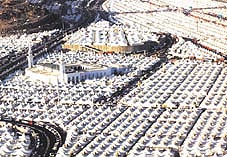
City of tents, Mina Click to view high resolution version

The Prophet s.a.w., stayed in Mina area during His Haj.
The stay had been ritually followed.
And staying arrangements had since been made throughout the centuries, nearly filling up the entire Mina area with tents to fit up to three million people. 

Mina is with two faces: 
Outside the Haj season, it's a haunting zero occupant white tent city. 
But come Dzulhijjah, it's abuzz with human activities - rituals and business - that makes it almost impossible to walk in the streets.

During the Haj season, Mina Tent City is injected with bodies and souls of Haj pilgrims.
What is there to say about Haj as being an eye opener in Mina?
Three to four million people from all walks of life, all over the woid, occupied the city for an average of only three days in a year, all at the same time.

Organising such a amssive event is no mean feat. The organisers deserve en-mass praises for the continuous effort in making one's Haj a safe journey. More praises for themif it is eternally etched in a memorable, significant moment of being close to GOD.

****** 

But after deeply engrossed in prayers for HIS acceptance, making up any shortcomings of the past, praying like there is no tomorrow in 'Arafah, praying for all the very best, and We ask everything that We wanted more than needed, these people, Myself too, contributed environment issues where they, and Myself too, left Our footprints behind. 

Authorities face the daunting task of cleaning up, after pilgrims turned the tents and streets into garbage dump, that pervaded every open space.

Rain or sunshine, the streets of Mina were bound to be with patches of coloured water on the road surface, and littered with all kinds of trash.

Pilgrims and traders create rubbish mould pretty fast - faster than the place can be cleared of all trash.
Should simple and sensible "no littering everywhere classes", be conducted and included in the pre-Haj courses too?

The unsightly amount of garbage all around, makes one wonder, where's the saying that cleanliness is part of the believe.
These old habit of littering and leaving litters meant nothing to irresponsible pilgrims.

Even when we picked them up and cleared them in front of their very eyes, they bat no eyelid, or at their very best, they pretended not to see anything.
Purification, being part of Islamic faith is yet being ignored.

******

The first thing needs to be done before each prayer is in a state of ablution.
Being clean is always the demarcation of being into the religion and GOD's acceptance.
But in Mina, where's the religious value being placed? 
Is it left at home when old habit of littering around is in tow?

Binmen could be seen toiling and pushing overflowing bins, sweeping the streets and loading large garbage containers onto lorries.
The number of  7,000 workers to clean The Holy Cities round-the-clock, I doubt is sufficient to help clean the cities.

******

Some people were adamant of 'answering ALLAH's call. 
Unable or unwilling to bear the cost, they would find their own spiritual journey ways to sneak into Mecca, 'Arafah, Muzdalifah and Mina. 
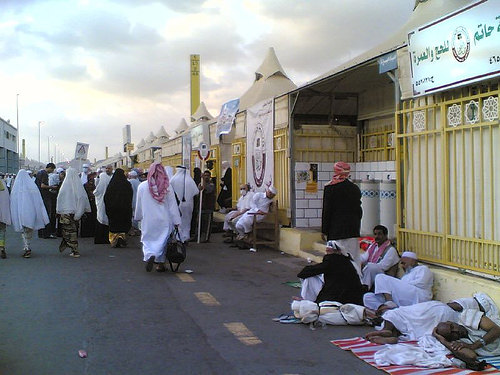
They armed themselves with carpets, straw mats, or simply discarded cardboard boxes for them to take a rest by the roadside, or any vacant place for that matter. 
They did not mind the unclean tarmac, walked on by millions sandals and shoes.

These adamant pilgrims sleep on pavements and under the bridges too.

Colourful blankets and carpets were spread in open spaces and some camped in the street

Pilgrims with young children had their meals at the place surrounded with trash flowed out. 
It can be scattered around bin amidst growing litters around them.
Rubbish grew faster than they could be collected.

Some were used to the surroundings, they did not mind dirt and rubbish as their situation back home was of no difference.

Cleanliness, the basic hygiene tenet, is obviously ignored.
Pray in such environment?
GOD answers them, not us.

Police turned a blind eye on them, thus walking around could cause chaos. 
Pilgrims could be found sleeping on th streets. 
they could be seen fighting for space too. ace too.
They were all over the streets, that led to slowed down moving vehicles and pedestrians' movements. 


.
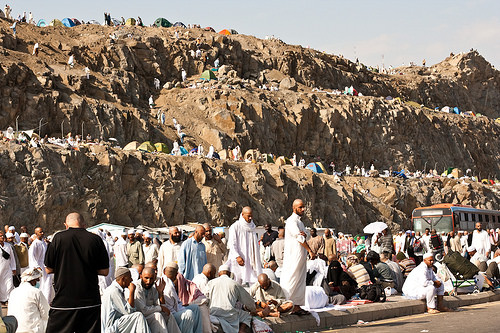
Photos: Muslimmatters.

Unofficial tents perched on rocky terraces and hills too. 
Some pitched their tents at steep inclines on the mountainsides and on top of the mountains too.

****** 

I was in Mina in 2001 for Haji Ifrad flying from Singapore to Jeddah and 2005 for Haji Tamattu', flying from JB straight to Madinah Airport.
On both occasions, thank GOD, I was lucky for being with the right agency.

For the Ifrad, we flew from Singapore to Jeddah, left our luggage in Hilton and did our Tawaf Qudum before leaving for 'Arafah.

In Mina, we were given two places - the tents, which were very near to the Jamrah sites, or an apartment in Shisha, within Aziziyah which is in between Makkah and Mina.
For the elderlies and those who had no issue with public toilets and sharing with tens of others, the tents was  the answer but the majority of us, we chose Shisha, less than half an hour's walk to the Jamrahs.
After all, Shisha itself ends where Jamrah starts.

The three Jamrah sites, before my 2005 Haj, were only tall pillars with low circular walls which some enthusiastic pilgrims would accidentally threw pebbles at others, on the opposite side. 
No distance or toilet issues arise when I was in Shisha as we would walk to the tents after 'Asr, had the night prayers in the tents and left at midhight for Jamrah sites.
Our tents which were left almost empty, with only a few number of the agency's own pilgrims during daytime,  were usually occupied by pilgrims from another Singapore tour agency who did not book another accommodation in Aziziyah.

Even then, an elderly lady in her late 60s, lost her direction on our way to Jamrah sites, when our group of around 130 was intercepted midway, by one of the big number of few hundred Indonesian group.
For two days, there was a frantic search for her, although she was known to be always independent, always on her feet, raring to explore new places.
Thanks a million to Malaysian Tabung Haji as she was finally sent back to Hilton by its staff, dirty clothings, crying and shivering, traumatised by the temporary disappearance incident.

Although an unlikely story, but for that two days, she was not provided with any food or drinks as, according to her, some of the Indonesian pilgrims claimed Singaporeans, like her, are loaded with money, so there was no need of them to provide her with compassionate free meals.
Only GOD knows why.
Days followed in Mecca, Madinah and Jeddah, transformation to a mellowed person in her, followed too...

******

When I did my Haj 2005, for safety reason and as not to allow pebbles flying across, the relevant authority had erected a 26 m (85') long walls around the three Jamrahs.
A single tiered Jamrah bridge, meant for pedestrians, was built around them too, so pilgrims could cast their pebbles from either the ground level or from the bridge, if it was daytime.

There was once when we had to wait in the tents, as the scheduled after Zohor Jamrah time was postponed to after Magrib because of sudden crowd.
Despite the stern warning, few men defied the order and went ahead to perform the ritual after the Zohor prayers, as it was said they had to make several turns as they had to perform on behalf of their parents.

When one of the men did not came back with the group he went with, the search team was not even allowed to go out doing their duty as there was great sandstorm blowing.
It was only after two hours can the search be resumed, and he was found lifeless because of fatigue.

The sudden overcrowded one of the Jamrah's place was caused by luggage fell from a bus, thus causing a bottleneck.
Some pilgrims tripped on them and those who were tripped were then crushed by the wave of people behind them that led to a stampede causing 345 deaths.

Because of the postponement, we made do with the pavement to wait after midnight, for the the next day's pebble casting to save the three and a half kilometre walking journey back to the tents.
To reach Jamrahs, we had to pass through the three and a half kilometre Muassim tunnel which in 1990, 1,426 lives were snapped away just because of movement flows of pre and post Jamrahs were not in proper queue. 
The Muassim stampede led to the regulation of all Haj pilgrims needed to wear bracelets with self and country's identity, and blood group too, for instant identification in emergency cases.

Just a week earlier, four Malaysians were among 76 people killed when Al Ghaza hotel collapsed in Mecca.

******

Unlike the Haj 2001, this time in 2005, we stayed at Mina Tent City for a few days.
The three days in the big but crowded tent-stay, made me realise why the previous Haj agency did not mind to spend extra for the Shisha stay to avoid physical discomfort for many.

Although courses for processes and procedures, dos and don'ts were organised years ahead and prospective pilgrims' attendance reminders after reminders were mailed home, one is hard to leave home the signatured old habits, cultural and personal beliefs and to attach with them only the stamped real religious practice.

It could be a taxing period for some, creeping up their nerves with ceaseless coughings from one end of the tent to another.
Getting sick is one's health but to spread germs to others, its cruel.

Leaving spitted tissue lying around is disgusting.
It will expose germs and spreading it around in the air.
Personal hygiene lost in thin air, sure is the most unkindest act to other Haj  pilgrims.
The sacred Haj spirit is lost too.

If everybody acknowledge of not contributing to make matters worst, then in no time, hearing coughings and  seeing spittings is but a once upon a time story of a long, long time ago Haj.
Action taken there and then will shorten the Mina's living discomfort, no denials about that.
Let the Mina stay be a clean, healthy and sick free stay.

Sad to note when some pilgrims found Zamzam not drinkable, not even meant for health when the water had miraculously flowing from its source, underneath the Ka'abah, amidst the barren desert of Mecca for over 4,000 years.

It's best I think, to firstly prepare our veryselves, with correcting our very own innerselves and our daily habits before to psychologically preparing for any unbecoming disgusting inborn attitude of others, and the unbecoming health act of theirs.
Prepare ouselves for the worst, InsyaALLLAH, our minds are all prepared for the next unpredictable scene.
The shock of the least expected of others' daily lives may not be too shocking as to affect our psychology that played in our minds that may place doubts in us and our beliefs. 
Listen and learn not only to accept the rewards of Haj, but also the trying, negative aspects of the masses process, lest, it will come as a big shock.

******

For a peaceful shower in Mina, one needs to head the toilet at 3.00a.m.
Showering in the day time is a no, as we will invite bangings on toilet doors.
For just relieving oneself, be prepared to spent at least half an hour in the queue alone.
Ablution in Mina is done best with handy bottled water.

It's good to always having tissue, wet wipes and bottled water within our reach, and possibly, bring them to the toilet too.
No one knows when to open the tap with no running water.

Some toilets may come as a shock:
Either we get used to it - some people entering and walking out of the toilets without seeing anything or pretending nothing unpleasant is around - or, we shun them all, for days ahead.
But for some who lives and places toilet cleanliness and hygiene at the topmost of this Haj pilgrimage, toilet issues can go a long way.
The pilgrimage can be dreaded for life.

Hundreds of people share the units of toilets within the same tent area in Mina, thousands in 'Arafah and Muzdalifah, and millions in areas of Masjidil Haram and Masjidin Nabawi.
Pilgrims from the world over, bringing along with them good and evil hearts and habits, congregate into the Holy Cities to perform their rites and rituals, thus allowing toilet users to use and abuse it, all behind close doors.

Honestly, I've been to toilets in areas of Masjidil Haram for just a couple of times, and found many women with children, sleep and I think, stay there too.

I've never been to toilets nearby Masjidin Nabawi but looking back, the minor detail of toilet issues did not occupy My mind.
All these health and toilet issues will fade into insignificance, as Haj by itself, is such an amazing experience.

Haj experience is one undescribable beautiful memories that is hard to be pen even by best writers too. Suffice to say, the memory always bring out the best in each individual.

I've been to places in other countries, that fared much worse than the batnrooms and toilets in Mina

- An open air toilet in running river, men's section at the lowest end, where one has just to perch on the bridge across it, above women's section, to have the full bird's eye view.

- Toilets in remote forested boarding school, in mountainous area, were just big holes dug deep into the ground.
Stench emitted will get stuck to us,felt like vomiting it out from us. It upset our stomach.

- Mountain top home toilet with just a foot high bamboo partition sans its door, and

- Toilets in exclusive restaurants with the traditional doorless - no doors at all.
All activities inside the cubicles are for all the toilet users and passers' by eyes.

Just to name a few which I can think of, as now.

The toilets in The Holy Cities itself had to deal with thousands of people all over the world.
It is impossible to have its own time to clean itself unless, the users themselves clean it after each use - as how they want it to be sparkling clean all the time, for their own use.

****** 

This year,  Arab News  reported that over 1,500 Pakistani pilgrims shouted slogans against the Pakistani mission outside their 2 tents, at the edge of Muzdalifah.

Quoting Zulqarnain Ahmad,
“As per our package and arrangement with the mutawwif we were promised breakfast, lunch, dinner and even dry fruits, but we did not get anything. Furthermore there are neither bedsheets nor pillows in our camps. And above all there is no water, which has made the situation worse, compelling us to come out and protest.”

A similar situation occurred for some 800 Qatar pilgrims, including 250 women.
Although they were provided good hotels in Madinah, their tour operator did not make arrangement for their stay in Mina.
Only two tents were provided - all 250 women were accommodated in one tent, and around 200 elderly pilgrims in another - the rest had to make do with the pavements.
The tents were temporary ones erected using pipes and tarpaulin with no air conditioners or toilets.
They were agitated about the lack of of basic amenities in their tents in Mina on their first day in the valley.

In 1997, fire took 340 lives and injuring some 1,500 others.
Since then, steps were taken ensuring all 40,000 durable fireproof tents and cooling systems being placed.

******

These news sobers me enough but the urge to always be there is as great as ever.

The mention of Haj is enough to brim one's eyes with tears, chocked us with emotion.masjid-nabawi

It gives us another perspective of how much The Prophet s.a.w. and His Companions r.a. went through, in order to get the message of Haj directly passed to us, fourteen centuries later, in its originality, although the twenty first century's Haj has been made easiest for us, in a more bearable universality of the Haj atmosphere.

Haj, the perfection of faith, with its most basic meaning translates to an act of continuous strive in reaching one’s goal.
The rigourous rituals which had just been tasked to all recent pilgrims of diverse nationalities, as according to The Prophet s.a.w., in his last Haj sermon, is to convey the meaning and message of the rituals they had just performed, to those in their homelands irrespective of faith, who were not present during the world's greatest spiritual assembly.

Haj pilgrimage is best summarised as spiritual journey to reach HIM, taken by humans who are just mere physical creatures possessed by THE ONE beyond the material world.

'Whoever performs Haj and does not commit any wrongdoing, they'll be in the state of pure', as it's best said.

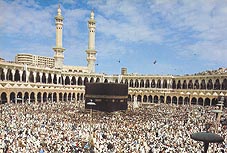
Ka'abah is gravititional.
Kaaba in the Grand Mosque
Ka'abah is very inviting, to lay bare our hearts and souls all for HIM to see.

Pilgrims from distant land come to Mecca or Baca as in the  bible
(Psalm 84:
5.Blessed is the man whose strength is in thee; in whose heart are the ways of them.
6.Who passing through the valley of Baca make it a well; the rain also filleth the pools.
7.They go from strength to strength, every one of them in Zion appeareth before God),
to be part of the whirling scene, likened to orbiting planets, never strayed away from the designated path, until THE CREATOR call it the day.

The experiences and emotions to be put ito words???
The very inviting Ka'abah invites all sincere guests - Be truthful to ownself.
Its JUST OWNER selects HIS guests: So Be One Of Them.
People from all walks of life, bringing with them plentiful of requests and needs.
Bring more and more of ours, too.

SubhaanALLAAH
The seeing is believing experiences had transformed many pilgrims, if not all, for the betterment in leading ones life.
It's all about amazement, from the niat to the tahallul, amazing and relieved for being able to complete the challenging journey of Haj.

Turning over a new leaf, a changed person, feeling physically, mentally and spiritually cleansed, it's all part of HIS acceptance.
A fresh, spotless new chapter in one's life journey continues...