
"Chinese?"
Then He was shown the escalator to the second floor, I supposed, when He nodded.
I followed Him from behind, about to escalate, when the guard in Masjidil Haram stopped me.
"Malaysia," he said as he pointed to the straight path ahead on the ground floor.
At that moment, He realised He was mistaken again as a Chinese pilgrim from China.
That was in 2005, when we did our Haj.

Way back in 2005, I used to see Chinese pilgrims, after their 'Isyak prayer, on the way back, would carry fresh chickens, vegetables and groceries to cook.
They passed by the place we stay at Habibah, some 300 metres from The Grand Mosque.
They walked further uphill, not sure their living place, though.
On our part, there were a lot of daily food wastage as each pilgrim's portion was the same - men and women.
To top that, not all Malaysian pilgrims have Johor taste-bud, as the food was prepared by Johoreans.
I told the personnel in charge of food distributions about giving the extras to the Chinese, but complain of not getting food is the thing they did not want to hear.
Gladly, at least after that, dinner not taken at the cut-off time was finally brought down to be distributed to the Chinese pilgrims or any passers-by.
******
In 2005, the China Islamic Association established the Haj Working Office.
Aside from the establishment of the provincial religious and ethnic administrations, it also organises and serves ethnic Muslim pilgrims in China.
The number of Chinese pilgrims increased significantly, thus their presence were felt and seen, projecting its economic stability, ethnic unity and the international image of China.
With the growing number of pilgrims, China Islamic Association began to study, thus gradually improving the management system of the Chinese Haj affairs and formed the regulated, institutionalised and regular mechanism of Haj work.
On the invitation of Saudi Arabia and working together with the Saudi Haj Ministry and other supervising and service agencies, the association, summarised the service of the previous Haj and makes plans for the coming year, to ensure that the Chinese can accomplish their pilgrimage.
The association set a target of the “safe, orderly and well-conducted Haj”.
It was in 2005 too, the Chinese government, to shorten the travel duration and reduce the cost of Haj, launched the pilgrimage direct flight from Lanzhou, Northwest China's Gansu Province, Yinchuan and Kunming, Beijing, and Urumqi too.
In the same year, it was said, about 2,000 Kyrgyzstan places were taken by the Chinese using Kyrgyz passports
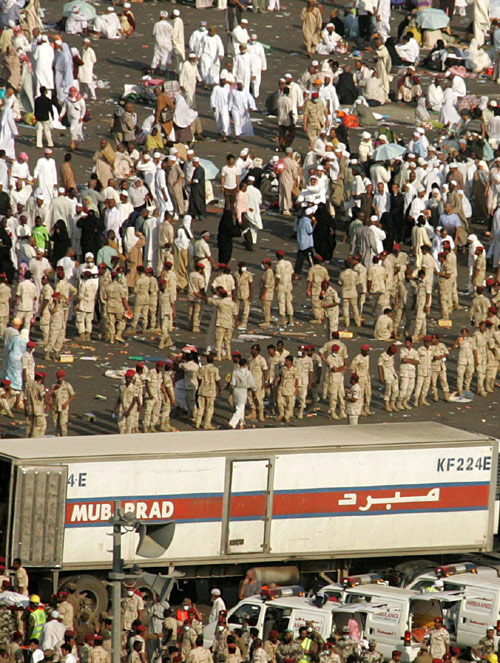 Bodies removed in Mena January 12, 2006. Photo: Reuters |
| |
In 2005 too, pilgrims tripped over luggage in Mina that caused tramplings resulting in at least 345 death - four were confirmed to be Chinese nationals. Several Chinese pilgrims were injured in the tragedy.
All the four were from Qinghai Province in western China - 62-year old Ma Taishan, 61-year old Ma Delin, 58-year old Sha Tianlu and a 49-year old woman Ru Geya.
About 20,000 Muslims gathered in Xining, capital of Northwest China's Qinghai Province prayed for the four deceased after religious leaders informed the Friday crowd of their identities.
Families of the four Chinese pilgrims, regarded such deaths predestined, were handed 50,000 yuan (US$6,200) each, from the China Islamic Association.
About 7,000 Chinese performed their Haj in 2006, 10,700 in 2007, 11,000 in 2008 and 12,700 in 2009.
******
The earliest Haj visit recorded in the historical literature of the Chinese ethnic Muslims was in the middle of the Ming Dynasty (1368 - 1644) when the famous Chinese navigator Zhen He (Cheng Ho 1371–1435), led his fleet to Mecca to perform Haj during one of his seven marine adventures.
The Chinese used to follow two routes to Mecca: the sea and the land.
The land route passed through the Hexi Corridor in Gansu - the most important route from North China to Central Asia for traders - passed Xinjiang, Central Asia, Iran, Iraq, Syria, Palestine and Egypt before crossing the Red Sea and reaching the Jeddah port.
The marine route started from Hong Kong and passed Myanmar and India until arriving at Jeddah port.
These travellers encountered difficulties in their efforts to reach Makkah for Haj - financial constrain, long journey and backward transportation means: They had to walk, carriage or horse-ride, or take another ship before reaching home.
The trip often took months, or even years that led to sufferings and death for many Chinese pilgrims.
******
After the People’s Republic of China was founded and with more liberal religious freedom policy, China Islamic Association, with its missions and duties of assisting the people's government in the implementation of the policy of freedom of religion, was formed in July 1952.
The national organisation represent Muslims of all ethnic groups, unifying them in participating in the socialist construction of the motherland and to cherish it.
Its establishment placed a bridge between China's Muslims of different ethnicities.
The association's main tasks, beside The Haj Office being responsible for bringing together people of different nationalities to perform Haj,
- its Academic Department involved in implementing Islamic regulations within the context of service activities, to hold training of teaching personnel to attend the masses religious issues.
- to meet the requirements and interpretation of social development and - The Offices Operational Agencies promote Islamic associations and mosques around the country and serve the community.
- The Research Department identifies and colllects Islamic historical data and the cultural heritage beside books compilation and publication, and
- The International Department is task with relationship promotion with Muslim countries.
******
The Office of Haj's team of 16 pilgrims set off for Saudi Arabia in 1952.
For some reason, they returned home after reaching Pakistan.
In 1955, the late Chinese Prime Minister Zhou Enlai (1898 -1976), after meeting with Prince Faisal of Saudi Arabia (1904 - 1975) in Bali, a 20-member Chinese team were approved of their Haj visas, thus accomplished their Haj mission.
Between 1955 and 1964, China organised 10 Haj trips to Mecca attended by altogether 132 pilgrims.
However, the trips came to a stop after the Cultural Revolution in China but the pilgrimage resumed again, after a lapse of fourteen years.
The Chinese government used to allocate part of the foreign currency quota for Haj pilgrims, even when the country was faced with foreign currencies shortage.
It facilitated visits to their relatives in Saudi Arabia too.
Despite forbidden to perform pilgrimage during the Cultural Revolution, the persistent Chinese still attended to the callings through Pakistan, until the reverse in policy in 1979.
When the 80s came, Chinese pilgrims paid their own expenses. They were responsible for their own fare, no more allocations from the Chinese government.
Despite the self-funded Haj trips, the number of Chinese pilgrims grown considerably to 2,200 in 1985.
In 1986, the government gave its support for the organised Chinese Haj team - The organisation has been incorporated into the government management tasks.
To help Muslims perform their pilgrimage and striving towards excellent management of the pilgrims, it provided all-round service for the Chinese.
China Islamic Association sent its first Haj Team on the field, in the same year.
It helped the pilgrims with Haj visa application, ticketing, traffic, accommodation and all formalities in Karachi and Islamabad in Pakistan, and Jeddah, Mecca and Madinah in Saudi Arabia as diplomatic relations with Saudi Arabia was not established, then.
In 1989, China and Saudi Arabia reached an agreement to set up business offices in each other’s capital city. To facilitate the Haj for its Muslims, the Chinese government once arranged six chartered flights directly to Jeddah and helped 900 Chinese pilgrims get visas on arrival.
In July 1990, the two countries established diplomatic relations, thus laying the foundation to cooperate in politics, economy and culture and making it easier for pilgrims to perform Haj and get consular protection.
April 2001, the government set up the China Islamic Association, described as aiming to "help the spread of the Qur'an in China and oppose religious extremism". It is run by 16 religious leaders, in charge of making "a correct and authoritative interpretation" of Islamic creed.
With the awareness, in 2003, more than 3,000 people in the Ningxia Hui Autonomous Region alone, performed their religious call - contrary to 1988 when only 15 pilgrims made their journey.
The mostly farmers pilgrims - along with imams from some mosques - paid more than 30,000 yuan (US$3,627) for the pilgrimage.
By then, more than 45,000 Chinese had done so. Beside direct flight, they were provided with Arabic interpreters and health workers too.
******

In 2004, more than 4,000 Chinese performed their Haj.
30 Chinese pilgrims from Gansu were pushed to the ground in a stampede that took away 244 lives - five were from China.
******
In 2004, the government - working with China Islamic Association - to safeguard the interests and legitimate rights of the Haj pilgrims and facilitating the trips, issued the Regulations on Religious Affairs - the first comprehensive decree regulating the religious affairs.
In accordance with the Article XI in the Regulations, “The national Islamic organisation is responsible for organising the Chinese citizens holding Islam as their belief to go on Haj overseas.”
The article conveyed two messages: Clarifies and protects the basic rights of the Muslims going on Haj, which are not be infringed on by any organisation or individual, and designated the China Islamic Association as the main body of organising, managing and serving the teams and regulates that "no other organisation or individual" can organise the Haj teams as there were still illegal organisers that deceived pilgrims and some were forced out of their hotels to the streets - The legitimate rights and interests of the pilgrims, while abroad, are not guaranteed.
******
The last 980 Chinese pilgrims for 2010, left Beijing on Wednesday evening aboard three chartered flights headed for Saudi Arabia.
 |
Gathering in front of a mosque before leaving for Mecca in Yinchuan, capital of northwest China's Ningxia Hui Autonomous Region |
The first 2010 chartered flight from northwest China's Ningxia Hui Autonomous Region to Mecca took off on October 18, marking the start of pilgrims' annual journey from China's largest Hui community.
2,250 people from Ningxia, had left by seven chartered planes from Yinchuan, Ningxia's capital
- An official with the regional religious bureau of Ningxia, 71 personnel, including doctors and interpreters, accompanied the pilgrims, helping them in the foreign country.
- Fourteen imams, or senior and revered Muslims, accompanied them too, to help solving religious and Haj issues.
The pilgrims, mostly farmers, paid 30,000 yuan (US$4,412).
Ningxia, known as China's "Muslim province" has more than one third of its population - 2.1 million - are from Hui ethnic minority.
The number of Chinese pilgrims coming for Haj is seeing the ever increasing number.
This year, around 13,500* pilgrims had their spiritual callings answered.
*** 13,500* - Many papers claim the figure of 24,000. One of them is here.
.


