Showing posts with label regulation. Show all posts

Thursday, June 30, 2011

The Choicest Rotten Meat (2)

Sex Business Is Booming In Singapore      
By Philip Lim 

SINGAPORE, Friday 4 March 2011 (AFP) - Standing outside a harmless-looking two-storey terrace house, a middle-aged man with a balding pate and wispy white goatee greets people walking by with a constant refrain.

"You want to see my girl? Come in, come in!" he exhorts every man in sight, pointing to skimpily-clad Asian prostitutes waiting in a softly-lit sitting room along a back street in Geylang, Singapore's red-light district.
The tout says more than 50 customers patronise his business daily.

"Our customers are international, anybody can come as long as they can pay," he says, brushing aside a reporter's suggestion that the police might not approve of his operation.

"We're legal!" he scoffs loudly.

Despite its prudish reputation -- the government still bans magazines like Playboy and Penthouse -- Singapore allows prostitution to thrive in strictly designated areas, and Geylang is the largest and most famous.

Brothels operating out of houses -- one calls itself "Heaven on Earth" -- operate in the district alongside budget hotels, sidewalk cafes, community associations and even Buddhist temples.

Despite the presence of legal prostitution, foreign women on short-term visitor passes also ply their trade on the streets and lanes of Geylang, and there seems to be enough business for everyone.

More than a fifth of the island state's population of five million are foreigners, the majority of them blue-collar and manual workers.

And one million tourists a month now visit Singapore thanks to a booming casino industry.
The local sex trade came under the spotlight in June last year when the US State Department downgraded Singapore in its Trafficking in Persons (TIP) report.

The report said some women from China, the Philippines and Thailand were tricked into coming to the city-state with promises of legitimate employment and then coerced into the sex trade after arrival.

Singapore authorities issued an indignant reply, saying their efforts to curb trafficking had not slackened and asking the US government to look at its own immigration record before commenting on other countries' situations.

In Geylang's licensed brothels, customers pay an average of Sg$50 ($38) for sex inside cramped cubicles, according to operators who spoke on condition of anonymity.

Their primary customers are the masses of testosterone-driven guest workers from China, Bangladesh and Southeast Asia.

Business is best on weekends when hordes of foreign men on their day off throng its narrow lanes looking for fun.

Like other businesses in Singapore, the sex trade has clear rules.

Brothels can only hire Malaysian, Thai and Chinese girls between the ages of 21 and 27, said one tout.

Prostitutes are also required to make customers wear condoms and report for monthly medical check-ups, he added.

Streetwalker Dan Dan, a Beijing native who refused to disclose her real name, said an increased presence of plainclothes police was deterring customers from taking up her 100-dollar "guaranteed good" service.

Foreign women like Dan Dan who work freelance in the sex trade and bring customers to motel rooms cannot be arrested unless they are caught offering their services out in the street, or violate immigration and other laws.

For a first offence, Dan Dan faces a fine of up to Sg$1,000 if she is caught soliciting in public, with subsequent convictions carrying higher fines and potential jail terms.

But Dan Dan, who has been working Geylang's alleys since she came to Singapore three months ago, said she was willing to brave the consequences.

"The money's good on busy days," she said.

Local women's rights activist Braema Mathi advocates protection of prostitutes in Singapore and closer regulation of the industry.

"All we want is for the women to be protected and not judge them for the work that they have decided to take on," she told AFP.

"We believe that one of the better ways to protect women is to ensure that they work in licensed brothels, where there is a fee structure and condoms," Mathi added.

"This way the women can be protected from exploitation and from succumbing to diseases."

With a regulated sex industry, Singapore authorities can turn their attention to women forced into prostitution, she said.

"We see more women in the trade and definitely not all of them are willing."

Source: My SinChew - March 4, 2011

****** 

The Brothel in Singapore: Karin's True Story of Slavery 
by Amanda Kloer


Traffickers lure victims in a number of ways, but one common technique is to promise a job opportunity, often abroad.  Sometimes, that job turns out to be slavery in the industry the promised job was in, and sometimes that job is forced prostitution.  This is the story of Karin, from the U.S. Department of State Office to Monitor and Combat Trafficking in Persons.
Karin, a young mother of two, was looking for a job in Sri Lanka when a man befriended her and convinced her that she could land a better job in Singapore as a waitress. He arranged and paid for her travel. A Sri Lankan woman met Karin upon arrival in Singapore, confiscated her passport, and took her to a hotel. The woman made it clear that Karin had to submit to prostitution to pay back the money it cost for her to be flown into Singapore. Karin was taken to an open space for sale in the sex market where she joined women from Indonesia, Thailand, India, and China to be inspected and purchased by men from Pakistan, India, China, Indonesia, and Africa. The men would take the women to nearby hotels and rape them. Karin was forced to have sex with an average of 15 men a day. She developed a serious illness and three months after her arrival was arrested by the Singaporean police during a raid on the brothel. She was deported to Sri Lanka.
Sadly, not many stories of trafficking end happily, or even with the victim getting needed services.  Karin's story illustrates the vast work which needs to still be done.

Source: News.change.org - April 1, 2009

Thursday, June 2, 2011

When Ethics Losing Out To Logics

Free Market Babies And Reproductive Tourism 
As egg sales, IVF and surrogacy become more common and commercial, a conflict arises between social justice and profit.
Donna Dickenson

Does India need a new independence struggle?

The fight this time would not be against British colonialism, but rather against the United Kingdom's approach to regulating reproductive medicine. At a time when India is considering a sort of match-making service for Western couples seeking to hire Indian surrogate mothers, the UK government has announced the abolition of two leading medical regulatory agencies.

Meanwhile, as these countries move farther down the road to free markets in reproductive medicine, France is debating all of its bioethics laws - and continuing to stand up for a different model - focused on social justice and protection of vulnerable women. There is an alternative simply to letting the market decide, the French Assembly insists.

At some point, many countries are likely to find themselves embroiled in similar debates and controversies over reproductive rights and obligations. So it is necessary to clarify what is at stake in how we regulate - or de-regulate - in vitro fertilisation (IVF), egg sales, and surrogacy.

It may come as a surprise to observers in the US, in particular, that the British approach could be considered "free market". After all, the UK forbids outright payment for eggs, whereas in the United States, a highly differentiated market has grown up around "consumer demand". And the UK has a national regulatory agency for IVF, whereas the US has a patchwork of state regulations (or a lack thereof).

But the UK's Human Fertilisation and Embryology Authority (HFEA) might not be around for much longer. Prime Minister David Cameron's government announced in July that it intended to abolish the HFEA by 2014, along with the Human Tissue Authority, which deals with non-reproductive tissues. Already, the HFEA appears to be attempting to preempt the government by softening its regulatory touch.

Last month, the HFEA finished a consultation on increasing the level of "expenses" payable for eggs used in IVF. European law forbids outright payment for eggs, but the Authority suggests that increasing "expenses" considerably would not constitute an impermissible inducement. The HFEA is merely "removing disincentives", not "creating incentives". You could be forgiven for missing the difference.

Proponents of the Assisted Reproductive Technologies Regulation Bill 2010, now before the Indian Parliament, employ a similar rhetorical twist. They say that the bill actually protects surrogate mothers - for example, by limiting the number of pregnancies they can undergo. But the law would make surrogacy contracts legally binding, requiring the mother to give up the baby even if she changes her mind.

Opponents say that the agencies making the arrangements will be the biggest winners - that the huge profits they reap will dwarf the fees paid by foreign couples to the women bearing their children. As NB Sarojini and Aastha Sharma wrote in the Indian Journal of Medical Ethics, "The Bill actively promotes medical tourism in India for reproductive purposes." 

Reproductive tourism

France, like most European countries, has a problem with reproductive tourism: a yearly shortage of about 700 egg donors sends some couples over the Pyrenees to Spain, where private IVF clinics pay providers more in "expenses" than the UK allows. Even so, the draft bill continues to prohibit payment for eggs.

And it's not just France's official ethics committee that takes an anti-commodification stance. The French have recently conducted a series of two-day meetings in several provincial cities. In Rennes, the panel debating reproductive medical issues supported the policy of not paying for eggs or sperm - not even by the back door of increasing the level of "expenses".

While the HFEA document calls for ethical concerns to be "balanced" against increasing egg supply, French Assembly members insist that law, morality, and progress are compatible. They reject the view that ethics is optional, even though some influential professors, such as Rene Frydman, who helped to create the first French IVF baby, have warned that France will fall behind in the science race unless it abandons its principles. The upper house, the Senate, was much more minded to listen to that view, so the outcome is still uncertain.

France is no Shangri-La, isolated from global markets or the pressures of international research. In the words of Emmanuel Hirsch, professor of medical ethics at the University of Paris-XI, "How long can our bioethical standards continue to resist the rise of other logics - particularly financial ones?"

To be sure, French regulation can be heavy-handed. For example, IVF is restricted to heterosexual couples who are married or in long-term relationships. The official rationale was that eggs and sperm are not commodities, but gifts from a fertile couple to an infertile one.

That is also one reason why the French restricted egg donation to women who had already had at least one baby (though this is being changed).

But the limitation to heterosexual couples was rightly condemned as homophobic by the French public in the consultations. So the draft bill has been amended to allow lesbian women to receive donated eggs. Gay men will still be barred, because they would require a surrogate, and surrogacy remains prohibited.

That sort of responsiveness to popular sentiment in the legislative process gives the lie to the canard that French regulation is inflexible and hopelessly bureaucratic. In fact, the free-market "Anglo-Saxon" attitude sounds like nothing so much as the old prejudices about the French that have been around since the novelist Thackeray told English readers: "The Frenchman has after his soup a dish of vegetables, where you have one of meat. You are a different and superior animal - a French-beating animal."

Of course, we now know that a diet of bully beef is likely to result in hardening of the arteries, whereas the vegetable-centered Mediterranean diet is much better for human health. Enough said? 

Donna Dickenson, Emeritus Professor of Medical Ethics and Humanities at the University of London, won the International Spinoza Lens Award in 2006 for contributions to public debate on ethics. Her latest book is Body Shopping: Converting Body Parts to Profit.

A version of this article was previously published on the Project Syndicate.

The views expressed in this article are the author's own and do not necessarily represent Al Jazeera's editorial policy. 

Source: AlJazeera - May 30, 2011

Thursday, January 6, 2011

5 Hrs In Malaysia, 30 Hrs In UK

A Man Sits In His For 5 Hours To Prevent It From Being Taken Away


Saravanan Abbu
NO WAY! Saravanan's colleagues taking turns to sit in the car while negotiations were ongoing at the police station. They were afraid it would have been towed away — Pic: Gan Jin Liang

PETALING JAYA: A man whose car was about to be towed away by Petaling Jaya City Council officers for parking on a yellow line created a ruckus when he refused to get out of his vehicle.
"You can't tow my car with me in it. I won't get out," he insisted during the five-hour standoff.
The fiasco began about 12.30pm yesterday when credit services assistant manager Saravanan Abbu, 35, was having lunch at a restaurant in Section 8 when he saw council officers attempting to tow away his illegally-parked Honda City.
He rushed to his car and apologised to the council officers who were hooking up his car to a tow truck.
He pleaded with them to issue him a summons instead.
When they ignored his plea, and knowing a car cannot be towed with a passenger inside, he got into the driver's seat.
"I wouldn't have done so if the car was already hooked up to the truck and moving.
"I would have gladly acknowledged my fault and followed procedures," said Saravanan, adding the officers were only in the midst of hooking up the car to the truck and they could have considered his plea.
"They hadn't towed it yet, but still they wouldn't accept my plea for a straightforward summons, which is why I decided to sit in the car."
To break the impasse, police were called in.
"We were informed this standoff was causing traffic congestion. So, we urged both parties to go to the PJ police headquarters instead to settle the matter," said one of the police officers called to the scene.
He said police could not interfere in such a case as all they could do was provide security if things went out of control.
"The council has its own guidelines and rules. We can't interfere."
At the PJ police headquarters, both parties lodged separate reports on the incident.
The council officers alleged Saravanan was obstructing when they were carrying out their duties while Saravanan's complaint was against them attempting to tow away his car despite his early presence at the scene.
After an hour of discussion mediated by an inspector at the police headquarters, the matter was eventually settled with Saravanan paying a RM270 fine, after negotiating it down from RM310.
While these negotiations took place, Saravanan's colleagues took turns to sit in the car as he was afraid it would be towed while he was away.
Saravanan remains unhappy with the council and plans to take the case further.
"All I care now is I've got back my car and I need to get back to work."
Said council spokesperson: "We were only carrying out our duties following the rules. He was obstructing our duties and wasting our time.
"We had to call the police as Saravanan was adamant on staying in his car despite numerous attempts by our officers to explain our regulations to him."

******

Similar Cases In UK Too

Reported on Aug 17, 2010
HAROON ZAFARYAB was returning from Ramadan prayers last August when he found his car clamped for being parked illegally on private property.
The Daily Mail had then reported Haroon was met by an official who demanded £100 (RM477) for the clamping fine and an extra £265 for a tow truck which had been called to haul his Toyota Prius away even though the car was clearly still there.
While admitting he had failed to see a small notice saying he had parked on private property, Haroon said he knew the officials were trying to rip him off.
Furious at the cost and knowing a car cannot be towed with a passenger inside, he decided to get into the driver's seat in protest.
So he sat inside for 30 hours to prevent it from being towed away. Two tow trucks turned up for an around-the-clock watch on Haroon.
Residents in the local area cheered Haroon on and provided him with refreshments and treats to keep his energy up. Some of his friends also arrived to show their support.
As he was planted inside the vehicle, police clamped all four wheels and stuck about 40 more tickets onto the windshield, amounting to £3,565 in fines.
Haroon even called lawyers, who said the police were just trying to scare him. They advised him to stick it out.
Finally, after 30 hours, his car was finally released after he paid a £100 ($156) fine for parking on private land without a permit.

******

Reported on Sept 23, 2008
ANOTHER British driver had also managed to escape paying a parking fine of £250 in September 2008 by refusing to leave his car for almost three hours.
Tow truck workers, who had loaded his BMW 5 Series onto their truck, gave in and lowered it back down after the man claimed to have been asleep in the back seat.
Known as Mr Shah , the 29-year-old personal trainer later admitted he had actually hopped onto the tow truck and got into the driver's seat as the attendants looked the other way.
Alerted by his neighbours of his car being loaded onto the truck, he later described the feat as a victory escaping the fine. It would have cost him £250 if they had taken it to the pound.
He admitted he was in the wrong but said he had not understood the parking signs near his West London house when he parked on a single yellow line in Beaconsfield Terrace Road, West Kensington.
Not only refusing to get out, he also sat in the car reading the papers, listening to music and even ordered a sandwich from the cafe nearby.
The police came around and the owner of the tow company arrived but Shah was still adamant, and in the end, they got frustrated and released the car.

Friday, November 5, 2010

The Haj - Chinese Pilgrims, Then And Now

Photo:<!--###IMAGE_BRIEF###-->

"Chinese?"
Then He was shown the escalator to the second floor, I supposed, when He nodded.

I followed Him from behind, about to escalate, when the guard in Masjidil Haram stopped me.

"Malaysia," he said as he pointed to the straight path ahead on the ground floor.

At that moment, He realised He was mistaken again as a Chinese pilgrim from China.
That was in  2005, when we did our Haj.


Way back in 2005, I used to see Chinese pilgrims, after their 'Isyak prayer, on the way back, would carry fresh chickens, vegetables and groceries to cook.
They passed by the place we stay at Habibah, some 300 metres from The Grand Mosque. 
They walked further uphill, not sure their living place, though.

On our part, there were a lot of daily  food wastage  as each pilgrim's portion was the same - men and women. 
To top that, not all Malaysian pilgrims have Johor taste-bud, as the food was prepared by Johoreans.

I told the personnel in charge of food distributions about giving the extras to the Chinese, but complain of not getting food is the thing they did not want to hear.

Gladly, at least after that, dinner not taken at the cut-off time was finally brought down to be distributed to the Chinese pilgrims or any passers-by.

******

In 2005, the China Islamic Association established the Haj Working Office.
Aside from the establishment of the provincial religious and ethnic administrations, it also organises and serves ethnic Muslim pilgrims in China.

The number of Chinese pilgrims increased significantly, thus their presence were felt and seen, projecting its economic stability, ethnic unity and the international image of China.
With the growing number of pilgrims, China Islamic Association began to study, thus gradually improving the management system of the Chinese Haj affairs and formed the regulated, institutionalised and regular mechanism of Haj work.

On the invitation of Saudi Arabia and working together with the Saudi Haj Ministry and other supervising and service agencies, the association, summarised the service of the previous Haj and makes plans for the coming year, to ensure that the Chinese can accomplish their pilgrimage.
The association set a target of the “safe, orderly and well-conducted Haj”.

It was in 2005 too, the Chinese government, to shorten the travel duration and reduce the cost of Haj, launched the pilgrimage direct flight from Lanzhou, Northwest China's Gansu Province, Yinchuan and Kunming, Beijing, and Urumqi too.
In the same year, it was said, about 2,000 Kyrgyzstan places were taken by the Chinese using Kyrgyz passports


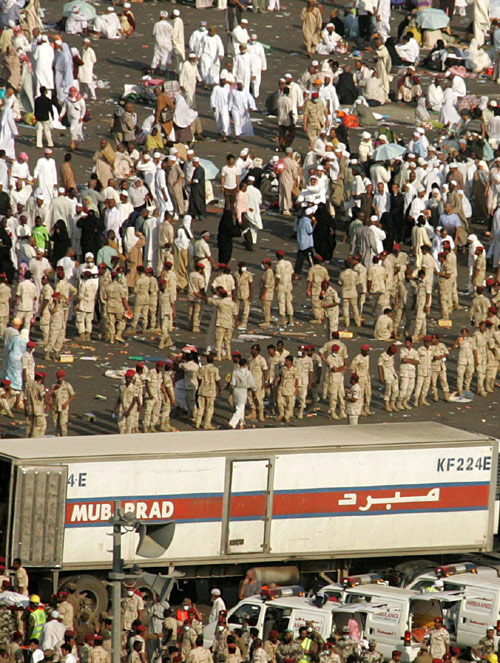
Bodies removed in Mena January 12, 2006. Photo: Reuters


In 2005 too, pilgrims tripped over luggage in Mina that caused tramplings resulting in at least 345 death - four were confirmed to be Chinese nationals. Several Chinese pilgrims were injured in the tragedy.
All the four were from Qinghai Province in western China - 62-year old Ma Taishan, 61-year old Ma Delin, 58-year old Sha Tianlu and a 49-year old woman Ru Geya.

About 20,000 Muslims gathered in Xining, capital of Northwest China's Qinghai Province prayed for the four deceased after religious leaders informed the Friday crowd of their identities.

Families of the four Chinese pilgrims, regarded such deaths predestined, were handed 50,000 yuan (US$6,200) each, from the China Islamic Association.

About 7,000 Chinese performed their Haj in 2006, 10,700 in 2007, 11,000 in 2008 and 12,700 in 2009.

******

The earliest Haj visit recorded in the historical literature of the Chinese ethnic Muslims was in the middle of the Ming Dynasty (1368 - 1644) when the famous Chinese navigator Zhen He (Cheng Ho 1371–1435), led his fleet to Mecca to perform Haj during one of his seven marine adventures.

The Chinese used to follow two routes to Mecca: the sea and the land.
The land route passed through the Hexi Corridor in Gansu - the most important route from North China to Central Asia for traders - passed Xinjiang, Central Asia, Iran, Iraq, Syria, Palestine and Egypt before crossing the Red Sea and reaching the Jeddah port.
The marine route started from Hong Kong and passed Myanmar and India until arriving at Jeddah port.
These travellers encountered difficulties in their efforts to reach Makkah for Haj - financial constrain, long journey and backward transportation means: They had to walk, carriage or horse-ride, or take another ship before reaching home.
The trip often took months, or even years that led to sufferings and death for many Chinese pilgrims.

******

After the People’s Republic of China was founded and with more liberal religious freedom policy, China Islamic Association, with its missions and duties of assisting the people's government in the implementation of the policy of freedom of religion, was formed in July 1952.

The national organisation represent Muslims of all ethnic groups, unifying them in participating in the socialist construction of the motherland and to cherish it.
Its establishment placed a bridge between China's Muslims of different ethnicities.

The association's main tasks, beside The Haj Office being responsible for bringing together people of different nationalities to perform Haj,
- its Academic Department involved in implementing Islamic regulations within the context of service activities, to hold training of teaching personnel to attend the masses religious issues.
- to meet the requirements and interpretation of social development and - The Offices Operational Agencies promote Islamic associations and mosques around the country and serve the community.
- The Research Department identifies and colllects Islamic historical data and the cultural heritage beside books compilation and publication, and
- The International Department is task with relationship promotion with Muslim countries.

******

The Office of Haj's team of 16 pilgrims set off for Saudi Arabia in 1952.
For some reason, they returned home after reaching Pakistan.

In 1955, the late Chinese Prime Minister Zhou Enlai (1898 -1976), after meeting with Prince Faisal of Saudi Arabia (1904 - 1975) in Bali, a 20-member Chinese team were approved of their Haj visas, thus accomplished their Haj mission.
Between 1955 and 1964, China organised 10 Haj trips to Mecca attended by altogether 132 pilgrims.

However, the trips came to a stop after the Cultural Revolution in China but the pilgrimage resumed again, after a lapse of fourteen years.

The Chinese government used to allocate part of the foreign currency quota for Haj pilgrims, even when the country was faced with foreign currencies shortage.
It facilitated visits to their relatives in Saudi Arabia too.

Despite forbidden to perform pilgrimage during the Cultural Revolution, the persistent Chinese still attended to the callings through Pakistan, until the reverse in policy in 1979.
When the 80s came, Chinese pilgrims paid their own expenses. They were responsible for their own fare, no more allocations from the Chinese government.
Despite the self-funded Haj trips, the number of Chinese pilgrims grown considerably to 2,200 in 1985.

In 1986, the government gave its support for the organised Chinese Haj team - The organisation has been incorporated into the government management tasks. 
To help Muslims perform their pilgrimage and striving towards excellent management of the pilgrims, it provided all-round service for the Chinese.

China Islamic Association sent its first Haj Team on the field, in the same year.
It helped the pilgrims with Haj visa application, ticketing, traffic, accommodation and all formalities in Karachi and Islamabad in Pakistan, and Jeddah, Mecca and Madinah in Saudi Arabia as diplomatic relations with Saudi Arabia was not established, then.

In 1989, China and Saudi Arabia reached an agreement to set up business offices in each other’s capital city. To facilitate the Haj for its Muslims, the Chinese government once arranged six chartered flights directly to Jeddah and helped 900 Chinese pilgrims get visas on arrival.
In July 1990, the two countries established diplomatic relations, thus laying the foundation to cooperate in politics, economy and culture and making it easier for pilgrims to perform Haj and get consular protection.

April 2001, the government set up the China Islamic Association, described as aiming to "help the spread of the Qur'an in China and oppose religious extremism". It is run by 16 religious leaders, in charge of making "a correct and authoritative interpretation" of Islamic creed.
With the awareness, in 2003, more than 3,000 people in the Ningxia Hui Autonomous Region alone, performed their religious call - contrary to 1988 when only 15 pilgrims made their journey.
The mostly farmers pilgrims - along with imams from some mosques - paid more than 30,000 yuan (US$3,627) for the pilgrimage.
By then, more than 45,000 Chinese had done so. Beside direct flight, they were provided with Arabic interpreters and health workers too.

******


In 2004, more than 4,000 Chinese performed their Haj. 

30 Chinese pilgrims from Gansu were pushed to the ground in a stampede that took away 244 lives - five were from China.

******

In 2004, the government - working with China Islamic Association - to safeguard the interests and legitimate rights of the Haj pilgrims and facilitating the trips, issued the Regulations on Religious Affairs - the first comprehensive decree regulating the religious affairs.
In accordance with the Article XI in the Regulations, “The national Islamic organisation is responsible for organising the Chinese citizens holding Islam as their belief to go on Haj overseas.”
The article conveyed two messages: Clarifies and protects the basic rights of the Muslims going on Haj, which are not be infringed on by any organisation or individual, and designated the China Islamic Association as the main body of organising, managing and serving the teams and regulates that "no other organisation or individual" can organise the Haj teams as there were still illegal organisers that deceived pilgrims and some were forced out of their hotels to the streets - The legitimate rights and interests of the pilgrims, while abroad, are not guaranteed.

******

China, with official statistics recorded of around 23 million Muslims in more than 20 provinces, autonomous regions, and municipalities, is seeing a steep jump in the number of its Haj pilgrimage.

 The last 980 Chinese pilgrims for 2010, left Beijing on Wednesday evening aboard three chartered flights headed for Saudi Arabia.
 
Muslims gather in front of a mosque before going to an airport to leave for Mecca in Yinchuan, capital of northwest China's Ningxia Hui Autonomous Region, Oct. 31, 2009. A group of 297 Muslims took off from Yinchuan by chartered flight to Mecca for hajj Saturday. From Oct. 30 to Nov. 18, about 12,700 Muslims will go to the holy city for hajj in 41 chartered flights from Xinjiang, Gansu, Ningxia, Yunnan and Beijing. The number of pilgrims is 700 more than that of last year.
Gathering in front of a mosque before leaving for Mecca in Yinchuan, capital of northwest China's Ningxia Hui Autonomous Region


The first 2010 chartered flight from northwest China's Ningxia Hui Autonomous Region to Mecca took off on October 18, marking the start of pilgrims' annual journey from China's largest Hui community.

2,250 people from Ningxia, had left by seven chartered planes from Yinchuan, Ningxia's capital 
- An official with the regional religious bureau of Ningxia, 71 personnel, including doctors and interpreters, accompanied the pilgrims, helping them in the foreign country. 
- Fourteen imams, or senior and revered Muslims, accompanied them too, to help solving religious and Haj issues. 

The pilgrims, mostly farmers, paid 30,000 yuan (US$4,412). 
Ningxia, known as China's "Muslim province" has more than one third of its population - 2.1 million - are from Hui ethnic minority.

The number of Chinese pilgrims coming for Haj is seeing the ever increasing number.
This year, around 13,500* pilgrims had their spiritual callings answered.

*** 13,500* - Many papers claim the figure of 24,000. One of them is  here.


.