Showing posts with label economy. Show all posts

Tuesday, June 7, 2011

President? George Yeo Yong-Boon

Papers had reported 15 representatives of former Foreign Minister George Yeo, between the age of 16 and 41, were at the Elections Department at about 1pm yesterday, to collect forms for a certificate of eligibility for him to contest the Presidential Elections. 

The supporters said they are hopeful Mr Yeo will run for the Presidential Election.
The youths are very comfortable with Mr Yeo's brand of leadership as he has devoted a considerable amount of time interacting with young people.
He had often speak and listen to them in informal groups and organised dialogues.  
Thus, they believe Mr Yeo is the type of leader the younger generation will rally around, since he had made an earlier promise to engage the younger generation. 

The promise had made him more appealing to them, and these youths really wish for a free-spirited Mr President who will be able to communicate openly and very open to new ideas when meeting new people, from all walks of life. 
Mr Yeo is known to have attended and supports many youth driven community projects and events.
He is said to be "energised" by the younger generation and "constantly learns from them". 

Mr Yeo is known to be close to the people on the ground, the very most important essence to these youths, someone who is able to have a sense of the people.

A 36-year-old Lien We King said he received a phone call from Mr Yeo on Sunday evening, asking him to help collect the forms on his behalf.

Mr Yeo had left for Taiwan yesterday morning, to offer his gratitude and thanks in person to the Tzu Chi Stem Cell Center for saving the life of his leukemia patient son. 
The stem cell centre had given his son a bone marrow transplant.

He is expected to return to Singapore in 10 days time. 
The forms will then be passed on to him. 

****** 

Mr Yeo was the first Singaporean Minister to start blogging, and he had blogged since August 2006
.
He then moved on to Facebook and is one of the most active Singaporean politician on it, with over 85,000 friends and supporters. 

On Sunday, on his Facebook page, Mr Yeo wrote,
'In case the presidential election writ is issued while I'm away, some young friends will collect the eligibility forms for me.
'It is a big decision which I hope to make two weeks from now after taking in views n advice from many people. I ask for your patience n understanding.'

Mr Yeo had earlier ruled himself out as a presidential candidate, despite numerous calls for him to run after he lost his seat in Parliament in the recent General Election.
His People's Action Party (PAP) team was defeated by the Workers' Party in Aljunied GRC.

After 23-years in politics, and following his intended exit, Mr George Yeo finally spoke the unspoken that there is a deep resentment among Singaporeans towards the ruling party.
He called on the PAP to listen harder, and to take into account people’s unease over the pace of change driven by globalisation.

Mr George Yeo is considered one of the more liberal-minded ministers in the PAP.
He feedbacked the ground sentiments to PM Lee that not just the question about policies, not just the minds, but the hearts needed address too.

Prime Minister Lee Hsien Loong then frankly apologise publicly for the regime’s mistakes during a lunchtime rally at UOB.

******

Earlier, when asked about running for president, Mr Yeo told a press conference on May 10 that he did not think he was 'temperamentally suited for such a job' as he considered himself 'a free spirit'.

However, he sparked off online discussion after announcing on Wednesday, June 1, that he was 'thinking hard' about reconsidering running for President.

His just two short lines posted,  
'Many Singaporeans from different walks of life, young and old, have asked me to reconsider my decision on the Presidency, some impassionately,' he wrote.

About reconsidering running for President, 'Thinking hard about it and praying for wisdom.' 

******

If Mr Yeo does contest in the Presidential Election, he would be the second candidate from the PAP to do so.

His Facebook post had attracted more than 2,000 'likes' and more than 700 comments from netizens, most of whom supported him being a candidate in the upcoming presidential election.
He is set to be the more popular choice for President.

His experience in different ministries will be useful in carrying out presidential duties, since he had established diplomatic foreign relationships with important politicians of other countries.

Mr Yeo was part of the People's Action Party (PAP) team which contested in the recent May 7 General Election.
PAP team lost the Aljunied GRC constituency to The Workers’ Party team, with 54.71% of the votes.

In the recent General Elections, many voters has shown unhappiness with the ruling party, but this negative sentiment does not seem to extend to Mr Yeo.
The former Foreign Minister is still very popular and many have lamented that he is a victim of the Group Representative Constituency (GRC) Scheme.

In a twist of an event, now, Mr George Yeo Yong-Boon has a very definite advantage of he running for President. 

The first person to contest in the presidential Election is the former MP Tan Cheng Bock. 
Unlike Mr George Yeo who is still a member of the ruling party's central executive committee, Dr Tan has since resigned from the PAP. 

****** ****** ****** 

George Yeo: A Man Of All Season  

As Singapore’s Foreign Minister of nearly seven years, Mr George Yeo will leave a legacy of strategic thinking, cultural diplomacy and friendship, writes Professor Tommy Koh

ONE of my hopes for the 2011 General Elections was that those who won would be magnanimous and those who lost would be gracious.
Foreign Minister George Yeo was gracious in defeat. In his concession speech, he congratulated Mr Low Thia Khiang and his Workers’ Party team on their victory and wished them success. Of the other defeated candidates, only Mr Desmond Choo of the People’s Action Party and Ms Nicole Seah of the National Solidarity Party were just as gracious.
A man’s character can be gleaned from his conduct, both in victory and in defeat. Mr Yeo is a gentleman and an honourable man, whatever the conditions.
I have had the pleasure of working under his leadership in three of his ministerial portfolios. He was our first minister of the then Ministry of Information and the Arts, or Mita. During nine years at Mita, he changed Singapore from a so-called cultural desert to a cultural oasis.
He appointed Mr Tan Chin Nam chairman of the newly created National Library Board-and Mr Tan, together with Mr Christopher Chia, revolutionised our library system and made it one of the best in the world. Mr Yeo also appointed Mr Lim Chee Onn chairman of the National Heritage Board, and me, chairman of the National Arts Council.
It was under his leadership that the Esplanade was built, the Asian Civilisations Museum was envisioned, the Arts Festival was made an annual event, the LaSalle College of the Arts took off, and the Government agreed, for the first time, to subsidise arts education. Today, Singaporeans enjoy a rich and varied cultural life. They should not forget the person who planted the seeds that have blossomed.
Mr Yeo brought the same energy, imagination and enthusiasm to the Ministry of Trade and Industry. He realised that because trade is Singapore’s life blood, it should play a proactive leadership role in global trade forums like the World Trade Organisation (WTO). He quickly won the admiration and trust of his peers. They asked him to chair the negotiations on agriculture, one of the most contentious issues. WTO director-general Pascal Lamy is an admirer of Mr Yeo.
In order to enlarge Singapore’s economic space, Mr Yeo championed the idea of linking Singapore’s economy with other economies by way of free trade agreements (FTAs) and comprehensive economic partnership (CEP) agreements. During his watch, he launched more than a dozen FTA and CEP negotiations.
He appointed me chief negotiator in our negotiations with the United States. During the journey of two years, we encountered many difficulties. Throughout, Mr Yeo remained calm, optimistic and creative. He worked relentlessly with the different stakeholders in the US to earn their support and to find acceptable solutions to the difficulties. In the final stage of the negotiations, there was a shortlist of issues that the two chief negotiators could not resolve. Those issues were finally resolved by Mr Yeo and his American counterpart, Mr Robert Zoellick, in a marathon negotiating session that extended through the night without dinner and ended successfully at dawn. Members of the Singapore delegation were deeply impressed by the cool and masterly way in which Mr Yeo had negotiated with Mr Zoellick.
Mr Yeo has been Singapore’s Foreign Minister for nearly seven years now. He inherited a ministry in good order as a result of the legacy of Mr S. Rajaratnam, Mr S. Dhanabalan, Mr Wong Kan Seng and Professor S. Jayakumar. What contributions did Mr Yeo make to that heritage? I would single out three.
First, he taught us to think strategically and to prioritise. He constantly asked his staff to ensure that our most important bilateral relationships were in excellent order. He scanned the horizon for new opportunities - such as in the Middle East and Latin America.
Second, he was the first foreign minister to use history and culture as instruments of diplomacy. He persuaded the Chinese Chamber of Commerce to restore the Sun Yat Sen Villa and to turn it into a historic site linking Singapore, China and Taiwan. He requested that the National Heritage Board restore the memorial to Subhas Chandra Bose, who is celebrated in India as a nationalist and independence fighter. It was due to the leadership of Mr Yeo, a Roman Catholic, and of former Indian president Abdul Kalam, a Muslim, that the ancient Buddhist university at Nalanda, Bihar is being reincarnated.
Third, Mr Yeo believes in the importance of friendship in diplomacy. He often invited his foreign guests to his home to have dinner with him and his family. He went out of his way to show warmth and friendship to his foreign interlocutors. When Tan Sri Syed Hamid Albar was Malaysia’s foreign minister, Mr Yeo visited him in his constituency in Malaysia to pay his respects during Hari Raya.
Mr Yeo is blessed with high IQ, EQ and CQ - cultural intelligence. He is an exceptionally gifted man. Although an engineer by training and a soldier by profession, he is also a philosopher and historian. Although a devout Roman Catholic, he is a champion of inter-faith dialogue and understanding. Mr George Yeo is ideally qualified to play a leadership role on the global stage, and I sincerely hope he will do so.

The writer is special adviser to the Institute of Policy Studies at the National University of Singapore.

Source: News Today - May 11, 2011

Thursday, November 25, 2010

Profit From The Poor

Fifty-four suicides in Andra Pradesh  have blown the lid off the social posturing by microfinance companies. Before the news of the deaths sank in, the country feted Vikram Akula, head of SKS Micro-finance, as the new messiah of microcredit. A 273 per cent growth in loan disbursement and returns to investors made him a national hero. India’s micro-finance institutions claim they followed the fabled Grameen Bank model of Bangla­desh. In reality, they went against its principles. And the government did not do enough; regulations are fleeting and they don’t touch where it hurts most: the high interest rates.
Richard Mahapatra reports from Andhra Pradesh. Arnab Pratim Dutta charts the growth trajectory of India’s microfinance institutions
imageAn SHG in Warangal’s Jawahar Colony meets to discuss joint liability in October (Photo: Sayantan Bera)Ega Mounika was born into debt, lived in debt and died with debts. The college-going 20-year-old of Warangal’s Karimabad village immolated herself on September 25; three days later, she died. “My daughter wanted to release us from debt,” said her father Laxmi Narayan who sustained burn injuries trying to rescue her. He owns a paan shop and always had debts, which is why no bank found him worthy of a loan. So five years ago, when a microfinance institution (MFI) approached her mother, a beedi roller, offering a loan of Rs 10,000, Mounika was quick to say yes. She bought a sewing machine with the money, started a tailoring business, dividing her time between studies and the new machine. “Things were fine for two weeks,” said Narayan, “then we began to default.” Loan repayment is usually weekly in microfinance.
That was how the family entered a labyrinth of debts; nobody knew the way out. They borrowed afresh to pay off old debts and sank deeper. The only way they could avoid default was by taking yet another loan. “We took four loans worth Rs 80,000 from four different companies,” Narayan said. But that was hardly a solution. The family earned Rs 4,500 a month and had to repay loan installments of Rs 10,000 a month. With five loans on their head, Mounika’s family had a loan installment to repay almost every day. Then there were the three emergency loans of Rs 5,000 from moneylenders at 120 per cent interest in the past three years. Every day for five years, MFI collection agents would come to their house and get rough. “There was no peace any more, the family was ruined,” Narayan said.
On September 25, the collection agents told Mounika’s mother, sell your daughter to the flesh trade and repay. Mounika chose to die. Even before the family could come out of shock, the agents were back at their door. When Narayan asked for time, they refused saying the business model of microfinance companies does not allow that. Had the borrower committed suicide, in this case Mounika’s mother, the lending company could have claimed the sum from the insurance company as all loans are insured. No wonder, people have alleged MFI agents abet suicide (see ‘How the noose tightens’,).

image


If I am not creditworthy why did four MFIs give me loan? I need both credit as well as support to help me set up business that will be viable


MANJULA GIRABENI, MFI customer, Warangal, Andhra Pradesh


Some 20 km away, Mohammad Saif of Jawahar Colony feels lucky. His mother attempted suicide on October 20 but survived. She got loans worth Rs 2 lakh from four companies. But even after paying for over 400 weeks, the outstanding amount is around Rs 1.5 lakh. Saif said he sold his autorickshaw; the small hotel they ran is shut down.
In 2006, his mother along with 13 other women in the neighbourhood, had formed a self-help group (SHG). Under the state government’s Indira Kranthi Patham programme—linking SHGs to banks for loans based on group savings—they saved money every month for a year to get a bank loan. Only three women got a loan from the SHG as regulations stipulate revolving loans. A year of saving and ensuring that everybody complies took time.
“I withdrew. Then a microfinance company came to my doorstep and gave me Rs 14,000,” said Sarojini Rathipilli, a resident. She set up a sari shop but with a sale of one sari in three or four days, she had to take another loan to repay the first one. In four years she accumulated four loans and weekly repayment that was 10 times her earning.
“Repayment takes away everything, even the business set up with MFI loans,” said Matapalli Radhika, a borrower. No business started with loans from MFIs has survived in Jawahar Colony, where almost every family has taken a loan. Now as they try to revive the SHG, the past default doesn’t qualify them to access loan from a bank. The alternative: moneylenders.
Village after village in Warangal only confirms that the rural credit business has undergone a suicidal makeover. There is great need for credit that is in short supply from benign sources like public sector banks. It becomes clear that every borrower from a microfinance company has suffered acutely because of the failures of other public credit programmes.
Advantage MFIs
Bhagyalaxmi Mahila Multi-aided Cooperative Society in Enugallu village in Warangal’s Parbutagiri block has a public credit programme that has not failed its borrowers. It has several SHGs as members and gets loans from nationalised banks showing group savings. The repayment rate has been encouraging at 80 per cent. The cooperative society, unlike microfinance companies, distributes profits among members; this year it gave a dividend totalling Rs 3 lakh and set aside Rs 5 lakh as revolving fund to attract more bank loans. “The 15 per cent interest is heaven compared to 36 per cent of the MFIs,” said Turi Laxmi, president of the cooperative.
But things are changing. Banks have suddenly stopped loans to the cooperative; they lend directly to SHGs. Bhagyalaxmi is an innovation. It has been recommended by many high-level government panels on rural credit. “The average loan amount with an SHG is not adequate. But banks refuse to recognise us,” said T Yugandhar of Sanghatitha Mahila MACS Federation, Andhra Pradesh, the apex body of such cooperative societies with over 2,174 SHGs as members. The cooperative got its last bank loan in April 2008. “Without immediate loans we will not be able lend to the rural poor. This obviously leaves space for MFIs to capture,” he said.
Rural India’s subprime crisis
Warangal’s story repeats itself in And­hra’s 22 other districts; it is constricted by a rural credit crisis. Around 75 per cent of India’s MFIs are located here.
The current crisis in Andhra Pradesh is the rural Indian version of the subprime crisis in the US in 2006. It started at the same time and with a similar unsustainable model of credit that involved high risk and high profit. In subprime lending, organisations give loans to people with poor credit worthiness. In the US, subprime lured many to multiple loans. But these loans had mortgages like the house or the car borrowers bought with the loan. MFIs adopted the same model but without a collateral. In the US lending companies took the hit while in Andhra Pradesh borrowers were crushed.
imageThe news of recent suicide deaths provoked workers of a political party to vandalise the office of an MFI in WarangalAccording to information submitted by MFIs on October 29 to the state government, 50 per cent of rural poor households in the state have taken multiple loans. The interest rate ranges from 21.2 per cent to 60.5 per cent.
Down To Earth accessed these MFI submissions and found more than 80 per cent borrowers are from non-farm sectors. The majority of the rural poor sought loans to sell vegetables, run a dairy or do scrap and steel business. MFIs lend close to Rs 200 crore every week to non-farmers. According to a confidential report prepared by the Society for Elimination of Rural Poverty (SERP), state government body linking SHGs with banks for credits, of the 54 suicides in the state recently, allegedly due to harassment by MFI agents, 45 were by landless. “Most MFI borrowers are landless. And unlike the last spate of farmer suicides five years ago, mostly non-farmer and first time borrowers died in the current wave,” said Narasimha Reddy, journalist with Eenadu.
SHGs slow but steady
A survey found that only three per cent of rural borrowers were confident of getting a bank loan. Thus the SHG-bank linkage is a bonanza. Women first save—usually Rs 30-40 a month per member in a group of 14—for close to a year. The banks treat the savings as the collateral and lend an equal amount or more at 14-15 per cent interest. The SHG re-lends at around 16-24 per cent interest after assessing the borrower’s ability to pay back. Since 2006, under the Pavalla Wadi scheme SHG members pay an interest of three per cent while the state government bears the rest.

image


On one hand you are for profit so that you can attract capital from the market. On the other, you are under pressure from investors to grow fast. It is now all about making profit


VIPIN SHARMA,CEO, Access


The state has the country’s largest number of micro-credit groups—975,362 SHGs with 11 million members. The number of SHGs has increased 10 times in the past decade covering almost 90 per cent of the state’s rural women.
An impact assessment by the Centre for Economic and Social Studies in Hyderabad, published in May this year, shows that while the micro-credit did help many, the sum was grossly inadequate. It found SHG members sourced 71 per cent of their credit demand from informal sources (read, moneylenders and relatives with interest rates ranging from 60 to 120 per cent).
Around 100,000 SHGs are yet to be linked to banks and thus to credit. “This probably explains why nationalised banks are lending less to SHGs and doing bulk lending to MFIs. This has been the trend since 2005,” said Kurapati Venkatanarayana, professor of economics with Kakatiya University, Warangal.
Another problem is the 12 per cent subsidy on interest. People pay the 15 per cent interest to the bank; after it certifies the SHG has repaid all loans, the government directly reimburses the 12 per cent in the SHG account. But there is a catch. “Banks delay the certification and it takes one to two years for the subsidy money to come through,” said Rama Jyothi, an independent observer.
Time is another factor. It takes an SHG three to four months to get a bank loan and another month to disburse. “Many banks don’t allow SHGs to lend their savings. This brings down the credit available,” admitted B Rajsekhar, chief executive officer of SERP.

image


The poor can handle credit, but it must be provided at a moderate interest rate. The current microfinance institutions tilt towards extreme profitability


VIJAY MAHAJAN, president, Microfinance Institutions Network


Given this widening gap in supply people turn to MFIs for credit. “These companies tapped into an organised captive market,” said Vijay Mahajan, president of the Microfinance Institutions Network (MFIN), a self-regulatory body of for-profit MFIs. An MFI loan is with the borrower in three days. With no collaterals there are two ways to ensure repayment: form a joint liability group (JLG); if one member defaults the group is responsible. The other is coercion. An MFI collection agent gets around 55 per cent of his salary as incentive if collection meets the target.
Close to 80 per cent of SHG members have taken MFI loans. Andhra Pradesh is a pointer to the future. As MFIs scale up in the rest of India they will most likely deliver similar distress on a wider scale.

Read more:  Rise And Rise Of MFIs

Source:  Down To Earth

Friday, November 5, 2010

The Haj - Chinese Pilgrims, Then And Now

Photo:<!--###IMAGE_BRIEF###-->

"Chinese?"
Then He was shown the escalator to the second floor, I supposed, when He nodded.

I followed Him from behind, about to escalate, when the guard in Masjidil Haram stopped me.

"Malaysia," he said as he pointed to the straight path ahead on the ground floor.

At that moment, He realised He was mistaken again as a Chinese pilgrim from China.
That was in  2005, when we did our Haj.


Way back in 2005, I used to see Chinese pilgrims, after their 'Isyak prayer, on the way back, would carry fresh chickens, vegetables and groceries to cook.
They passed by the place we stay at Habibah, some 300 metres from The Grand Mosque. 
They walked further uphill, not sure their living place, though.

On our part, there were a lot of daily  food wastage  as each pilgrim's portion was the same - men and women. 
To top that, not all Malaysian pilgrims have Johor taste-bud, as the food was prepared by Johoreans.

I told the personnel in charge of food distributions about giving the extras to the Chinese, but complain of not getting food is the thing they did not want to hear.

Gladly, at least after that, dinner not taken at the cut-off time was finally brought down to be distributed to the Chinese pilgrims or any passers-by.

******

In 2005, the China Islamic Association established the Haj Working Office.
Aside from the establishment of the provincial religious and ethnic administrations, it also organises and serves ethnic Muslim pilgrims in China.

The number of Chinese pilgrims increased significantly, thus their presence were felt and seen, projecting its economic stability, ethnic unity and the international image of China.
With the growing number of pilgrims, China Islamic Association began to study, thus gradually improving the management system of the Chinese Haj affairs and formed the regulated, institutionalised and regular mechanism of Haj work.

On the invitation of Saudi Arabia and working together with the Saudi Haj Ministry and other supervising and service agencies, the association, summarised the service of the previous Haj and makes plans for the coming year, to ensure that the Chinese can accomplish their pilgrimage.
The association set a target of the “safe, orderly and well-conducted Haj”.

It was in 2005 too, the Chinese government, to shorten the travel duration and reduce the cost of Haj, launched the pilgrimage direct flight from Lanzhou, Northwest China's Gansu Province, Yinchuan and Kunming, Beijing, and Urumqi too.
In the same year, it was said, about 2,000 Kyrgyzstan places were taken by the Chinese using Kyrgyz passports


Bodies removed in Mena January 12, 2006. Photo: Reuters


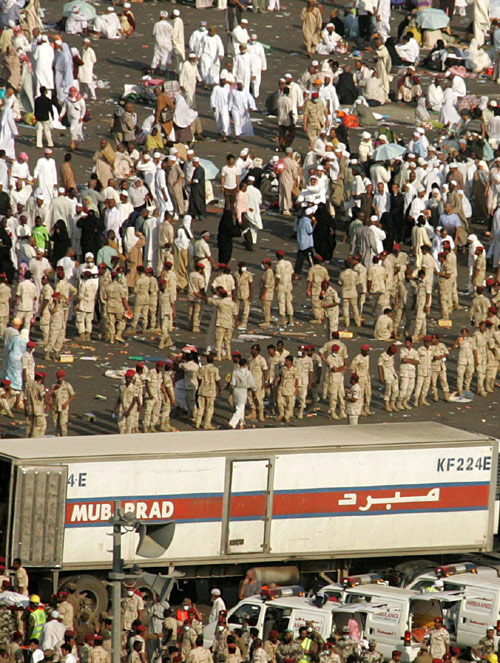
In 2005 too, pilgrims tripped over luggage in Mina that caused tramplings resulting in at least 345 death - four were confirmed to be Chinese nationals. Several Chinese pilgrims were injured in the tragedy.
All the four were from Qinghai Province in western China - 62-year old Ma Taishan, 61-year old Ma Delin, 58-year old Sha Tianlu and a 49-year old woman Ru Geya.

About 20,000 Muslims gathered in Xining, capital of Northwest China's Qinghai Province prayed for the four deceased after religious leaders informed the Friday crowd of their identities.

Families of the four Chinese pilgrims, regarded such deaths predestined, were handed 50,000 yuan (US$6,200) each, from the China Islamic Association.

About 7,000 Chinese performed their Haj in 2006, 10,700 in 2007, 11,000 in 2008 and 12,700 in 2009.

******

The earliest Haj visit recorded in the historical literature of the Chinese ethnic Muslims was in the middle of the Ming Dynasty (1368 - 1644) when the famous Chinese navigator Zhen He (Cheng Ho 1371–1435), led his fleet to Mecca to perform Haj during one of his seven marine adventures.

The Chinese used to follow two routes to Mecca: the sea and the land.
The land route passed through the Hexi Corridor in Gansu - the most important route from North China to Central Asia for traders - passed Xinjiang, Central Asia, Iran, Iraq, Syria, Palestine and Egypt before crossing the Red Sea and reaching the Jeddah port.
The marine route started from Hong Kong and passed Myanmar and India until arriving at Jeddah port.
These travellers encountered difficulties in their efforts to reach Makkah for Haj - financial constrain, long journey and backward transportation means: They had to walk, carriage or horse-ride, or take another ship before reaching home.
The trip often took months, or even years that led to sufferings and death for many Chinese pilgrims.

******

After the People’s Republic of China was founded and with more liberal religious freedom policy, China Islamic Association, with its missions and duties of assisting the people's government in the implementation of the policy of freedom of religion, was formed in July 1952.

The national organisation represent Muslims of all ethnic groups, unifying them in participating in the socialist construction of the motherland and to cherish it.
Its establishment placed a bridge between China's Muslims of different ethnicities.

The association's main tasks, beside The Haj Office being responsible for bringing together people of different nationalities to perform Haj,
- its Academic Department involved in implementing Islamic regulations within the context of service activities, to hold training of teaching personnel to attend the masses religious issues.
- to meet the requirements and interpretation of social development and - The Offices Operational Agencies promote Islamic associations and mosques around the country and serve the community.
- The Research Department identifies and colllects Islamic historical data and the cultural heritage beside books compilation and publication, and
- The International Department is task with relationship promotion with Muslim countries.

******

The Office of Haj's team of 16 pilgrims set off for Saudi Arabia in 1952.
For some reason, they returned home after reaching Pakistan.

In 1955, the late Chinese Prime Minister Zhou Enlai (1898 -1976), after meeting with Prince Faisal of Saudi Arabia (1904 - 1975) in Bali, a 20-member Chinese team were approved of their Haj visas, thus accomplished their Haj mission.
Between 1955 and 1964, China organised 10 Haj trips to Mecca attended by altogether 132 pilgrims.

However, the trips came to a stop after the Cultural Revolution in China but the pilgrimage resumed again, after a lapse of fourteen years.

The Chinese government used to allocate part of the foreign currency quota for Haj pilgrims, even when the country was faced with foreign currencies shortage.
It facilitated visits to their relatives in Saudi Arabia too.

Despite forbidden to perform pilgrimage during the Cultural Revolution, the persistent Chinese still attended to the callings through Pakistan, until the reverse in policy in 1979.
When the 80s came, Chinese pilgrims paid their own expenses. They were responsible for their own fare, no more allocations from the Chinese government.
Despite the self-funded Haj trips, the number of Chinese pilgrims grown considerably to 2,200 in 1985.

In 1986, the government gave its support for the organised Chinese Haj team - The organisation has been incorporated into the government management tasks. 
To help Muslims perform their pilgrimage and striving towards excellent management of the pilgrims, it provided all-round service for the Chinese.

China Islamic Association sent its first Haj Team on the field, in the same year.
It helped the pilgrims with Haj visa application, ticketing, traffic, accommodation and all formalities in Karachi and Islamabad in Pakistan, and Jeddah, Mecca and Madinah in Saudi Arabia as diplomatic relations with Saudi Arabia was not established, then.

In 1989, China and Saudi Arabia reached an agreement to set up business offices in each other’s capital city. To facilitate the Haj for its Muslims, the Chinese government once arranged six chartered flights directly to Jeddah and helped 900 Chinese pilgrims get visas on arrival.
In July 1990, the two countries established diplomatic relations, thus laying the foundation to cooperate in politics, economy and culture and making it easier for pilgrims to perform Haj and get consular protection.

April 2001, the government set up the China Islamic Association, described as aiming to "help the spread of the Qur'an in China and oppose religious extremism". It is run by 16 religious leaders, in charge of making "a correct and authoritative interpretation" of Islamic creed.
With the awareness, in 2003, more than 3,000 people in the Ningxia Hui Autonomous Region alone, performed their religious call - contrary to 1988 when only 15 pilgrims made their journey.
The mostly farmers pilgrims - along with imams from some mosques - paid more than 30,000 yuan (US$3,627) for the pilgrimage.
By then, more than 45,000 Chinese had done so. Beside direct flight, they were provided with Arabic interpreters and health workers too.

******


In 2004, more than 4,000 Chinese performed their Haj. 

30 Chinese pilgrims from Gansu were pushed to the ground in a stampede that took away 244 lives - five were from China.

******

In 2004, the government - working with China Islamic Association - to safeguard the interests and legitimate rights of the Haj pilgrims and facilitating the trips, issued the Regulations on Religious Affairs - the first comprehensive decree regulating the religious affairs.
In accordance with the Article XI in the Regulations, “The national Islamic organisation is responsible for organising the Chinese citizens holding Islam as their belief to go on Haj overseas.”
The article conveyed two messages: Clarifies and protects the basic rights of the Muslims going on Haj, which are not be infringed on by any organisation or individual, and designated the China Islamic Association as the main body of organising, managing and serving the teams and regulates that "no other organisation or individual" can organise the Haj teams as there were still illegal organisers that deceived pilgrims and some were forced out of their hotels to the streets - The legitimate rights and interests of the pilgrims, while abroad, are not guaranteed.

******

China, with official statistics recorded of around 23 million Muslims in more than 20 provinces, autonomous regions, and municipalities, is seeing a steep jump in the number of its Haj pilgrimage.

 The last 980 Chinese pilgrims for 2010, left Beijing on Wednesday evening aboard three chartered flights headed for Saudi Arabia.
 
Muslims gather in front of a mosque before going to an airport to leave for Mecca in Yinchuan, capital of northwest China's Ningxia Hui Autonomous Region, Oct. 31, 2009. A group of 297 Muslims took off from Yinchuan by chartered flight to Mecca for hajj Saturday. From Oct. 30 to Nov. 18, about 12,700 Muslims will go to the holy city for hajj in 41 chartered flights from Xinjiang, Gansu, Ningxia, Yunnan and Beijing. The number of pilgrims is 700 more than that of last year.
Gathering in front of a mosque before leaving for Mecca in Yinchuan, capital of northwest China's Ningxia Hui Autonomous Region


The first 2010 chartered flight from northwest China's Ningxia Hui Autonomous Region to Mecca took off on October 18, marking the start of pilgrims' annual journey from China's largest Hui community.

2,250 people from Ningxia, had left by seven chartered planes from Yinchuan, Ningxia's capital 
- An official with the regional religious bureau of Ningxia, 71 personnel, including doctors and interpreters, accompanied the pilgrims, helping them in the foreign country. 
- Fourteen imams, or senior and revered Muslims, accompanied them too, to help solving religious and Haj issues. 

The pilgrims, mostly farmers, paid 30,000 yuan (US$4,412). 
Ningxia, known as China's "Muslim province" has more than one third of its population - 2.1 million - are from Hui ethnic minority.

The number of Chinese pilgrims coming for Haj is seeing the ever increasing number.
This year, around 13,500* pilgrims had their spiritual callings answered.

*** 13,500* - Many papers claim the figure of 24,000. One of them is  here.


.

Wednesday, October 20, 2010

Tough Time For Illegals In The Two Holy Places


Today's news reported  Indonesian overstayers  in Saudi became unruly nuisance so they would be picked up by police and deported from the country free of charge.

When I was there last month, many Indonesians stay away from public areas and only come out when night falls under their black veils to do their trade.
Even then, they were always on the lookout for 'searching eyes'.
In Mecca, they had shifted their stay right up to the hilltop, away from the authority's long arm.
The immigration went all out to nab these over-stayers and illegal immigrants.

I had always with me many SR1.00 to be given away in Madinah.
But it was only on the first day of Syawal, after a week of my stay there, did I manage to meet the first girl  asking for money.
Even then, she was beautifully dressed - Aidilfitri perhaps - or to camouflage herself from the patrolling policemen.

The same scenario happened in Mecca, only few children - with beautiful dresses and shirts, asked for money.
I ended up bringing back much of the untouched SR1.00.
For the next trip, perhaps, GOD willing.

A six-month general amnesty was given, on the second week of Syawal, to overstayers after arriving on Haj, Umrah or visit visas but they are to approach the deportation center with their passports and air tickets to get an exit visa stamped on their travel documents.
Many of these illegals I met would rather lined themselves up on the street, hoping to be caught by the authority, jailed and deported - simple - as they said.
They were confidant that their embassy would arrange for their 'free' deportation.

The Saudi immigration really mean business this year - they'll do what they say.
Starting this year, to curb illegals, all food for pilgrimmers will be catered from legal sources.
Travel agencies are not allowed to have their food self-cooked or having their own kitchen hands.

Talking to these seasonal food caterers who had been in Mecca for the past many, many years, they knew their livelihood is at stake.
Even then, none I talked to, wanted to move back to Indonesia although they knew the amnesty is only until March 23, 2011

******

Police Target 'Fake Pilgrims'

Police were cracking down on 'fake pilgrims' after a record number of people registered to travel to Saudi Arabia to perform Hajj. - Photo: AFP

DHAKA - BANGLADESHI authorities said on Tuesday the police were cracking down on 'fake pilgrims' who may actually be migrants after a record number of people registered to travel to Saudi Arabia to perform Hajj.

This year, 93,875 people from Bangladesh have registered to perform the annual pilgrimage in November, up from just 58,489 in 2009, religious affairs ministry spokesman Anwar Hossain told AFP.
'We have warned the police, the Hajj travel agencies about fake pilgrims - we are worried some of them may not return from Saudi Arabia,' Hossain said.
Performing Hajj at least once is a religious obligation for all able-bodied Muslims who can afford it.
Bangladeshi police are cross-checking all Hajj applicants under 40 and any who do not appear to come from wealthy families in an attempt to weed out economic migrants trying to get to the Gulf on Hajj visas to work.
Bangladesh, the world's third largest Muslim-majority nation, relies heavily on remittances, but the global downturn affected jobs for migrant workers, particularly in the construction and manufacturing sectors in the Gulf. -- AFP

Sunday, October 10, 2010

Going Through These Miners' Diaries

A group of trapped miners waving to a video camera at mine San Jose, near of Copiapo, Chile

A group of trapped miners waving to a video camera at mine San Jose, near of Copiapo, Chile Photo: EPA 

******
 
A poignant moment watching people who had been camping at the desert near the northern Chilean town of Copiapo, cried tears of joy on BBC. 

Not only the miners' family, so are the engineers and all the rescue team are rejoicing, knowing that their efforts paid off. 
These miners will soon rejoin their family. 

The global focus now is in Chile as celebration is on the way as the rescuers reached the 33 trapped miners. 

In what has become the world’s longest-ever mine rescue, engineers will decide when evacuation will begin when the operation to bring to the surface, 33 Chile's San Jose miners trapped almost a half-mile underground for 65 days with an escape shaft.
The miners were trapped after an access tunnel caved in at Cia. Minera San Esteban Primera SA’s San Jose copper and gold mine in Chile’s northern Atacama.
However, the rescue team works work much faster than earlier expected.

The miners knew they were in a risky situation for their own escape, for the drill finally breaks through into the tunnels where they are trapped.
The rescue mission, upon reaching its most sensitive stage, slowed down the final stage of drilling in an effort to ensure that the hammer did not jam or punch through the rock that it became stuck.
Rescuers send a video camera down through the shaft to prevent rockfalls.
For the specially-designed rescue cage can reach these trapped miners, dynamite was used to clear a rock.

The actual rescue risk is with a disastrous setback and is expected to take more than 35 hours when the miners will eventually be pulled out one by one.
As engineers cut a path to the miners, workers on the surface were rehearsing plans to extract the miners from underground and to quickly transport them to a nearby hospital. Medical facilities will be ready by Monday evening.
The miners only contact with the outside world has been through tiny drill holes into which people on the surface send down food, water, medicine and games such as dominoes.

The rescue team has drawn up a provisional list of the order of the miners' rescue, based on daily examinations of the men's physical and mental health.

The 33 miners have been split into three groups.

The strongest will come out first in case they are needed to go back down to assist others with the rescue. One miner has been running six miles a day for this D-day, or, the four judged capable of handling a frightening setback as the cage is pulled through the narrow black shaft and describing the issuers to the others.

The next phase would be the rescue of those with illnesses, the weaker and older.
And coming up last will be another group who are physically and mentally strong enough to wait their moment.
One of these miners has acted as the mens' medic, and another, has been leading twice-daily prayer sessions.

“We’ve waited for two months, we can wait another two days,” said Norma Laques, in an interview at the mine site. Her son, Jimmy Suarez, 19, is the youngest trapped miner.

Many believe that the last man up will Luis Urzua, the shift supervisor and leader of Los 33 who is credited with keeping the men alive by eking out food rations during the first lost 17 days.

"It could be Urzua, but it's still not confirmed. The concept of a captain being the last one to abandon ship could be applied," said Commander Renato Navarro, the navy official running the rescue.

However, these miners will be assessed and the final order will be decided by the three navy paramedics and 13 rescue experts who will be lowered down into the mine to run the operation from below ground.

At the surface, excitement mixed with anxiety as the miners' families have maintained their vigil since the Aug 5 rockfall.
They maintained an overnight vigil by camp-fires at Camp Hope, the tent settlement they set up at the minehead in the desert near the northern Chilean town of Copiapo.

******

Read on, of this miner's diary for the love of his family.
If one of these men happened to be the person closest to us?  
Or whom we know?


A miner's diary
Wang Gang, 24, has followed in the footsteps of his father and grandfather
 to become a miner in Huairen, a county with dozens of coal mines in coal-
rich Shanxi province. Yin Zhiyong / for China Daily
 

Despite increasing mechanisation, life in the cold, dank, dark interiors of a coal mine remains as tough as ever. Lan Tian and Sun Ruisheng report
Growing up in the rural coal-mining community of Northern Shanxi province, Wang Gang knew just how tough and risky a miner's life can be. And he swore to himself that he would never follow in the footsteps of his father and grandfather.
But destiny had other plans.
Wang, 24, eventually returned to the community he once spurned, despite graduating from Shanxi Drama Vocational College in the provincial capital, Taiyuan.
"Given a choice, I would never work in a mine," says Wang dressed in a pair of old jeans, white tennis shoes and a brown artificial leather jacket, dirt clogging his long fingernails.
He has traveled a long way from the halcyon days of 2002, when the drama college student, a fan of Guns N' Roses, formed a four-member rock band, BY.
After class, the band would do the rounds of the nightclubs of Taiyuan, with Wang its lead singer/guitarist.
But BY did not get progress past being a warm-up band and soon broke up.
Wang then worked as a DJ, and sound and lighting engineer in bars, where he fell in love with a dancer, Zhang Yue.
When Zhang became pregnant, Wang asked her to marry him. Their daughter was born soon after.
He was making a modest 5,000 yuan ($740) a month at that time, which was just enough to get by.
But Wang felt working at nightclubs was full of temptations, and not conducive to a stable family life. So, despite the prospects of becoming a partner at the bar where he had worked for years, he quit.
"I like rock music, but I'm also a very conservative man," Wang says.
The couple soon spent all their savings as he could not find another job with a salary decent enough to pay for baby milk and diapers.
Wang returned to his hometown, Huairen, a county dotted with dozens of coal mines like countless others in the coal-rich province.
In March 2009, he began life as a miner in Wangping Mine Company, a State-owned mine where his father had once worked.
He clearly remembers how frightened he felt the first time he went down the maze of mine tunnels.
"It felt like hell," Wang says.
A miner's diary
Typically, a miner works 21 shifts every month to make the maximum he can - 4,000 yuan. Each shift lasts 12 hours and starts at 5 am, 1 pm and 9 pm.
Wang works the 1 pm shift. After a pre-shift meeting and an oath ceremony where the 10-member squad of miners vow to ensure safety, he changes into his work overalls.
Carrying his gear and equipment weighing some 100 kg, he boards a mini-train to descend the mine.
The train comes to a halt half an hour later. He gets off and walks another 20 minutes before reaching his work area.
There is darkness everywhere.
Besides the miners' headlights, there is just one light for every 100 meters along the tunnel.
The ground is cold and moist, with the chill factor amplified by ventilation fans used to blow fresh air into the mine, and the sprinkler that keep the coal dust down.
Wang has to wear three layers of cotton-padded clothes and trousers to protect himself from the cold and dampness.
In the past, miners used picks and shovels to dig the coal and load them on to small carts. Then mules would pull the carts to the entrance.
Nowadays, with mechanisation, machines are replacing miners to dig the coal.
But Wang, a newbie, is unfamiliar with these machines. His main tasks are to assist senior miners, carry equipment and prop up the mine roof with support materials.
His shift ends at 10:30 pm, by which time his clothes are soaked in sweat and his face covered with black dust.
Taking the same mini-train back to the entrance, he cleans up in the miners' bathroom, and arrives home around midnight.
His wife always stays up until he gets home safe and sound.
All the miners' families are aware of the risks the miners face and live with them. In compensation, they enjoy the highest monthly salaries in the area, which is almost equivalent to the annual income of local farmers.
As the world's largest producer and consumer of coal, the country's annual output of coal tripled from 1 billion tons in 1999 to 3 billion tons in 2009, to fuel the fast-growing economy.
Its coal mining industry remains one of the world's deadliest, although the situation has been improving, with the mortality rate per million tons declining from 5.71 in 2000 to 0.892 in 2009.
Accidents killed 2,631 coal miners in 2009. That was down from 6,995 deaths in 2002, the most dangerous year on record.
Having worked underground for 18 months, Wang says the worst thing about being a miner is not the danger but the "darkness".
In the winter, he often goes without seeing the sun for weeks, if the shift starts at 5 am and ends at 5 pm.
"Mechanisation and stricter supervision have greatly improved mine safety.
"As long as you pay 120 percent attention and follow safety instructions, you will be OK," he says.
Although Wangping, a medium-scale mine with an annual production of 1.5 million tons, has not seen a severe accident in years, Wang says this does not mean no blood has been shed.
Failure to follow instructions can result in ghastly wounds such as multiple compound fractures.
Wang recalls the utter shock he felt when he chanced upon several fingers of a young co-worker, which were accidentally severed.
Wang's experiences have transformed him, body and mind.
While the day-to-day physical work has bulked him up, he also suffers from joint pains and a cough, owing to the cold, damp and dusty environment underground.
"It is one of the hardest, dirtiest and most dangerous professions in the world," Wang says.
While miners are often thought of as victims of disasters, he is at pains to point out that "we miners are very brave, industrious, are able to work under great pressure, and pay constant attention to detail".
And it is a man's world - State labour laws prohibit the employment of women to work underground.
During breaks and meal times, the hottest topic is women. Who is the best looking girl in the community? Or, who is cheating on whom?
"It is the only entertainment we have underground," Wang says.
The trading of profanities and crude insults is common, and helps ease the stress of mine work, he says.
But as a post-80s college graduate, Wang senses a distance between him and older miners.
Of the mine's 6,000 employees, about 1,000 are miners, of which 30 percent belong to the post-80s generation, holding at least a senior high school diploma.
Most of the older miners have just a primary school education and some are illiterate. The oldest miner in Wang's team is 44.
"We younger miners have interests the older miners don't have. They don't care who (US President) Barack Obama is or what is the breaking news of the moment. They just care about how much money they can earn, or which grocery store has the cheaper eggs."
Few of the educated older miners surf the Internet, while Wang spends almost all his spare time online, teaching himself computer programming.
"Mining has isolated them from the outside world, and made them numb."
Wang says he has to constantly remind himself not to succumb to such numbness.
"It is just a job. I won't dig coal forever. I still have dreams," Wang says.
He says he will leave the mine if there are better job opportunities. Older miners tell him he's being impractical, but his family supports him.
For the time being, Wang is focused on a singing contest his company is organising.
He will sing his favorite song - Chinese singer Wang Feng's Life in Full Blossom:
I have lost my dreams many times;
I want to go beyond the common life;
I want life in full blossom;
Just like flying in the vast sky.


Thursday, December 17, 2009

The Diamond Curse At War

The war in Sierra Leone (1991 - 2002) was an epidemic in West Africa that started from Angola since 1975 to the year 2002.

These wars finally came to closure as awareness was increased between the link of diamond transactions and arms purchased in fuelling the civil war that caused regional conflict and disintegrated the countries.

The gem that is used to jewel exclusively the royals and aristocrats, found it's way into America.
America holds 1/2 of the world market.
The advertisement of De Beers - A Diamond Is Forever - Has transformed the stone with human love, engagement and marriage.
De Beers used to monopolise a lion share of the diamond market.
The pricing was fixed by them and their hordes were only sold to interested parties 10 times per year.

In 1999, De Beers closed it's mines in Angola when disputes of diamonds for arms and pressures mounting  concerning the transactions of conflicted diamonds.


60% of the world's rough diamond comes from Africa.
Angola, one of the African countries, produced the best diamond in the world.

Sadly, the more diamond revenues means more war machines and arms exchange and added.
The transactions were supposed to be able to make the countries' infrastructures possible.
It has offshore oil too.
But the natural resources income were cursed.
More exploitations followed in the more than 2 decades Angola entangled in civil wars.

The 90s sanctions failed to see the more than 1,000,000 innocent civilians caught entangled in the crossfire. Diamond caused civilians many tragedies and many sufferings.
People being dragged from their houses, people being butchered, and made many Angolans walking the streets legless.

With the sole aim to forever stop the conflicted diamond trade, an international certification system was introduced in the year 2000.
United Nation, upon adopting the system, called upon all member countries to stop buying diamonds from specific conflicted zones.
With support from all UN members, Kimberley Process Certification Scheme was implemented.
Legitimate diamond trading had contributed to regional prosperity.
Developments mushroomed in the continent of Africa.

Angola's economy took off.
It's average income rose by more than 20% between 2003 to 2005.