Papers had reported 15 representatives of former Foreign Minister George Yeo, between the age of 16 and 41, were at the Elections Department at about 1pm yesterday, to collect forms for a certificate of eligibility for him to contest the Presidential Elections.
The supporters said they are hopeful Mr Yeo will run for the Presidential Election.
The youths are very comfortable with Mr Yeo's brand of leadership as he has devoted a considerable amount of time interacting with young people.
He had often speak and listen to them in informal groups and organised dialogues.
Thus, they believe Mr Yeo is the type of leader the younger generation will rally around, since he had made an earlier promise to engage the younger generation.
The promise had made him more appealing to them, and these youths really wish for a free-spirited Mr President who will be able to communicate openly and very open to new ideas when meeting new people, from all walks of life.
Mr Yeo is known to have attended and supports many youth driven community projects and events.
He is said to be "energised" by the younger generation and "constantly learns from them".
Mr Yeo is known to be close to the people on the ground, the very most important essence to these youths, someone who is able to have a sense of the people.
A 36-year-old Lien We King said he received a phone call from Mr Yeo on Sunday evening, asking him to help collect the forms on his behalf.
Mr Yeo had left for Taiwan yesterday morning, to offer his gratitude and thanks in person to the Tzu Chi Stem Cell Center for saving the life of his leukemia patient son.
The stem cell centre had given his son a bone marrow transplant.
He is expected to return to Singapore in 10 days time.
The forms will then be passed on to him.
Mr Yeo was the first Singaporean Minister to start blogging, and he had blogged since August 2006
.
He then moved on to Facebook and is one of the most active Singaporean politician on it, with over 85,000 friends and supporters.
On Sunday, on his Facebook page, Mr Yeo wrote,
'In case the presidential election writ is issued while I'm away, some young friends will collect the eligibility forms for me.
'It is a big decision which I hope to make two weeks from now after taking in views n advice from many people. I ask for your patience n understanding.'
Mr Yeo had earlier ruled himself out as a presidential candidate, despite numerous calls for him to run after he lost his seat in Parliament in the recent General Election.
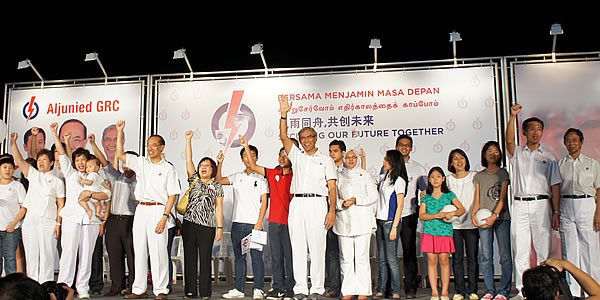
His People's Action Party (PAP) team was defeated by the Workers' Party in Aljunied GRC.
After 23-years in politics, and following his intended exit, Mr George Yeo finally spoke the unspoken that there is a deep resentment among Singaporeans towards the ruling party.
He called on the PAP to listen harder, and to take into account people’s unease over the pace of change driven by globalisation.
Mr George Yeo is considered one of the more liberal-minded ministers in the PAP.
He feedbacked the ground sentiments to PM Lee that not just the question about policies, not just the minds, but the hearts needed address too.
Prime Minister Lee Hsien Loong then frankly apologise publicly for the regime’s mistakes during a lunchtime rally at UOB.
Earlier, when asked about running for president, Mr Yeo told a press conference on May 10 that he did not think he was 'temperamentally suited for such a job' as he considered himself 'a free spirit'.
However, he sparked off online discussion after announcing on Wednesday, June 1, that he was 'thinking hard' about reconsidering running for President.
His just two short lines posted,
'Many Singaporeans from different walks of life, young and old, have asked me to reconsider my decision on the Presidency, some impassionately,' he wrote.
About reconsidering running for President, 'Thinking hard about it and praying for wisdom.'
If Mr Yeo does contest in the Presidential Election, he would be the second candidate from the PAP to do so.
His Facebook post had attracted more than 2,000 'likes' and more than 700 comments from netizens, most of whom supported him being a candidate in the upcoming presidential election.
He is set to be the more popular choice for President.
His experience in different ministries will be useful in carrying out presidential duties, since he had established diplomatic foreign relationships with important politicians of other countries.
Mr Yeo was part of the People's Action Party (PAP) team which contested in the recent May 7 General Election.
PAP team lost the Aljunied GRC constituency to The Workers’ Party team, with 54.71% of the votes.
In the recent General Elections, many voters has shown unhappiness with the ruling party, but this negative sentiment does not seem to extend to Mr Yeo.
The former Foreign Minister is still very popular and many have lamented that he is a victim of the Group Representative Constituency (GRC) Scheme.
In a twist of an event, now, Mr George Yeo Yong-Boon has a very definite advantage of he running for President.
The first person to contest in the presidential Election is the former MP Tan Cheng Bock.
Unlike Mr George Yeo who is still a member of the ruling party's central executive committee, Dr Tan has since resigned from the PAP.
George Yeo: A Man Of All Season
As Singapore’s Foreign Minister of nearly seven years, Mr George Yeo will leave a legacy of strategic thinking, cultural diplomacy and friendship, writes Professor Tommy Koh
ONE of my hopes for the 2011 General Elections was that those who won would be magnanimous and those who lost would be gracious.
Foreign Minister George Yeo was gracious in defeat. In his concession speech, he congratulated Mr Low Thia Khiang and his Workers’ Party team on their victory and wished them success. Of the other defeated candidates, only Mr Desmond Choo of the People’s Action Party and Ms Nicole Seah of the National Solidarity Party were just as gracious.
A man’s character can be gleaned from his conduct, both in victory and in defeat. Mr Yeo is a gentleman and an honourable man, whatever the conditions.
I have had the pleasure of working under his leadership in three of his ministerial portfolios. He was our first minister of the then Ministry of Information and the Arts, or Mita. During nine years at Mita, he changed Singapore from a so-called cultural desert to a cultural oasis.
He appointed Mr Tan Chin Nam chairman of the newly created National Library Board-and Mr Tan, together with Mr Christopher Chia, revolutionised our library system and made it one of the best in the world. Mr Yeo also appointed Mr Lim Chee Onn chairman of the National Heritage Board, and me, chairman of the National Arts Council.
It was under his leadership that the Esplanade was built, the Asian Civilisations Museum was envisioned, the Arts Festival was made an annual event, the LaSalle College of the Arts took off, and the Government agreed, for the first time, to subsidise arts education. Today, Singaporeans enjoy a rich and varied cultural life. They should not forget the person who planted the seeds that have blossomed.
Mr Yeo brought the same energy, imagination and enthusiasm to the Ministry of Trade and Industry. He realised that because trade is Singapore’s life blood, it should play a proactive leadership role in global trade forums like the World Trade Organisation (WTO). He quickly won the admiration and trust of his peers. They asked him to chair the negotiations on agriculture, one of the most contentious issues. WTO director-general Pascal Lamy is an admirer of Mr Yeo.
In order to enlarge Singapore’s economic space, Mr Yeo championed the idea of linking Singapore’s economy with other economies by way of free trade agreements (FTAs) and comprehensive economic partnership (CEP) agreements. During his watch, he launched more than a dozen FTA and CEP negotiations.
He appointed me chief negotiator in our negotiations with the United States. During the journey of two years, we encountered many difficulties. Throughout, Mr Yeo remained calm, optimistic and creative. He worked relentlessly with the different stakeholders in the US to earn their support and to find acceptable solutions to the difficulties. In the final stage of the negotiations, there was a shortlist of issues that the two chief negotiators could not resolve. Those issues were finally resolved by Mr Yeo and his American counterpart, Mr Robert Zoellick, in a marathon negotiating session that extended through the night without dinner and ended successfully at dawn. Members of the Singapore delegation were deeply impressed by the cool and masterly way in which Mr Yeo had negotiated with Mr Zoellick.
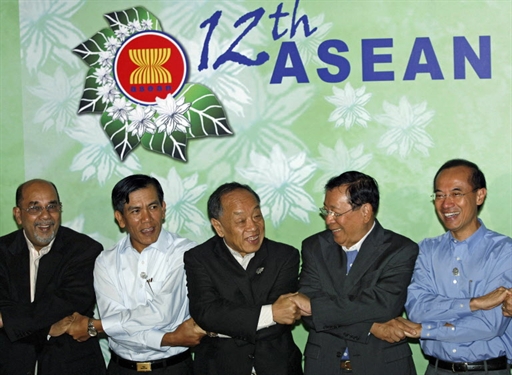
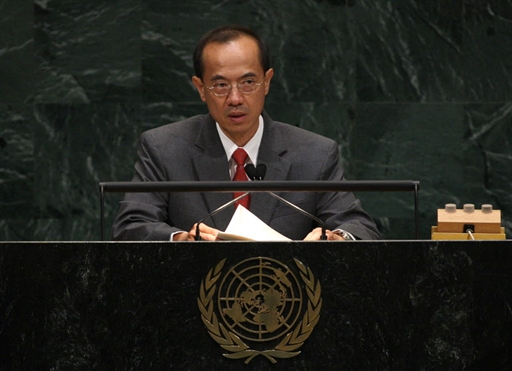
Mr Yeo has been Singapore’s Foreign Minister for nearly seven years now. He inherited a ministry in good order as a result of the legacy of Mr S. Rajaratnam, Mr S. Dhanabalan, Mr Wong Kan Seng and Professor S. Jayakumar. What contributions did Mr Yeo make to that heritage? I would single out three.
First, he taught us to think strategically and to prioritise. He constantly asked his staff to ensure that our most important bilateral relationships were in excellent order. He scanned the horizon for new opportunities - such as in the Middle East and Latin America.
Second, he was the first foreign minister to use history and culture as instruments of diplomacy. He persuaded the Chinese Chamber of Commerce to restore the Sun Yat Sen Villa and to turn it into a historic site linking Singapore, China and Taiwan. He requested that the National Heritage Board restore the memorial to Subhas Chandra Bose, who is celebrated in India as a nationalist and independence fighter. It was due to the leadership of Mr Yeo, a Roman Catholic, and of former Indian president Abdul Kalam, a Muslim, that the ancient Buddhist university at Nalanda, Bihar is being reincarnated.
Third, Mr Yeo believes in the importance of friendship in diplomacy. He often invited his foreign guests to his home to have dinner with him and his family. He went out of his way to show warmth and friendship to his foreign interlocutors. When Tan Sri Syed Hamid Albar was Malaysia’s foreign minister, Mr Yeo visited him in his constituency in Malaysia to pay his respects during Hari Raya.
Mr Yeo is blessed with high IQ, EQ and CQ - cultural intelligence. He is an exceptionally gifted man. Although an engineer by training and a soldier by profession, he is also a philosopher and historian. Although a devout Roman Catholic, he is a champion of inter-faith dialogue and understanding. Mr George Yeo is ideally qualified to play a leadership role on the global stage, and I sincerely hope he will do so.
The writer is special adviser to the Institute of Policy Studies at the National University of Singapore.
Source: News Today - May 11, 2011
The supporters said they are hopeful Mr Yeo will run for the Presidential Election.

The youths are very comfortable with Mr Yeo's brand of leadership as he has devoted a considerable amount of time interacting with young people.
He had often speak and listen to them in informal groups and organised dialogues.
Thus, they believe Mr Yeo is the type of leader the younger generation will rally around, since he had made an earlier promise to engage the younger generation.
The promise had made him more appealing to them, and these youths really wish for a free-spirited Mr President who will be able to communicate openly and very open to new ideas when meeting new people, from all walks of life.
Mr Yeo is known to have attended and supports many youth driven community projects and events.
He is said to be "energised" by the younger generation and "constantly learns from them".
Mr Yeo is known to be close to the people on the ground, the very most important essence to these youths, someone who is able to have a sense of the people.
A 36-year-old Lien We King said he received a phone call from Mr Yeo on Sunday evening, asking him to help collect the forms on his behalf.
Mr Yeo had left for Taiwan yesterday morning, to offer his gratitude and thanks in person to the Tzu Chi Stem Cell Center for saving the life of his leukemia patient son.
The stem cell centre had given his son a bone marrow transplant.
He is expected to return to Singapore in 10 days time.
The forms will then be passed on to him.
******
Mr Yeo was the first Singaporean Minister to start blogging, and he had blogged since August 2006
.
He then moved on to Facebook and is one of the most active Singaporean politician on it, with over 85,000 friends and supporters.
On Sunday, on his Facebook page, Mr Yeo wrote,
'In case the presidential election writ is issued while I'm away, some young friends will collect the eligibility forms for me.
'It is a big decision which I hope to make two weeks from now after taking in views n advice from many people. I ask for your patience n understanding.'
Mr Yeo had earlier ruled himself out as a presidential candidate, despite numerous calls for him to run after he lost his seat in Parliament in the recent General Election.
His People's Action Party (PAP) team was defeated by the Workers' Party in Aljunied GRC.
After 23-years in politics, and following his intended exit, Mr George Yeo finally spoke the unspoken that there is a deep resentment among Singaporeans towards the ruling party.
He called on the PAP to listen harder, and to take into account people’s unease over the pace of change driven by globalisation.
Mr George Yeo is considered one of the more liberal-minded ministers in the PAP.
He feedbacked the ground sentiments to PM Lee that not just the question about policies, not just the minds, but the hearts needed address too.
Prime Minister Lee Hsien Loong then frankly apologise publicly for the regime’s mistakes during a lunchtime rally at UOB.
******
Earlier, when asked about running for president, Mr Yeo told a press conference on May 10 that he did not think he was 'temperamentally suited for such a job' as he considered himself 'a free spirit'.
However, he sparked off online discussion after announcing on Wednesday, June 1, that he was 'thinking hard' about reconsidering running for President.
His just two short lines posted,
'Many Singaporeans from different walks of life, young and old, have asked me to reconsider my decision on the Presidency, some impassionately,' he wrote.
About reconsidering running for President, 'Thinking hard about it and praying for wisdom.'
******
If Mr Yeo does contest in the Presidential Election, he would be the second candidate from the PAP to do so.
His Facebook post had attracted more than 2,000 'likes' and more than 700 comments from netizens, most of whom supported him being a candidate in the upcoming presidential election.
He is set to be the more popular choice for President.
His experience in different ministries will be useful in carrying out presidential duties, since he had established diplomatic foreign relationships with important politicians of other countries.
Mr Yeo was part of the People's Action Party (PAP) team which contested in the recent May 7 General Election.
PAP team lost the Aljunied GRC constituency to The Workers’ Party team, with 54.71% of the votes.
In the recent General Elections, many voters has shown unhappiness with the ruling party, but this negative sentiment does not seem to extend to Mr Yeo.
The former Foreign Minister is still very popular and many have lamented that he is a victim of the Group Representative Constituency (GRC) Scheme.
In a twist of an event, now, Mr George Yeo Yong-Boon has a very definite advantage of he running for President.
The first person to contest in the presidential Election is the former MP Tan Cheng Bock.
Unlike Mr George Yeo who is still a member of the ruling party's central executive committee, Dr Tan has since resigned from the PAP.
****** ****** ******
George Yeo: A Man Of All Season
As Singapore’s Foreign Minister of nearly seven years, Mr George Yeo will leave a legacy of strategic thinking, cultural diplomacy and friendship, writes Professor Tommy Koh
ONE of my hopes for the 2011 General Elections was that those who won would be magnanimous and those who lost would be gracious.
Foreign Minister George Yeo was gracious in defeat. In his concession speech, he congratulated Mr Low Thia Khiang and his Workers’ Party team on their victory and wished them success. Of the other defeated candidates, only Mr Desmond Choo of the People’s Action Party and Ms Nicole Seah of the National Solidarity Party were just as gracious.
A man’s character can be gleaned from his conduct, both in victory and in defeat. Mr Yeo is a gentleman and an honourable man, whatever the conditions.
I have had the pleasure of working under his leadership in three of his ministerial portfolios. He was our first minister of the then Ministry of Information and the Arts, or Mita. During nine years at Mita, he changed Singapore from a so-called cultural desert to a cultural oasis.
He appointed Mr Tan Chin Nam chairman of the newly created National Library Board-and Mr Tan, together with Mr Christopher Chia, revolutionised our library system and made it one of the best in the world. Mr Yeo also appointed Mr Lim Chee Onn chairman of the National Heritage Board, and me, chairman of the National Arts Council.
It was under his leadership that the Esplanade was built, the Asian Civilisations Museum was envisioned, the Arts Festival was made an annual event, the LaSalle College of the Arts took off, and the Government agreed, for the first time, to subsidise arts education. Today, Singaporeans enjoy a rich and varied cultural life. They should not forget the person who planted the seeds that have blossomed.
Mr Yeo brought the same energy, imagination and enthusiasm to the Ministry of Trade and Industry. He realised that because trade is Singapore’s life blood, it should play a proactive leadership role in global trade forums like the World Trade Organisation (WTO). He quickly won the admiration and trust of his peers. They asked him to chair the negotiations on agriculture, one of the most contentious issues. WTO director-general Pascal Lamy is an admirer of Mr Yeo.
In order to enlarge Singapore’s economic space, Mr Yeo championed the idea of linking Singapore’s economy with other economies by way of free trade agreements (FTAs) and comprehensive economic partnership (CEP) agreements. During his watch, he launched more than a dozen FTA and CEP negotiations.
He appointed me chief negotiator in our negotiations with the United States. During the journey of two years, we encountered many difficulties. Throughout, Mr Yeo remained calm, optimistic and creative. He worked relentlessly with the different stakeholders in the US to earn their support and to find acceptable solutions to the difficulties. In the final stage of the negotiations, there was a shortlist of issues that the two chief negotiators could not resolve. Those issues were finally resolved by Mr Yeo and his American counterpart, Mr Robert Zoellick, in a marathon negotiating session that extended through the night without dinner and ended successfully at dawn. Members of the Singapore delegation were deeply impressed by the cool and masterly way in which Mr Yeo had negotiated with Mr Zoellick.
Mr Yeo has been Singapore’s Foreign Minister for nearly seven years now. He inherited a ministry in good order as a result of the legacy of Mr S. Rajaratnam, Mr S. Dhanabalan, Mr Wong Kan Seng and Professor S. Jayakumar. What contributions did Mr Yeo make to that heritage? I would single out three.
First, he taught us to think strategically and to prioritise. He constantly asked his staff to ensure that our most important bilateral relationships were in excellent order. He scanned the horizon for new opportunities - such as in the Middle East and Latin America.
Second, he was the first foreign minister to use history and culture as instruments of diplomacy. He persuaded the Chinese Chamber of Commerce to restore the Sun Yat Sen Villa and to turn it into a historic site linking Singapore, China and Taiwan. He requested that the National Heritage Board restore the memorial to Subhas Chandra Bose, who is celebrated in India as a nationalist and independence fighter. It was due to the leadership of Mr Yeo, a Roman Catholic, and of former Indian president Abdul Kalam, a Muslim, that the ancient Buddhist university at Nalanda, Bihar is being reincarnated.
Third, Mr Yeo believes in the importance of friendship in diplomacy. He often invited his foreign guests to his home to have dinner with him and his family. He went out of his way to show warmth and friendship to his foreign interlocutors. When Tan Sri Syed Hamid Albar was Malaysia’s foreign minister, Mr Yeo visited him in his constituency in Malaysia to pay his respects during Hari Raya.
Mr Yeo is blessed with high IQ, EQ and CQ - cultural intelligence. He is an exceptionally gifted man. Although an engineer by training and a soldier by profession, he is also a philosopher and historian. Although a devout Roman Catholic, he is a champion of inter-faith dialogue and understanding. Mr George Yeo is ideally qualified to play a leadership role on the global stage, and I sincerely hope he will do so.
The writer is special adviser to the Institute of Policy Studies at the National University of Singapore.
Source: News Today - May 11, 2011