Monday, November 8, 2010

Java's Merapi And Its Green Lady

Merapi is being associated with Mbah Marijan. But to associate Merapi with Nyai Gadung Melati too? Who is Nyai Gadung Melati? 

Channel News Asia did interview Mbah Marijan and I happened to watch the programme when it was shown - on October 26, the Tuesday that he was found dead, buried under Merapi's ash.
His life is believed to have been snapped instantly by the 1,000-degree Celsius cloud of gas and ash.  
His responsibility as Merapi's gatekeeper led to his refusal to evacuate the October 26 eruption and his body was found in a praying position. He died still honouring his words as Merapi's gatekeeper - with responsibility well intact. 
As he had said in 2006, "Everybody has their duty. Reporter, soldier, police, they have their duty. I also have a duty to stand here".
The Yogyakarta Palace, where he was a chosen palace servant (hamba dalem) there, was said that the palace had 'known long before it happened that Mbah Marijan would be taken by Merapi'.

The late Mbah Marijan is a well respected man who lived only about 5 kilometres (3m) from Merapi's peak in his home village of Kinahrejo.
The Merapi's folks believe the late Mbah Marijan had the ability to communicate with the Merapi's 'unseen beings'.
They believed he would be warned in a vision if an eruption was imminent.

The late Mbah Marijan is known for his dedication and loyalty to the king.
He was a chosen palace servant (abdi dalem) for the Yogyakarta Sultanate in 1970 by Sultan Hamengku Buwono IX and was named Mas Penewu Suraksohargo by the sultan.
His duty was, as an assistant to his father who was the then Merapi's gatekeeper until the father's death on March 3, 1982, when Mbah Marijan became the official Merapi's gatekeeper.
He spoke using refined 'palace' (Kraton) language - always soothing to the ears.

For Yogyakarta Sultanate, Merapi holds a significant cosmological symbolism, because it is forming a sacred north-south axis line between Merapi peak and Southern Ocean (Indian Ocean).
Merapi peak is a sacred axis - according to Javanese ancestral belief - the axis runs along Malioboro street to Northern Alun alun (square) across Yogyakarta's Kraton, and to the southern Alun-alun, all the way to Bantul -  Bantul's batiks  had been considered as world heritage by the UN.
The Sultan of Yogyakarta, Sultan Hamengku Buwono IX for now, is the leader of the Javanese kingdom.

Because of the history that goes way back before Islam came to the country, even though Indonesia is acknowledged as a republic country, Yogyakarta , or Solo to some, is always a 'special state' (D.I.Y - Daerah Istimewa Yogyakarta) to the Indonesians, especially the Javanese.


Mount Merapi is located in Indonesia
Mount Merapi

Merapi, which elevates on the main Java island, plays a great role in Javanese way of life, beliefs and livings - its more than just a volcanic mountain - Merapi is a special Javanese heritage and the heritage is a living thing too - it breathes - smoke can be seen emerging from the mountaintop almost all year round.
Merapi, being the youngest in a group of volcanoes in southern Java, is growing.
And as any growing human, a massive lava dome 'formed its height' near the tip of Merapi's crater.

As human who has to be look after, and whose body temperature undergoing subtle changes when not feeling well, so is Mount Merapi - It breathes, it grows, it sneezes, it coughs, it clears its phlegm, it sleeps and now it has awakened! - Not eruption -  Experts monitoring Merapi's awakening were reported as being 'baffled' despite earlier predictions that the earlier eruptions following the initial blast in the earlier weeks would ease pressure of building up behind a magma dome.

****** 

Mbah Marijan was surprised when Nyai Gadung Melati did appear in his dream. 
Something BIG is going to happen???
Only GOD knows, but it is not a good sign as Nyai Gadung Melati would occasionally appears in dreams of some 'selected' Merapi's villagers - to warn them of the coming Merapi's eruption. 
Mount Merapi and all mountain that matter, need to be pleased, need to be look after. 

Nyai Gadung Melati is fourth in line to Merapi unseen monarchy headed by King Kiyai Merapi. 
These 'unseen beings' to the naked eyes, made of fire by THE CREATOR, has its palace (Kraton) in Merapi's crater.  
Kiyai Merapi's main man, Kiyai Sapu Jagad, holds the key to the volcano and its pending eruption - but all eruption is not without its own mystical origins - mankind contributed to the factor too.  
Third in line is Kiyai Megantara, in charge of weather and the surroundings.  

Merapi has nine 'unseen guardians' and Nyai (Lady) Gadung Melati ( Leaf Green), the fourth, is in charge of merapi's environment - vegetations and animals - with staff of hundreds of ladies, are said all dressed in green - and their main duty is to look after Merapi's greeneries and fertility. 

Nyai  Gadung Melati is assisted too by Ada Kartadimeja - overseeing livestocks and always appear in common Merapi villagers' dreams about the coming eruption and steps that need to be taken.
The villagers living on Merapi's slopes rely on natural signs rather than official orders - usually they heeded not government warnings of evacuation, but the advice of the mountain’s official 'gatekeeper'. 
Or, they dream of Ada Kartadimeja, or some fortunate ones would dream of Nyai Gadung Melati.
Beside dreams, the villagers too, will always be on the look out for lightning around Merapi's peak, thundering clouds and days of ash raining down, or animals unusual activities and these animals' moving down the Merapi's slopes.

All mountains in Java islands are the dwelling places of the 'unseen beings' - so is Mount Merapi.
Their dwelling places and the surroundings need to be acknowledged, should not be disturbed - and the local folks knew that pretty well.
Unnecessary forest clearing is strictly forbidden!!!
Shifting or looting of forests' possessions have its consequences.

Javanese folks are known for their choicest of words, lest these words are offending to the ears, not only to mankind, but to the 'unseen beings' too - These 'unseen beings' hear and understand the conversations of human beings around them, and they just know how it is to be hurt.
These 'unseen beings' live with mother nature, appreciate mother nature, and they expect the same harmony living with us, human beings - not relieving ourselves - anywhere human beings assumed all-right, no eyes seeing them.
Not anywhere, any place in the forest is a relieving place. Some places up the mountain is sacred too. 

Local folks know and understand what should and should not be done, but not outsiders - and this seemed to anger Nyai Gadung Melati.
She feels ashamed, she feels hurt with them, seeing their abhor characters.

In 2004, the Ministry of Forestry declared a 6,410 hectares national park around Mount Merapi - the local residents were baffled.
During the 2006 Merapi 'awakened', local residents were reluctant to leave fearing their residences would be confiscated for further expansion of the national park.

Despite the devastation, lives lost and homes destroyed, Merapi's dwellers accept their fate - it's DIVINE retribution. 
The spate of recent disasters are warning signs to those who are out of touch with nature and not keeping and honouring their positions which they had promised to shoulder.

Indonesia, with 220 million people, which Muslims being the majority, greatly believe the 'unseen beings' - either in religious context or by way of ancestral belief: The spiritual past and an unseen kingdom that exists in Merapi's crater.

After thousands of years living dangerously, and Islam being the religion of most Javanese, it is hard to shed off the mythology and belief alongside the majority's religious believe. 

Friday, November 5, 2010

The Haj - Chinese Pilgrims, Then And Now

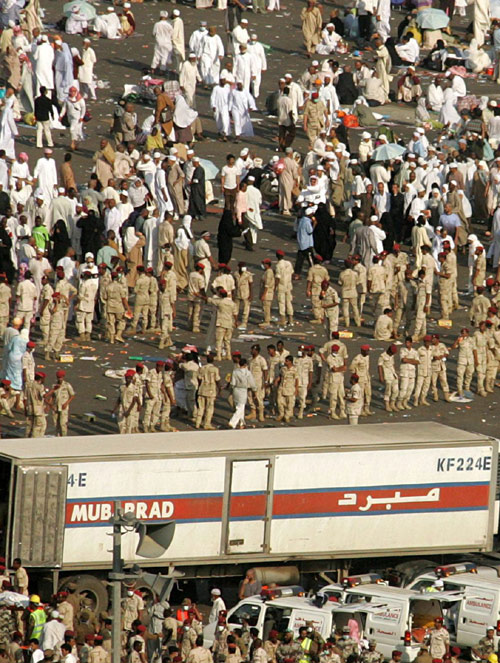
Photo:<!--###IMAGE_BRIEF###-->

"Chinese?"
Then He was shown the escalator to the second floor, I supposed, when He nodded.

I followed Him from behind, about to escalate, when the guard in Masjidil Haram stopped me.

"Malaysia," he said as he pointed to the straight path ahead on the ground floor.

At that moment, He realised He was mistaken again as a Chinese pilgrim from China.
That was in  2005, when we did our Haj.


Way back in 2005, I used to see Chinese pilgrims, after their 'Isyak prayer, on the way back, would carry fresh chickens, vegetables and groceries to cook.
They passed by the place we stay at Habibah, some 300 metres from The Grand Mosque. 
They walked further uphill, not sure their living place, though.

On our part, there were a lot of daily  food wastage  as each pilgrim's portion was the same - men and women. 
To top that, not all Malaysian pilgrims have Johor taste-bud, as the food was prepared by Johoreans.

I told the personnel in charge of food distributions about giving the extras to the Chinese, but complain of not getting food is the thing they did not want to hear.

Gladly, at least after that, dinner not taken at the cut-off time was finally brought down to be distributed to the Chinese pilgrims or any passers-by.

******

In 2005, the China Islamic Association established the Haj Working Office.
Aside from the establishment of the provincial religious and ethnic administrations, it also organises and serves ethnic Muslim pilgrims in China.

The number of Chinese pilgrims increased significantly, thus their presence were felt and seen, projecting its economic stability, ethnic unity and the international image of China.
With the growing number of pilgrims, China Islamic Association began to study, thus gradually improving the management system of the Chinese Haj affairs and formed the regulated, institutionalised and regular mechanism of Haj work.

On the invitation of Saudi Arabia and working together with the Saudi Haj Ministry and other supervising and service agencies, the association, summarised the service of the previous Haj and makes plans for the coming year, to ensure that the Chinese can accomplish their pilgrimage.
The association set a target of the “safe, orderly and well-conducted Haj”.

It was in 2005 too, the Chinese government, to shorten the travel duration and reduce the cost of Haj, launched the pilgrimage direct flight from Lanzhou, Northwest China's Gansu Province, Yinchuan and Kunming, Beijing, and Urumqi too.
In the same year, it was said, about 2,000 Kyrgyzstan places were taken by the Chinese using Kyrgyz passports


Bodies removed in Mena January 12, 2006. Photo: Reuters


In 2005 too, pilgrims tripped over luggage in Mina that caused tramplings resulting in at least 345 death - four were confirmed to be Chinese nationals. Several Chinese pilgrims were injured in the tragedy.
All the four were from Qinghai Province in western China - 62-year old Ma Taishan, 61-year old Ma Delin, 58-year old Sha Tianlu and a 49-year old woman Ru Geya.

About 20,000 Muslims gathered in Xining, capital of Northwest China's Qinghai Province prayed for the four deceased after religious leaders informed the Friday crowd of their identities.

Families of the four Chinese pilgrims, regarded such deaths predestined, were handed 50,000 yuan (US$6,200) each, from the China Islamic Association.

About 7,000 Chinese performed their Haj in 2006, 10,700 in 2007, 11,000 in 2008 and 12,700 in 2009.

******

The earliest Haj visit recorded in the historical literature of the Chinese ethnic Muslims was in the middle of the Ming Dynasty (1368 - 1644) when the famous Chinese navigator Zhen He (Cheng Ho 1371–1435), led his fleet to Mecca to perform Haj during one of his seven marine adventures.

The Chinese used to follow two routes to Mecca: the sea and the land.
The land route passed through the Hexi Corridor in Gansu - the most important route from North China to Central Asia for traders - passed Xinjiang, Central Asia, Iran, Iraq, Syria, Palestine and Egypt before crossing the Red Sea and reaching the Jeddah port.
The marine route started from Hong Kong and passed Myanmar and India until arriving at Jeddah port.
These travellers encountered difficulties in their efforts to reach Makkah for Haj - financial constrain, long journey and backward transportation means: They had to walk, carriage or horse-ride, or take another ship before reaching home.
The trip often took months, or even years that led to sufferings and death for many Chinese pilgrims.

******

After the People’s Republic of China was founded and with more liberal religious freedom policy, China Islamic Association, with its missions and duties of assisting the people's government in the implementation of the policy of freedom of religion, was formed in July 1952.

The national organisation represent Muslims of all ethnic groups, unifying them in participating in the socialist construction of the motherland and to cherish it.
Its establishment placed a bridge between China's Muslims of different ethnicities.

The association's main tasks, beside The Haj Office being responsible for bringing together people of different nationalities to perform Haj,
- its Academic Department involved in implementing Islamic regulations within the context of service activities, to hold training of teaching personnel to attend the masses religious issues.
- to meet the requirements and interpretation of social development and - The Offices Operational Agencies promote Islamic associations and mosques around the country and serve the community.
- The Research Department identifies and colllects Islamic historical data and the cultural heritage beside books compilation and publication, and
- The International Department is task with relationship promotion with Muslim countries.

******

The Office of Haj's team of 16 pilgrims set off for Saudi Arabia in 1952.
For some reason, they returned home after reaching Pakistan.

In 1955, the late Chinese Prime Minister Zhou Enlai (1898 -1976), after meeting with Prince Faisal of Saudi Arabia (1904 - 1975) in Bali, a 20-member Chinese team were approved of their Haj visas, thus accomplished their Haj mission.
Between 1955 and 1964, China organised 10 Haj trips to Mecca attended by altogether 132 pilgrims.

However, the trips came to a stop after the Cultural Revolution in China but the pilgrimage resumed again, after a lapse of fourteen years.

The Chinese government used to allocate part of the foreign currency quota for Haj pilgrims, even when the country was faced with foreign currencies shortage.
It facilitated visits to their relatives in Saudi Arabia too.

Despite forbidden to perform pilgrimage during the Cultural Revolution, the persistent Chinese still attended to the callings through Pakistan, until the reverse in policy in 1979.
When the 80s came, Chinese pilgrims paid their own expenses. They were responsible for their own fare, no more allocations from the Chinese government.
Despite the self-funded Haj trips, the number of Chinese pilgrims grown considerably to 2,200 in 1985.

In 1986, the government gave its support for the organised Chinese Haj team - The organisation has been incorporated into the government management tasks. 
To help Muslims perform their pilgrimage and striving towards excellent management of the pilgrims, it provided all-round service for the Chinese.

China Islamic Association sent its first Haj Team on the field, in the same year.
It helped the pilgrims with Haj visa application, ticketing, traffic, accommodation and all formalities in Karachi and Islamabad in Pakistan, and Jeddah, Mecca and Madinah in Saudi Arabia as diplomatic relations with Saudi Arabia was not established, then.

In 1989, China and Saudi Arabia reached an agreement to set up business offices in each other’s capital city. To facilitate the Haj for its Muslims, the Chinese government once arranged six chartered flights directly to Jeddah and helped 900 Chinese pilgrims get visas on arrival.
In July 1990, the two countries established diplomatic relations, thus laying the foundation to cooperate in politics, economy and culture and making it easier for pilgrims to perform Haj and get consular protection.

April 2001, the government set up the China Islamic Association, described as aiming to "help the spread of the Qur'an in China and oppose religious extremism". It is run by 16 religious leaders, in charge of making "a correct and authoritative interpretation" of Islamic creed.
With the awareness, in 2003, more than 3,000 people in the Ningxia Hui Autonomous Region alone, performed their religious call - contrary to 1988 when only 15 pilgrims made their journey.
The mostly farmers pilgrims - along with imams from some mosques - paid more than 30,000 yuan (US$3,627) for the pilgrimage.
By then, more than 45,000 Chinese had done so. Beside direct flight, they were provided with Arabic interpreters and health workers too.

******


In 2004, more than 4,000 Chinese performed their Haj. 

30 Chinese pilgrims from Gansu were pushed to the ground in a stampede that took away 244 lives - five were from China.

******

In 2004, the government - working with China Islamic Association - to safeguard the interests and legitimate rights of the Haj pilgrims and facilitating the trips, issued the Regulations on Religious Affairs - the first comprehensive decree regulating the religious affairs.
In accordance with the Article XI in the Regulations, “The national Islamic organisation is responsible for organising the Chinese citizens holding Islam as their belief to go on Haj overseas.”
The article conveyed two messages: Clarifies and protects the basic rights of the Muslims going on Haj, which are not be infringed on by any organisation or individual, and designated the China Islamic Association as the main body of organising, managing and serving the teams and regulates that "no other organisation or individual" can organise the Haj teams as there were still illegal organisers that deceived pilgrims and some were forced out of their hotels to the streets - The legitimate rights and interests of the pilgrims, while abroad, are not guaranteed.

******

China, with official statistics recorded of around 23 million Muslims in more than 20 provinces, autonomous regions, and municipalities, is seeing a steep jump in the number of its Haj pilgrimage.

 The last 980 Chinese pilgrims for 2010, left Beijing on Wednesday evening aboard three chartered flights headed for Saudi Arabia.
 
Muslims gather in front of a mosque before going to an airport to leave for Mecca in Yinchuan, capital of northwest China's Ningxia Hui Autonomous Region, Oct. 31, 2009. A group of 297 Muslims took off from Yinchuan by chartered flight to Mecca for hajj Saturday. From Oct. 30 to Nov. 18, about 12,700 Muslims will go to the holy city for hajj in 41 chartered flights from Xinjiang, Gansu, Ningxia, Yunnan and Beijing. The number of pilgrims is 700 more than that of last year.
Gathering in front of a mosque before leaving for Mecca in Yinchuan, capital of northwest China's Ningxia Hui Autonomous Region


The first 2010 chartered flight from northwest China's Ningxia Hui Autonomous Region to Mecca took off on October 18, marking the start of pilgrims' annual journey from China's largest Hui community.

2,250 people from Ningxia, had left by seven chartered planes from Yinchuan, Ningxia's capital 
- An official with the regional religious bureau of Ningxia, 71 personnel, including doctors and interpreters, accompanied the pilgrims, helping them in the foreign country. 
- Fourteen imams, or senior and revered Muslims, accompanied them too, to help solving religious and Haj issues. 

The pilgrims, mostly farmers, paid 30,000 yuan (US$4,412). 
Ningxia, known as China's "Muslim province" has more than one third of its population - 2.1 million - are from Hui ethnic minority.

The number of Chinese pilgrims coming for Haj is seeing the ever increasing number.
This year, around 13,500* pilgrims had their spiritual callings answered.

*** 13,500* - Many papers claim the figure of 24,000. One of them is  here.


.

Wednesday, November 3, 2010

The Open-Up Earth

Where did that come from! This giant whole looks as though it should have been created by a meteorite crashing into the ground. It's actually a landslide that residents in the German town of Schmalkalden woke up to this morning
The a large crater in the central German town of Schmalkalden on Monday. - Photo: AP

An enormous crater of about the depth of 20 meters and 30 to 40 meters wide has opened up in the middle of a subdivision overnight in a usually quiet residential manicured-lawns of an eastern German town on Monday, November 1.

Residents of Schmalkalden in Germany were shocked when the giant sinkhole opened up in their town.
Although there was no injury, it forced the evacuation of about 25 people in nine houses. Residents from 23 nearby buildings were evacuated too.

Emergency services were called to the scene after a resident heard an unusual deafening noises - of rushing water and gravel trucks being emptied - when the earth moved.
Thuringia state's environment and geology wasn't immediately clear why the ground gave way although there is the possibility of rock formations underground broke up, creating a cavity.

The gaping earth swallowed a car, with another being dangled precariously over the edge.
A row of garages were in danger of collapsing with one its door being swallowed too.

Workers had started with repairs on the same day, with estimation of about 1,000 truckloads of gravel to fill the hole. 

******

[guatemala sinkhole[5].jpg].

A sinkhole of almost 200 feet deep opened up in the middle of the northern part of a Guatemala City on May 30, in the midst of the city intersection.

It had put Guatemala in the spotlight once again in less than a week, after the region was battered by a large volcanic eruption from Pacaya volcano that rained down a blanket of ash. Ttropical storm Agatha soon followed resulting in an estimation of  132 people lost their lives in Guatemala, Honduras and El Salvador due to the intense weather.

The shaft-like crater was blamed or made on very poor sewage system and massive underground water torrents created by the tropical storm Agatha.

Sinkholes - producing bowl-shaped areas or shafts like as in this Guatemala City - can be formed either when the bedrock or soil of an area are removed by water or when ground water is removed, leaving gaps underground.
They can happen suddenly, as this, with the land just cracked open., or over a period of time.

No lives lost although it forced more than 100,000 people to be evacuated from their homes.


Monday, November 1, 2010

The Haj - InsyaALLAH, Mabrur

hajj_copy

Haj -  the annual Pilgrimage to Mecca, Saudi Arabia - the world's largest annual Pilgrimage.

Fulfilling one of the five "Pillars" of Islam, it's the central religious' duties of the believer - The Duty that must be carried out at least once in the lifetime by every able-bodied Muslim who can afford to do so - as long as the pilgrim possesses the means.
The Pilgrimage begins from the 8th to 12th day of Dzulhijjah, the 12th and last month of the Islamic calendar, the lunar calendar - Eleven days shorter than the Gregorian calendar used in most parts of the world.
The Gregorian date of the Haj changes yearly.

******

The Haj is a demonstration of the solidarity of the worldwide Muslims, and their submission to GOD.
Pilgrims join processions of millions of people, who simultaneously converge to Mecca for the week of the Haj, and perform a series of rituals: Each person walks counter-clockwise seven times about the Ka'abah, the cube-shaped building which is the Kiblah, Muslim's direction of prayers.
Walks or runs back and forth between the hills of Safa and Marwah, drinks from the Zamzam Well, goes to the plains of Mount 'Arafah, and throws stones in a ritual Stoning of the Devil.
The pilgrims then cut some of their hair, or for some males, their heads shaved, perform a ritual of animal sacrifice, and celebrate 'Iidil Adha - Performing animal sacrifices, symbolising GOD's Mercy on Ibrahim a.s. and replacing His Son with a ram.

Centralised butcher houses sacrifice for each pilgrim, a single sheep, the meat then packaged and given to charity and shipped to the poor, around the world.
At the same time as the sacrifices occur in Mecca, Muslims worldwide perform similar sacrifices, in a four day global festival 'Iidul Adha.

Haj - A journey of a lifetime in the life of a Muslim - Pilgrimage to Mecca is an ultimate journey to GOD.
The Holy Qur'an lay the emphasis on the importance of Haj - once in a lifetime, irrespective of ethnic group, colour, social status or culture - A Ritual that is designed to promote the bonds of Islamic fraternity by showing that everyone is equal in the eyes of ALLAH Subhaanahu Wa Ta'aala.
The Pilgrimage makes a Muslim realise the importance of life on earth, and therefore, do away with all social status, wealth and pride.

******

According to the Holy Qur'an, it was Prophet Ibrahim (Abraham) 'alaihis salam who, together with Isma'il  (Ishmael) 'alaihis salam, built the Ka'abah, "The House of GOD," the focal point toward which Muslims turn to, in the five times a day and night, worshipping HIM.
It was Ibrahim a.s., too, around 2000 BC, - known as Khalilullah, "The Friend of GOD" - who established the rituals of the Haj.

It recall events or practices in His life and that of  Siti Hajar (Hagar) radhiallaahu 'anha and Their Son Isma'il.
It is believed that the Prophet Ibrahim a.s. was ordered by ALLAH s.w.t. to leave His Wife Siti Hajar r.a. and His infant Son Ismail alone in the desert.
While He was away, the Child crying of thirst, and Siti Hajar r.a. frantically ran back and forth seven times searching for water for Her Son.
The Baby cried and hit the ground with His foot - Or the Angel scraped His foot or the tip of His wing along the ground (whichever is believed) - And source of Zamzam water miraculously sprang forth.

******

In the Holy Qur'an, the chapter "The Pilgrimage" speaks of the DIVINE command to perform the Haj and prophesies the permanence of this institution:

And when We assigned for Abraham the place of the House, saying "Do not associate anything with ME, 
and purify MY House for those who go around It and for those who stand and bow and prostrate themselves in worship. 
And proclaim the Pilgrimage among humankind: They will come to you on foot and on every camel made lean. 
By traveling deep, distant ravines.

Indeed, The First House (of worship) established for mankind was that at Makkah - blessed and a guidance for the worlds. - (Quran - 3:96)  

Ka'abah, Baitullah, or the House of GOD, is one of GOD's sign on earth. 

In it are clear signs (such as) the standing place of Abraham.
And whoever enters it shall be safe. And (due) to ALLAH from the people is a Pilgrimage to the House - for whoever can make their way there.

The ritual of Pilgrimage that stretched back thousands of years to the Prophet Ibrahim a.s., brings together Muslims of all races and languages for one of life's most moving spiritual experiences.

The haj, based on a pilgrimage, was ancient practise, even in the time of 7th century Prophet Muhammad sollallaahu 'alaihi wasallam.
Then, each year, tribes from all around the Arabian peninsula would converge on Mecca, as part of the pilgrimage.
The exact faith and religion of each tribe was never a great importance, then.

******

The Haj is associated with the life of Islamic Prophet Muhammad s.a.w. began when He s.a.w., received the DIVINE call, ordained by GOD, continued the original observances of Abrahamic Haj after restoring the Rituals to their original purity which was muddied with pagan practices.

Prophet Muhammad s.a.w. Himself instructed the believers in the rituals of the Haj - by His own practice, or by approving the practices of His Companions. 
Although This added some complexity to the Rituals, but It also provided increased flexibility in carrying Them out, much to the benefit of pilgrims ever since.
It is lawful, for instance, to have some variation in the order in which the several Rites are carried out, because the Prophet s.a.w. Himself is recorded as having approved such actions.
Thus, the rites of the Haj are elaborate, numerous and varied.

'GOD, from such a distant land I have come to YOU... 
Grant me shelter under YOUR Throne.'

******

For 14 centuries, millions of Muslims, men and women, have made the Pilgrimage to Mecca, the birthplace of Islam.
A pilgrim undertaking the journey, they follow in the footsteps of millions before them.
For souls that have strayed, seek HIM for comfort once again.
Hearts, that have hardened, melt them before HIM.
And eyes which had lost its vision, sparkle them with HIS radiance. 
Redress all wrongs, pay all debts, prepare for good conduct throughout the Haj.
Be kind, be considerate, render help in the way we can, is the key to Haj being accepted.

People asked, "What makes Haj mabrur, Messenger of ALLAH?"

He s.a.w. said "Providing food to people and spreading the greeting of salaam." 

****** 

Haj is a comprehensive act of worship, involving finance and physical exertion - Both for HIS sake.
Come prepared, never be ignorant, confused, frustrated or angry during the holy Journey.
Prepare - physically and spiritually - for this sacred Journey!
Lest It's only a vacation that leaves no lasting impression.        

Haj is not a vacation - “Going to the Haj” is submitting to GOD's command.
All the excitement about the luxurious hotels and sophisticated lifestyle will narrow down to just two pieces of cloth, responding to ALLAH s.w.t.’s invitation, chanting:  

“Labbaik, Allaahhumma Labbaik”
crying to the CREATOR, needing and hoping for HIS Mercy.
One should utilise his time to the maximum in 'ibadah and praising ALLAH s.w.t. during the Journey and in all the Holy Places.

******

During the Haj, ihram, a white seamless garment made up of two pieces of cloth or towel worn by men, with the top thrown over the shoulder or draped over the body, the bottom covers the body from waist to ankle. The pilgrim wears a pair of sandals, with exposed toes.
Male pilgrim does not cover the head - at all times.

A symbol of purity and of the renunciation of evil and mundane matters, it also indicates the equality of all human beings in GOD's 'eyes'.
This garb was worn by both Ibrahim a.s. and Muhammad s.a.w., too

Women are simply required to maintain their normal modest dress, which does not cover the hands or face. Women generally wear a simple white dress and with their heads covered but not veiled.

In Ihram is also the name given to the special state in which pilgrim lives whilst on the Pilgrimage.
Ihram is also symbolic for holy virtue and pardon from all past sins.
The ihram, meant to show equality of all pilgrims in the eyes of GOD, - no difference between black and white, blue blooded or the normal red blooded human beings.

Once wearing the white apparel ihram, the pilgrim enters into a state of purity that prohibits shaving, clipping of nails, wearing perfume, wearing of any jewellery, marrying or performing any ugly acts of swearing and quarrelling.
Pilgrim needs to have a love for ALLAH's creations - Prohibited from committing violence to all living creatures, no uprooting or damaging plants, and no killing of animals: Insects too.

The donning of the ihram is accompanied by the primary invocation of the Haj, the Talbiyah:

Here I am, O GOD, at YOUR Command! 
Here I am at YOUR Command! YOU are without associate; 
Here I am at YOUR Command! 
YOU are Praise and Grace and Dominion! YOU are without associate.  

The thunderous, melodious chants of the Talbiyah ring out not only in Mecca, but at other nearby sacred Locations connected with the Haj too.

******

As the pilgrims throng spread through Mina, an uninhabited place east of the city, on the eight day, the pilgrims generally spend their time meditating and praying, as the Prophet s.a.w. did on His Pilgrimage.

On the ninth day, pilgrims leave Mina for Mount 'Arafah, the central rite of the Haj - Haj is invalid if pilgrims do not spend the afternoon on 'Arafah.
There, pilgrims spend the afternoon within a defined area of 'Arafah until after sunset.

No specific rituals or prayers are required during the stay at 'Arafah, although many pilgrims spend time praying, and thinking about the course of their lives.
As pilgrims congregate at 'Arafah, the gathering bring to the mind of the Judgment Day. Some pilgrims in contemplative vigil and pray and recite the Holy Qur'an, near the hill of Jabar Rahmah (The Hill of Forgiveness, Mount Arafah) from where the Prophet s.a.w. delivered his unforgettable Farewell Sermon, enunciating far-reaching religious, economic, social and political reforms.
On the sacred spot of 'Arafah, pilgrims feel the presence and closeness of the Merciful GOD. 

These are emotionally charged hours, which the pilgrims spend in worship and supplication.
Many shed tears, poignant in its intensity, of that great concourse of humanity as GOD's forgiveness is seek. Many tears streaming down, others raised their faces to the night sky that had witnessed this repeating episodes since the past centuries - the shining eyes, the passionate appeals, the pitiful hands outstretched in prayer, a strong wave of spiritual exaltation, an act of complete surrender to HIS Supremacy.
The ultimate closeness one can achieve while living in this world. Haj holds a prominent position among all Muslim acts of worship - It is the supreme act of Worship.  

The hopeful pilgrims prepare to leave 'Arafah with feeling of reborn, pure and with new leaf turned.
The spirit of the religion is, submission to GOD's will, will always lead.

'GOD, from such a distant land I have come to YOU... 
Grant me shelter under YOUR Throne.' 

As pilgrims of diverse races worldwide, return to their countries and lands, they carry with them cherished memories of Ibrahim a.s., Isma'il a.s., Siti Hajar r.a. and Muhammad s.a.w., memories of Ihram, Tawaf, Sa'ie, Wukuf and Ziarah, and memories of Mecca, Zamzam, Arafah, Muzdalifah, Mina and Madinah.

They will always remember that universal concourse, where poor and rich, black and white, young and old, met on equal ground.
They return with a better understanding of the conditions of their brothers in Islam - Thus is born a spirit of caring for others and human understanding that will last throughout a lifetime.

The pilgrims return with a sense of serenity - Serenity for having shed sins on that 'Arafah plain, and being thus relieved of such a heavy burden.
The experience at 'Arafah, where GOD is felt the closest, at the place where the Prophet s.a.w. delivered His sermon during His first and last Pilgrimage.
They have fulfilled GOD's ancient injunction to humankind to undertake the Pilgrimage.

The pilgrims, radiance with hope and joy, for above all, they return with prayer set deep in the heart.
Haj is not just the importance of the rites of Pilgrimage, it is the spirit in which the Haj is performed.

Complete the Haj and 'Umrah for ALLAH!!! 
Whoever submitted oneself wholeheartedly, body and soul, for this act of 'Ibadah, then as The Prophet Muhammad s.a.w. said,

"... there is no reward for Haj mabrur, except Paradise."

May it please GOD, the Haj acceptable, and may what the Prophet s.a.w. said - be true of one's own individual Journey.
It is not merely going to and returning from Mecca, but returning from Mecca with faith in GOD strengthened and rekindled. 

For the disbelievers, indeed, ALLAH s.w.t. is free from all worldly needs...

Thursday, October 28, 2010

Java's Bantul Earthquake Revisited


I was in Bantul, Indonesia, in June 2006, few weeks after the city was struck by May 27 earthquake which happened at 5.54am.
 

Although the quake was felt for 57 seconds, yet more than 5,500 people were to have died of the tremor, resulting 50,000 casualties, 50,000 houses destroyed, 200,000 left homeless and almost half of them, children.  
The 6.2 magnitude shake had cracked the runway at the airport in Yogyakarta and still wasn't in use when we booked our flight, so we make do with Semarang Airport.

As we passed through roads which some had become impassable, the quake left the sight of flattened large swaths of built-up areas and roofs caved in were everywhere, many on top of sleeping inhabitants.
Electricity was already resumed when we were there.

A month after the quake, victims were still traumatised to enter their cracked houses, and many chose to stay and sleep under the makeshift blue tents.
Children were still recovering from the trauma of seeing their houses crumbled around them, amidst the tightly-knit, close bonding neighbours - the nature of village life.
For me who do not live above the world's tectonic faultlines, as  My Late Father and Forefathers  did, it is difficult to imagine and visualise what these people went through, but this is the reality for most Indonesians. Situated almost entirely on the famous 'Ring of Fire', the country, according to locals' count, has 220 active volcanoes and said to face an average of 7,000 yearly earthquakes.

Words could not express my feelings seeing the survivors gazing aimless at what the quake had left them - the horrific loss of life and stressful environment.
Their calm expressions were not without grieve, and the thoughts of those affected by the tragedy is unerasable and only prayers can sooth my disturbed emotion.
My heart goes out to those who lost their loved ones.

******

We went to a place where batik was made - as a matter of fact, Bantul is  famous for its batik  - 'batik cap' or 'batik tulis', the process of cultural assimilation of ancestors, the cultural values of Bantul.


Created by using wax and natural dyes from plants applied with simple tools 'tjanting' for hand drawn batik, the early recognition of batik art in Bantul helped the development of high-value national wealth and the growth of  high economic value handicraft that  becomes a great source of income.

The owner, in his 70s or early 80s, whose factory was badly affected by the earthquake, was without workers since it struck as some were dead or they were rebuilding their damaged or destroyed homes.


Not far from Bantul, Klaten experienced 95% damage, with homes constructed with mud bricks flattened.

Amidst the eerie and sombre atmosphere of post earthquake, my heart was further wrenched watching many resigned faced elderly villagers scrambling to a hilltop at sunset, to spend their nights in what they assume the safest place then - on a cemetery plot, sleeping in between the dead - among the graveyards.

The scale of every Indonesian earthquake destructions are impossible to put on Indonesians' shoulders alone. International communities are tasked too to integrate disaster preparedness and socio-economic development.

To top the trembling quake then, the city which lives in the shadow of one of the world's most active volcanoes, Mount Merapi, with summit elevation of nearly 10,000 feet (3,000 meters), thousands of people were evacuated from its slopes as Merapi had spitted clouds of hot ash and debris.
It increased its activity shortly after the quake struck.

Preparing to save lives of those affected by natural disaster was and is very, very relevant. 

*UN noted that compared to other countries in 2006, Indonesia has the most disaster-related deaths in the world.

*Then, last August 22, Bantul, and the surrounding area of Yogyakarta was again shaken by another earthquake measuring 5 Richter scale that resulted nine lives being taken away.

******

Today, Indonesia is grasping with great twin disaster - volcano and tsunami.

Again, tens of thousands of residents were displaced by Java Merapi's at least three times Tuesday's eruption that forced residents to flee. Many fled with only the clothes on their backs although some residents refused, holding out to watch over their crops and livestock.

More than 50,000 people had cramped in temporary shelters around the nearby city of Yogyakarta, but there were fears for the fate of thousands more who had refused to budge.
Merapi is the most active of the 69 volcanoes with histories of eruptions in Indonesia.
It last erupted in June 2006, killing two people.

The mountain slopes is now an eerie wasteland, with houses burnt and flattened, trees scorched and stripped of leaves and the stench of rotting bodies filling the air.
At least 32 bodies were recovered from a tomb of fine grey ash of the "Mountain of Fire".
Mass funeral was held for those killed when the nation's most active volcano erupted.

Then, there's 9:42 p.m. Monday's tsunami after 10 minutes residents felt the 7.7-magnitude quake in remote Sumatra Mentawai, 150 miles from Padang, a popular destination for foreign surfers, which had claimed 311 lives.

Survivors had almost no warning that the three-metre (10-foot) wall of water, with waves went as far as 600 meters inland was bearing down on them, despite the installation of sophisticated network of alarm buoys off the Sumatran coast.
The expensive warning system had failed - It was established after at least 168,000 lives were taken away by the  2004 Asian tsunami, triggered by a 9.3-magnitude quake along the same faultline of last year's 7.6-magnitude  Padang earthquake  which claimed about 1,100 people.  
Hundreds still feared missing although bodies were found on beaches and coastal areas in the Mentawai island chain, which washed away entire villages.

Many villagers required stitches to open cuts suffered as they were tossed around in the surging sea.

Indonesia, a vast archipelago, a nation prone to earthquakes and volcanic activity due to its location - with hundreds active volcanoes to constantly need watched, spread across 17,500 islands inhibitat by 237 million people.
The country is strategically situated on a region where the meeting of continental plates cause high seismic activity, shaken by thousands of yearly earthquakes, is indeed a nation which often finds itself battling calamities, one after another.

But this time, they came overlapping, simultaneously ...


Tuesday, October 26, 2010

Fashion Statement Of A Different Kind


"Nothing too revealing" - outlaw everything from miniskirts to low-cut jeans when people walk around, is the  new dress code policy  a mayor at the seaside city in Italy wants to enforce.

In an effort to "restore urban decorum and facilitate better civil co-existence", Mayor Luigi Bobbio is planning to ban miniskirts and other revealing clothing to improve what the mayor calls standards of public decency to crack down anti-social behaviour. 
He wants to target people who are "rowdy, unruly or simply badly behaved". 

In the effort to fight crime and confront anti social behaviour, there will also be a ban on sunbathing, playing football in public places, and blasphemy. 
If the proposals are approved at a council , then it's the right decision made.
It's also a way of combating the rise in sexual harassment.

In other places they have banned sandcastles, kissing in cars, feeding stray cats, wooden clogs and the use of lawn mowers at weekends.
Offending the regulations would face fines of between €25 (US$35) and €500 (US$696).

******


Meet Xi Li Ge - the so-called hottest homeless guy in Ningbo, Zhejiang, China

The 35-year-old man, Cheng Guorong, originally from Ningbao, Zhejiang province, has gone from vagrant to model.
Since the first picture of this vagrant homeless guy who had been roaming the streets of Ningbo was posted in the Internet, he had been the most searched-for-figure in early March. 
He gained a following and was elevated to the celebrity status.  

He shot to fame after an amateur photographer snapped a photo of him while testing a camera in a shop and uploaded it on the Chinese Internet site.  
Mr Cheng's life changed dramatically after the posted pictures of him. 
He had a  distinctive dress style which had him noticed. With a scraggly beard and long tousled hair, he used bright scraps of fabric as a belt and wore a grubby sheepskin-lined overcoat over a faux leather jacket.

Though he looked scruffy, his hair was carefully disarrayed and he was seen in a well- coordinated overcoat on top of a leather jacket. Soon, netizens began nicknaming him XiLi Ge (or Brother Sharp).  
The homeless guy has been hailed as "the best-looking beggar ever" by adoring netizens. 
As his fan club spread worldwide, he was given more endearing nicknames such as the Handsome Beggar, Beggar Prince and Handsome Vagabond. 
 
Cheng, whom witness had seen him laughing to himself, at times, was seen clad in female attires, suffered from minor mental problems. 

He had lost contact with his family after he arrived in Ningbo in 1996 in search of better prospects, looking for work. 
He was initially successful and was able to send money home to his wife and two sons. 

After being robbed of his savings, he was fired from a succession of jobs until he found himself on the streets. Filled with shame at not being able to provide for his children, he did not call home for years. 
Since then, he began roaming the streets and led a wandering life. He spent his days scouring the streets  for food and rummaging through rubbish for discarded plastic bottles and cigarette butts.

Chinese tramp becomes film star

Several photographs of the 34-year-old were uploaded to the Internet and the community of netizens was intrigued by the appearance of the man, who was likened to models and good-looking actors.  

His style is one that's on fashion catwalks. Netizens have gushed over his look and compared the way he dressed to the bohemian style modeled by fashion icons and celebrities. His unfocused gaze described as "deep and penetrating". 
His prominent cheekbones and bohemian clothes quickly won him a legion of fans who called him ''China's sexiest tramp''. 


It did not take long for his photographs went viral on the Internet, where sympathetic fans teamed together and have donated more than 100,000 yuan (S$20,000) to help him getting his life back on track.
His rising popularity soon drew the attention of the Chinese mainstream media.
The local authority was alerted and when they found Guorong on the streets, the helpless man burst into tears under the glaring spotlight of the media, who swarmed around him as soon as he was found. 

After his story was widely reported in China, he was later admitted to Ningbo Mental Hospital. 
With the help of the local media and efforts of the local authority, Cheng Guorong met his mother and younger brother Guosheng for the first time in more than 10 years at the hospital. 
The family last heard from him in 2003. 

They had been trying for years to locate Guorong and at one point, even went to Ningbo. 
Attempts to locate him failed and efforts were in vain. His family believed he was dead until they saw his picture on the Internet in January. 

He had became one of the most talked-about personalities on the Internet.

When Guorong returned to his village in Poyang, Shangrao, he was given celebrity treatment, as villagers surrounded him and even set off firecrackers to welcome him.

 He returned home in March to find that his father and his wife had been killed in a car accident last year in June. The trauma of his five years on the streets has left him withdrawn and shy.

******


Public offers had since poured in for him to appear in advertisements and he did a stint as a catwalk model.
This 35-year old man is recognised for his great fashion sense and has been offered a 3,000 yuan (S$600) a month job as the Fashion Show manager in Shunde near Guangzhou - a far cry from his days as a vagrant where he was seen walking aimlessly in tattered but well-coordinated clothes with a cigarette in hand. 

“I am just a normal pathetic person. It was the Internet that rescued me from the streets and I am grateful to the netizens who had lent their helping hand.
“I do not know anything about fashion and don’t understand why people said I am fashionable,” he said.


Now the story of Cheng Guoron's life will be made into a film.

''It will be a sad story, but at the end there will be the happiness of a family reunion.''


Sunday, October 24, 2010

The Shouldn't Be Breadwinner

Woman In Her 70s Deliver Water To Support Family


Gao Meiyun, who is in her 70s, has to climb the stairs carrying bottled water weighing 20 kilograms to her clients every day, even though she weighs less than 38 kilograms. Gao lives with her sick son and grandson in Shijingshan District of Beijing, and the burden falls on her sore shoulders. [Photo/Xinhua]


Gao looks at her house piled with water bottles and takes a break. The house has neither air conditioner nor a fun making people feel a little suffocated. [Photo/Xinhua]


Gao suffers a severe cough and other illnesses but has no money for medical care, as all the money gained from her water station is used to support her family. [Photo/Xinhua]


Gao considers how many bottles of water she needs to sell in a day. If she stocks more bottles than she needs in a day, she will have less money to buy food. [Photo/Xinhua]


Gao loads a 20-kilogram bottle of water for delivery. [Photo/Xinhua]


Gao takes a breath after climbing the stairs while making a delivery. [Photo/Xinhua]